TABLE OF CONTENTS
What Are White Label Supplements?
White Label vs Private Label Supplements: What's the Difference?
How to Launch A White Label Supplement Brand in 2027
Step 1: Pick Your Niche and Your First Product
Step 2: Choose a White Label Supplement Manufacturer
Step 3: Understand MOQ, Costs, and Timeline
Step 4: Get Your Supplement Facts Label Right
Step 5: Follow the Rules in the US and Canada
Step 6: Make Your White Label Brand Stand Out


Share via:
To launch a white label supplement brand fast, choose a stock formula from a contract manufacturer that follows current good manufacturing practice (cGMP), then add your brand and a compliant label. In the US, you can sell once your product, label, and claims follow FDA rules, but in Canada you need a Natural Product Number (NPN) first.
When most people hear about launching a supplement brand, they imagine needing a lab, a formulator, and about a year of work. But in reality, it requires less. White label supplements let you skip the lab and start with an already existing formula.
Although this process is fast, you are still responsible for what's in the bottle and what's on the label. If you skip the rules, you could have your product removed from the market.
This article shows you how to launch a brand with white label supplements. You'll learn how white label differs from private label, how to vet a manufacturer, what minimum order quantities (MOQs) and costs to expect, and what the rules say in the US and Canada.
What Are White Label Supplements?
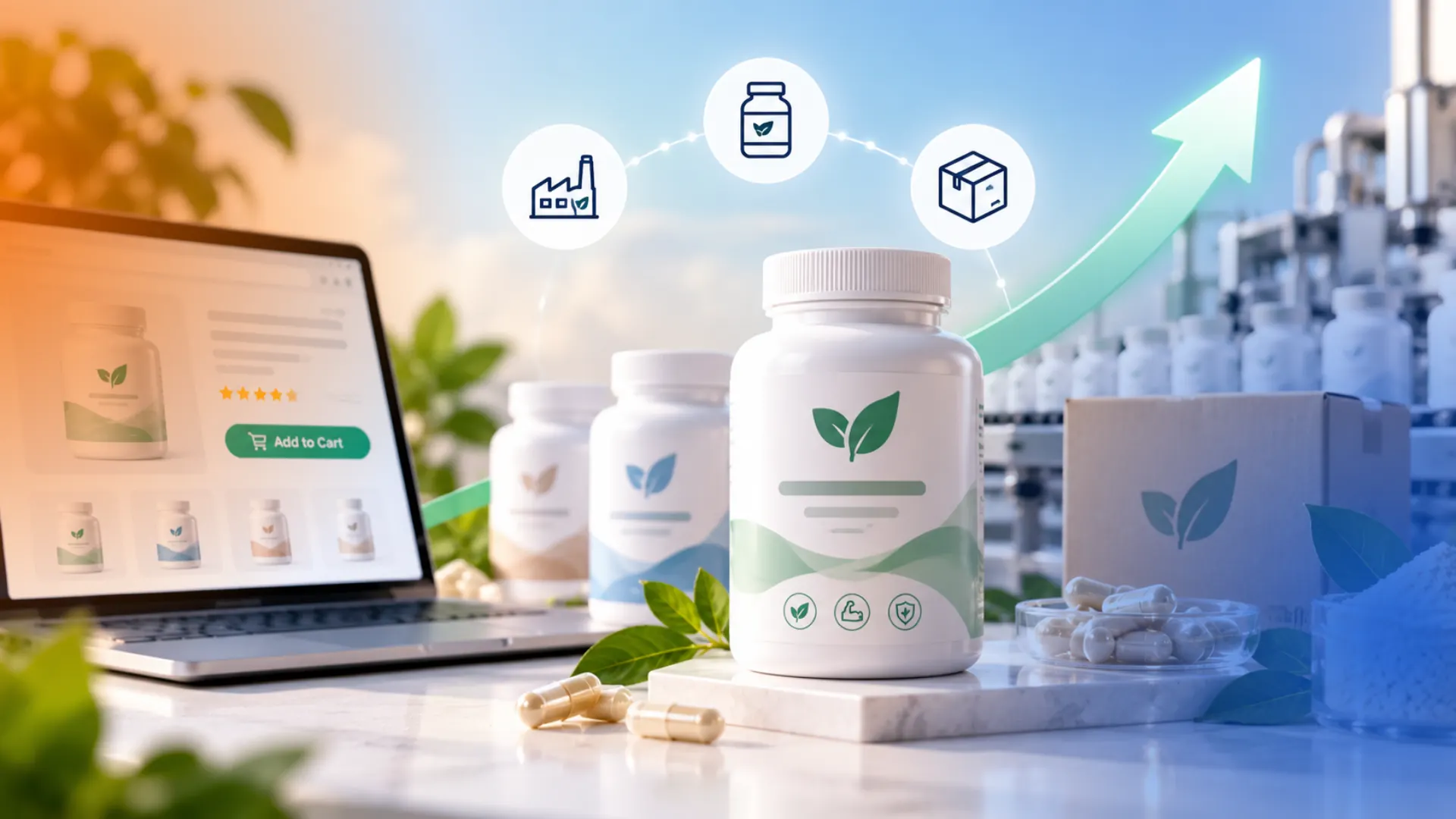
White label supplements are ready-made products that a manufacturer already makes and sells to many brands. You pick a product, add your brand name and label, and sell it as your own. The formula isn't exclusive to you.
White label health supplements usually start from the manufacturer's stock formulas: standard recipes in standard capsules, tablets, or powders. That is why this is the quickest way to launch. There is little to develop and little to test from scratch.
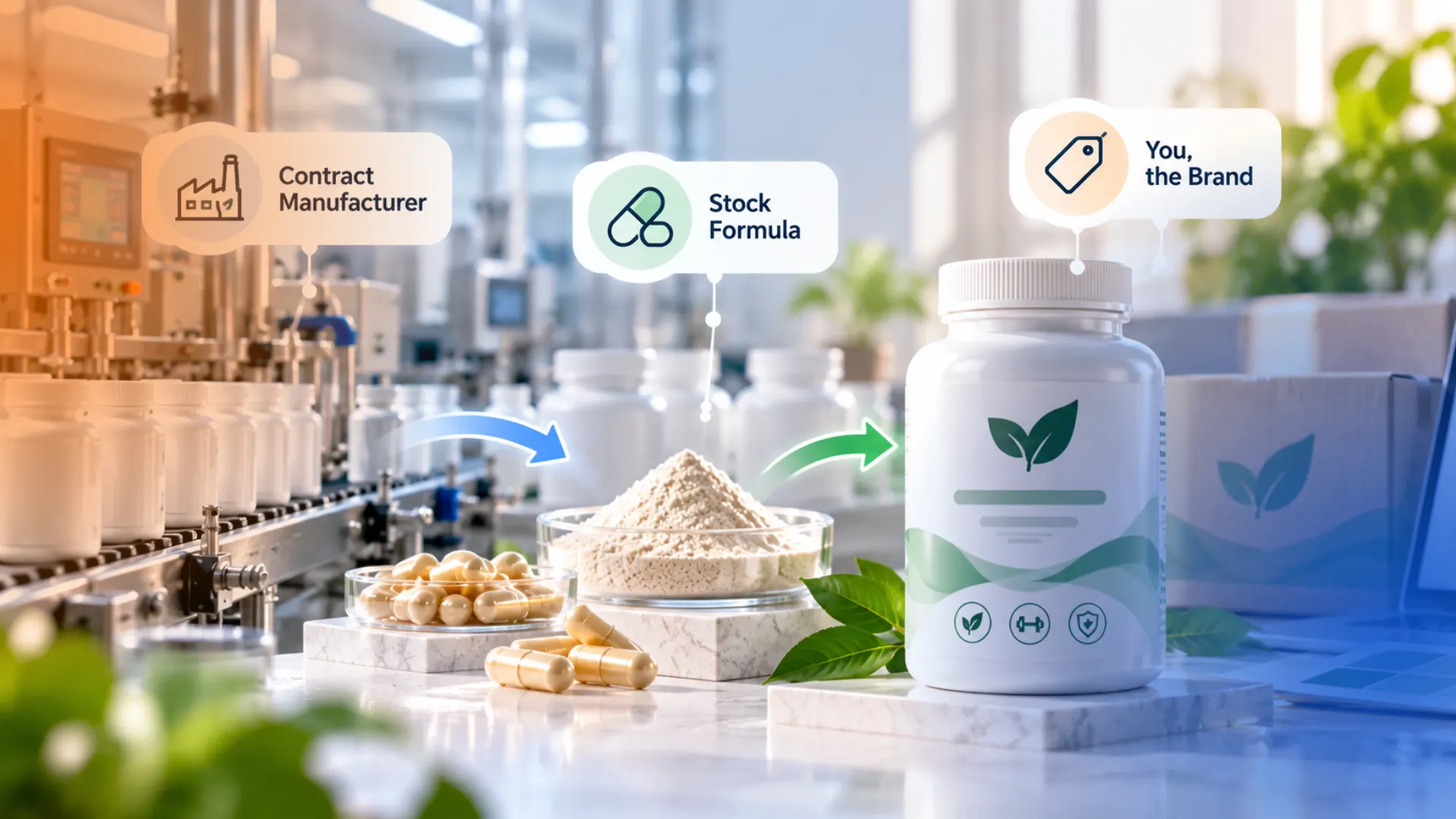
Three parties are involved:
- Contract manufacturer: The facility that makes, and usually packs and labels, your product
- Stock formula: The recipe the manufacturer already has on its shelf
- You, the brand: You own the brand, the label design, the marketing, and the customer
A white label supplement is only as good as the manufacturer that’s producing it. That is why choosing a good manufacturer matters more than any other decision.
White Label vs Private Label Supplements: What's the Difference?
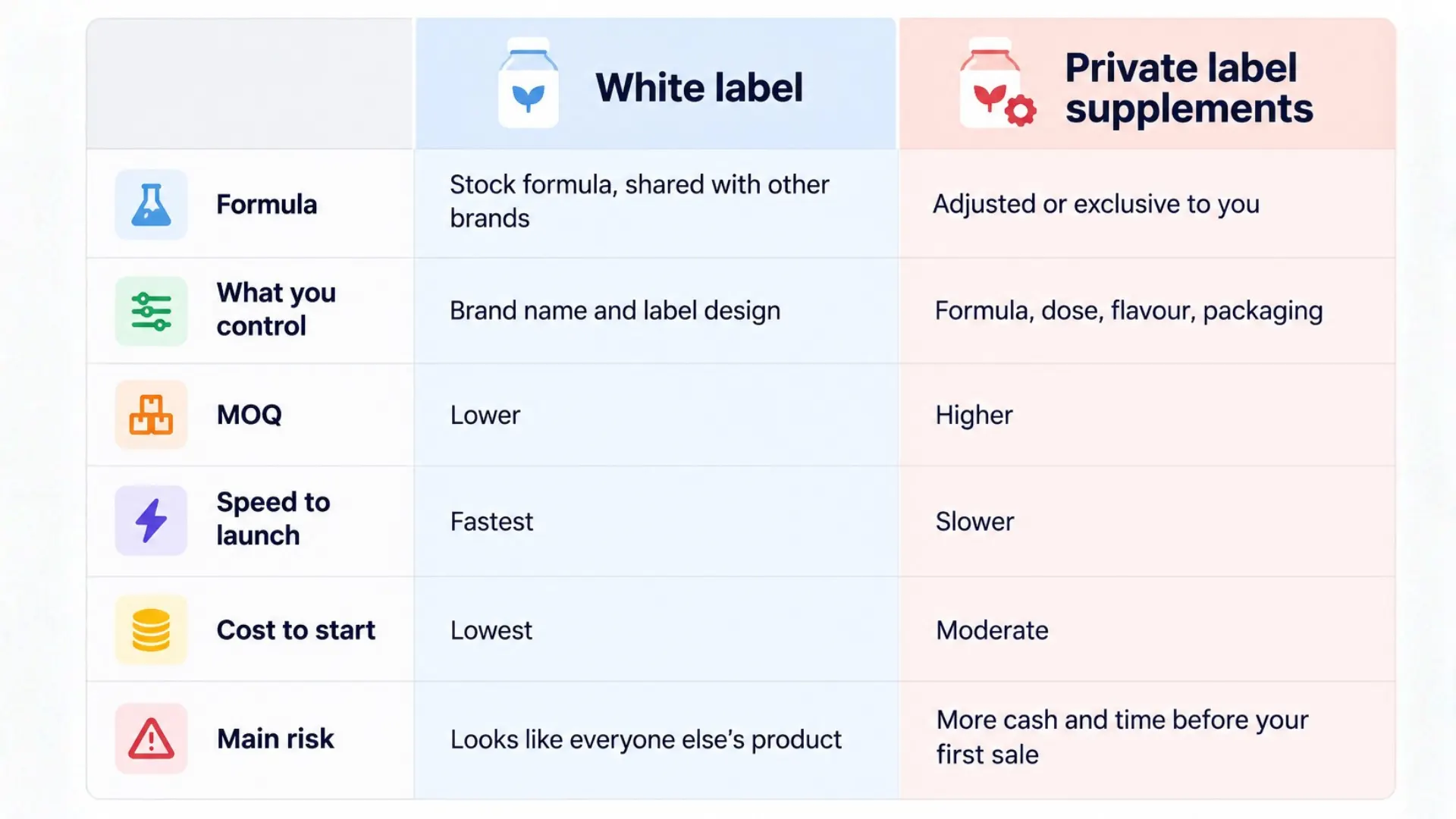
White label has the lowest barrier to entry but also the highest risk of commoditization. Private label suits brands that already have some traction and want to move away from generic stock products.
Before you sign, ask each manufacturer how it uses these terms. Some call a catalogue formula "private label." Get it in writing whether the formula is exclusive to you, and for how long.
How to Launch A White Label Supplement Brand in 2027
Step 1: Pick Your Niche and Your First Product
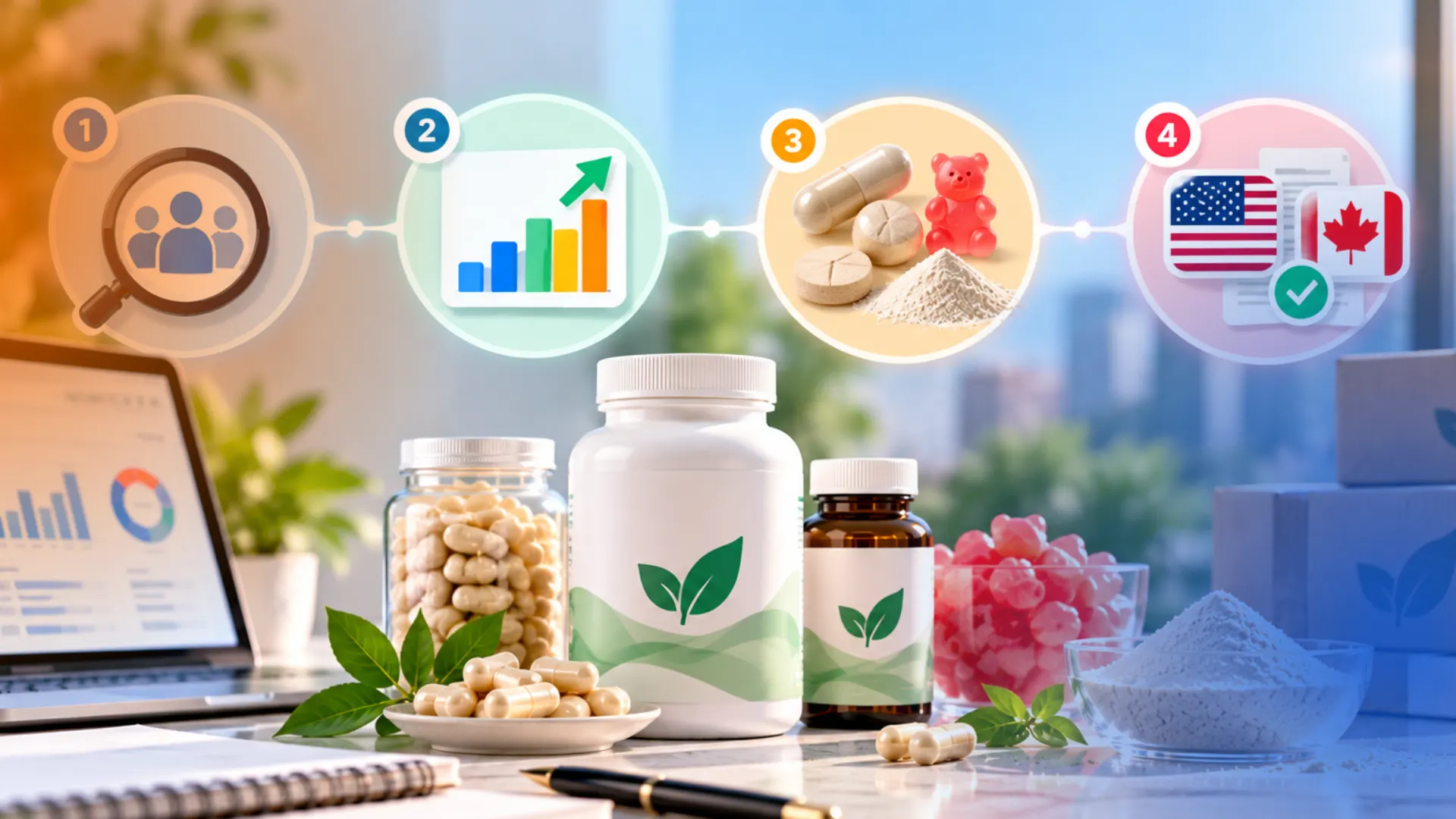
Start with one customer and one product. A narrow focus is easier to market than a catalogue of ten formulas.
- Choose a customer: Think of a specific group, like new moms, runners, or people who want better sleep. Read competitor reviews to see what buyers praise and complain about
- Check demand: Look at search volume, marketplace listings, and our guide to supplement trends before you commit
- Match the format to your budget: Capsules, tablets, and powders cost less to make. Gummies, softgels, and liquids need more specialized equipment and cost more
- Check your market: A formula that works in the US may not qualify in Canada because Health Canada reviews safety and evidence on its own. Our Natural Product Number (NPN) guide explains why.
Pick the one product you would be proud to put your name on. You can add more after the first one sells.
Step 2: Choose a White Label Supplement Manufacturer
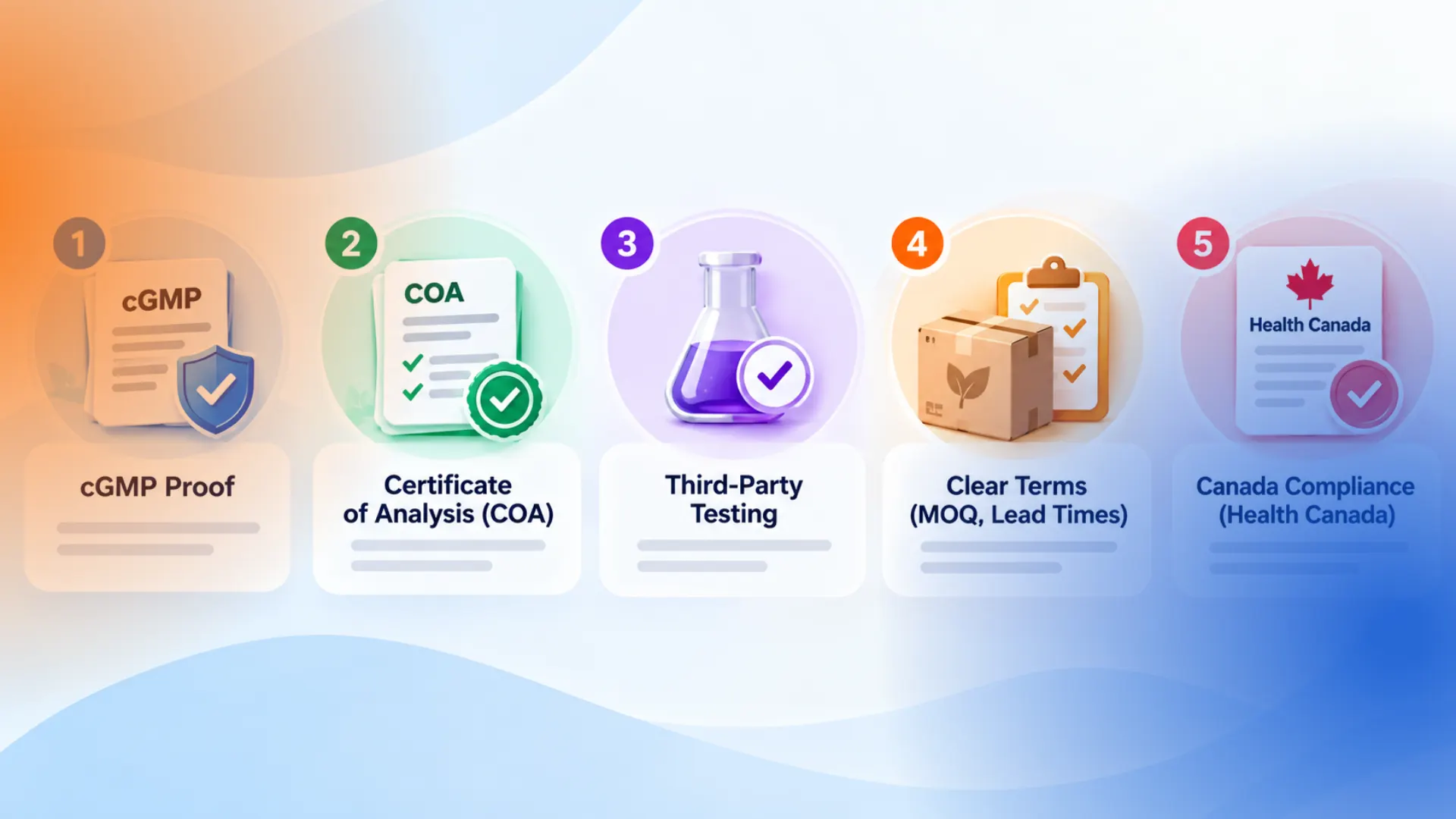
No single white label supplement manufacturer is best. The best one for you makes your product format, fits your MOQ, serves your market, and can prove its quality. When comparing white label supplement companies, ask for these:
- cGMP proof: In the US, dietary supplements must be made under current good manufacturing practice (cGMP), set out in 21 CFR Part 111. Ask for audit reports, third-party certifications, and inspection history
- A certificate of analysis (COA): For your exact product and lot. It should show potency and contaminant test results, such as heavy metals
- Third-party testing: From a named lab, not only the manufacturer's own
- Clear terms: Ask about MOQ, lead times, what is included (printing, packaging), and whether your formula is exclusive
- For Canada: A Canadian manufacturer should hold a Health Canada site licence, which you can confirm with Health Canada. Site licences go only to Canadian sites, so a product made abroad needs a licensed Canadian importer
Under 21 CFR 111.75, a manufacturer must also verify the identity of every dietary ingredient with at least one test before using it. Ask how they do it.
Hiring a contract manufacturer does not hand off your responsibility. In one of its warning letters, the Food and Drug Administration (FDA) says a firm that contracts out production is still responsible for making sure the product meets cGMP, regardless of who does the work.
For a deeper checklist, read our guide on choosing a supplement manufacturing partner. Order a sample before you order inventory.
If you’d prefer to meet manufacturers in person, look at sourcing-focused trade shows, such as SupplySide Connect and SupplySide Global. You can also find other upcoming shows on our list of top supplement trade shows in 2026.
Step 3: Understand MOQ, Costs, and Timeline
A minimum order quantity (MOQ) is the smallest quantity a manufacturer will make. White-label MOQs are usually the lowest; sometimes, 150 to 500 units is possible.
In Canada, many contract manufacturers start at 1,000 to 5,000 units for capsules and tablets, and higher for powders, according to our Canadian cost guide.
But keep in mind that cost per unit rises at lower volumes, and labels, bottles, and cartons can have their own minimums.
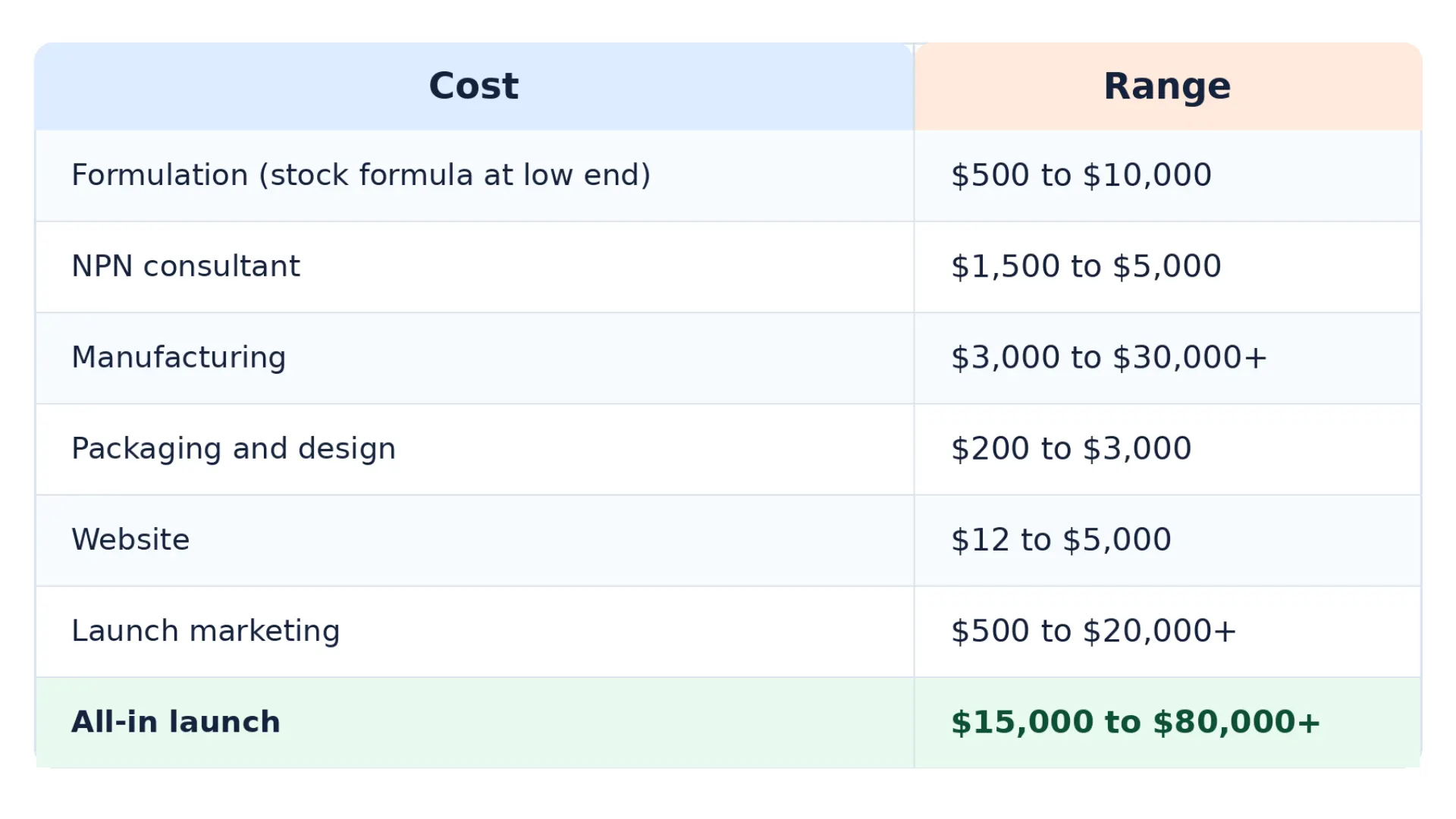
Here are the cost ranges from our guide:
Regarding timing, white or private label can launch within 4 to 8 weeks. In Canada, the NPN is the challenge for a quick launch. Health Canada's review targets are 60, 90, and 210 days for Class I, II, and III applications.
- Class I: Here, your ingredients are covered by one existing Health Canada monograph, a pre-approved standard. Target: 60 days
- Class II: Here, your ingredients are covered by more than one monograph. Target: 90 days
- Class III: Here, at least one ingredient isn’t covered by a monograph, so you must submit your own evidence. Target: 210 days
NOTE: A monograph is a Health Canada document that sets a pre-approved standard for a natural health product ingredient. It lists what Health Canada has already accepted for an ingredient, such as vitamin C or a common herb.
Step 4: Get Your Supplement Facts Label Right
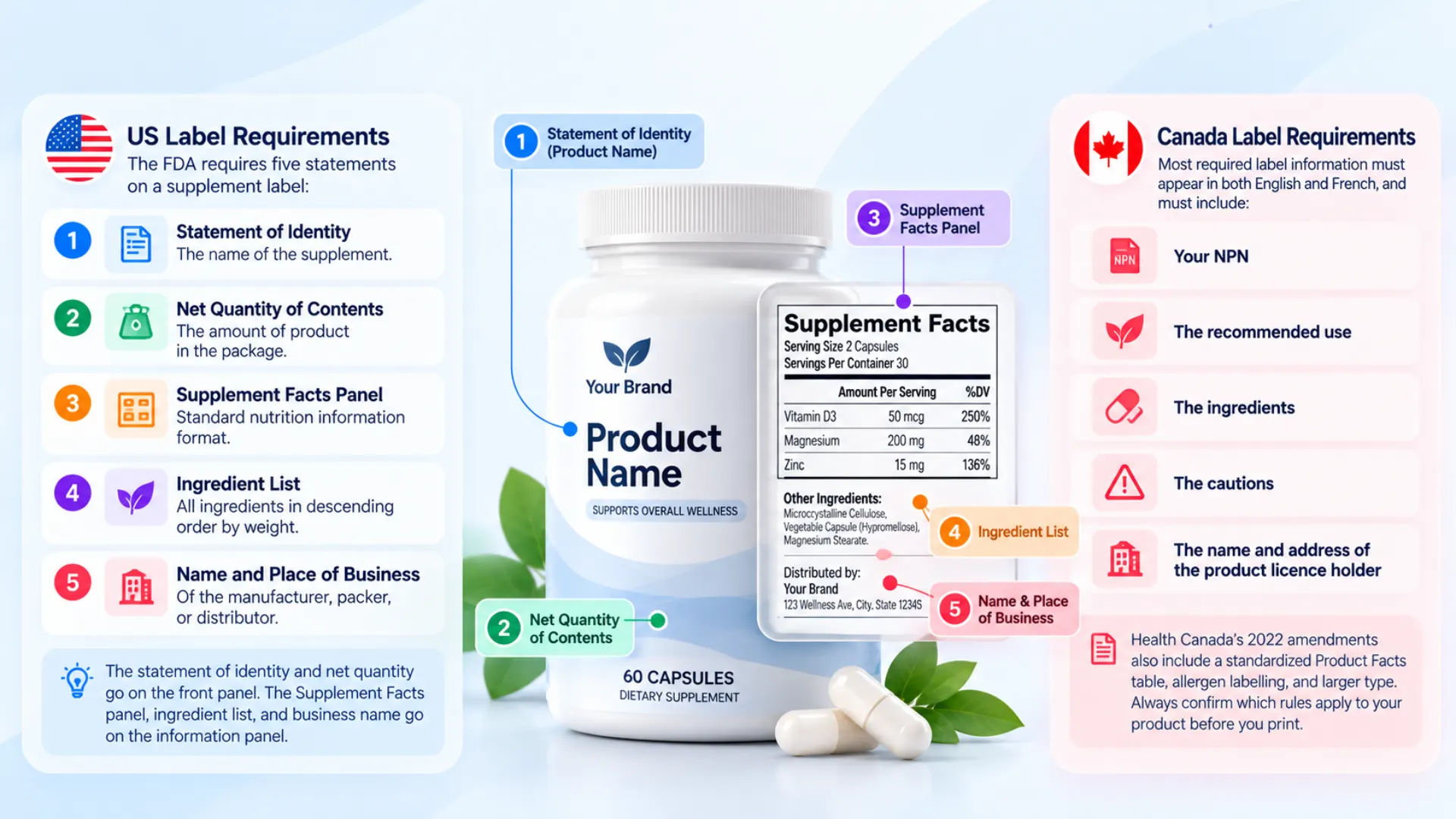
You're responsible for getting your label right, even for a white-label product. In the US, the FDA requires five statements on a supplement label:
1. The statement of identity, which is the name of the supplement
2. The net quantity of contents.
3. The Supplement Facts panel.
4. The ingredient list.
5. The name and place of business of the manufacturer, packer, or distributor.
The statement of identity and net quantity go on the principal display panel (the front of the pack). The Supplement Facts panel, ingredient list, and business name go on the information panel. On a white label product, your company can appear as the distributor.
FDA does not approve dietary supplements, so never write "FDA approved" on a label or in an ad. Our free Supplement Facts Label Generator can help you draft your label layout. We recommend having a regulatory reviewer check it before you print.
Also keep in mind that Canada has its own label rules. Most required label information must appear in both English and French, and the label must show:
- Your NPN
- The recommended use
- The ingredients
- The cautions
- The name and address of the product licence holder.
Health Canada's 2022 amendments also include a standardized Product Facts table, allergen labelling, and larger type.
Products authorized on or after June 21, 2025, are exempt from the new provisions if they follow the previous labelling rules, and Health Canada has said it plans to make labelling requirements more flexible. Always confirm which rules apply to your product before you print. A US label usually needs to be rewritten for Canada.
Step 5: Follow the Rules in the US and Canada
United States
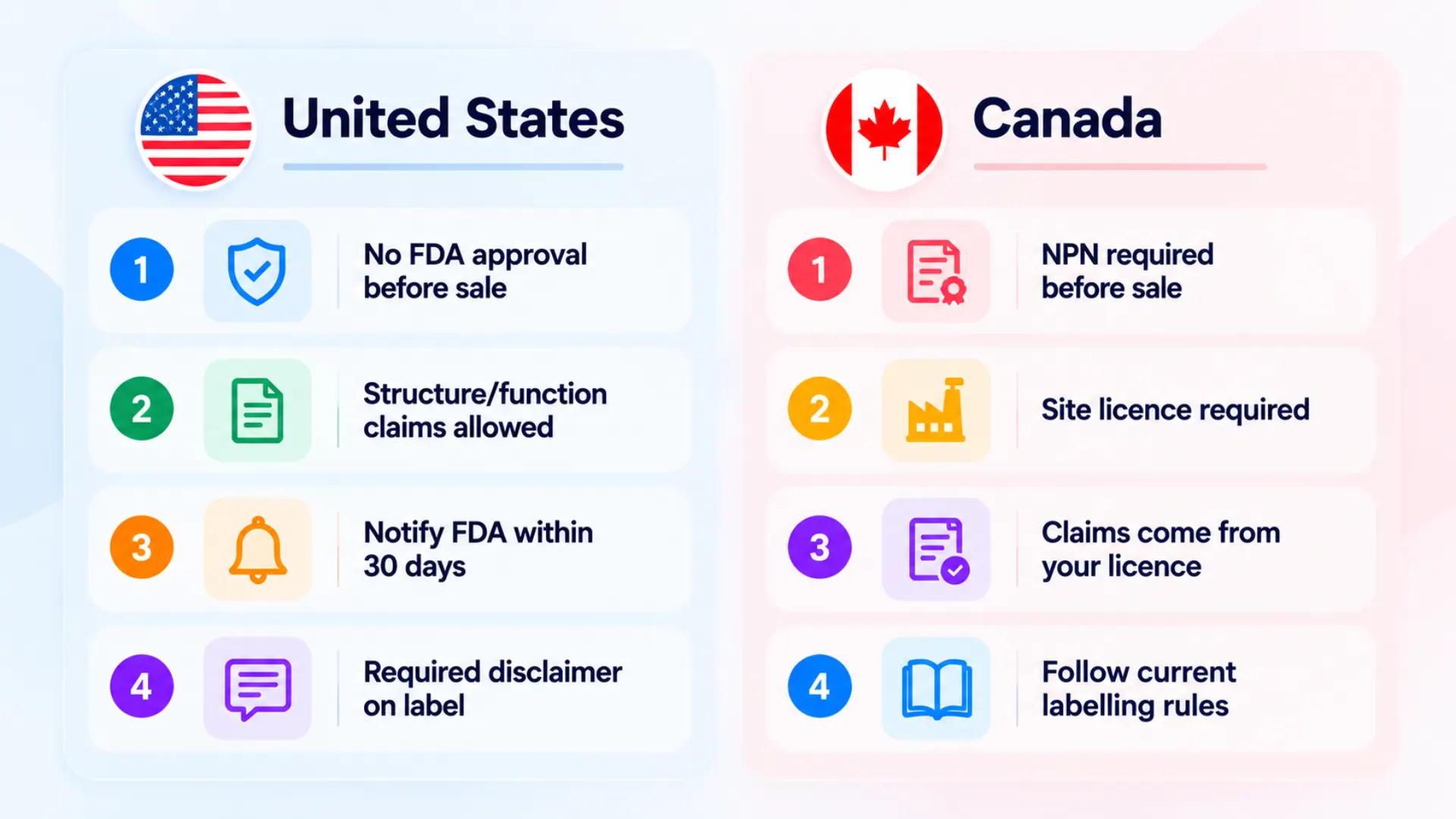
FDA does not approve supplements before they go on sale, but you are still responsible for safety, labelling, and cGMP.
You can make structure/function claims, which describe a nutrient's role in the body, but not disease claims such as treating, curing, or preventing a condition.
For a structure/function claim, you must notify the FDA within 30 days after you first market the product.
The label must also carry this statement in bold: "This statement has not been evaluated by the Food and Drug Administration. This product is not intended to diagnose, treat, cure, or prevent any disease."
Canada
Most supplements in Canada are natural health products (NHPs). Every NHP needs a product licence, shown on the label as an NPN, before it can be sold.
The Canadian sites that manufacture, package, label, or import NHPs also need site licences.
Health Canada sets the level of evidence by the claim you want to make, so claims on the label come from your licence, not from your manufacturer.
This article is not legal advice. For your own formula and claims, talk to a regulatory consultant.
Step 6: Make Your White Label Brand Stand Out

Other brands can buy the same stock formula, so you need other ways to stand out in this crowded space.
You do the following things to stand out:
- Own a narrow audience: For instance, "electrolytes for trail runners" gives people a reason to remember you. "Wellness for everyone" does not
- Show your proof: Publish the Certificate of Analysis (COA) for each batch and name the lab that did the third-party testing. Proof like this gives buyers a reason to trust a new brand
- Use the room you have: White label usually limits you to your logo and label design, so make the label and pack do the work. Ask what else is flexible, such as bundles or inserts
- Design for the shelf and the screen: Optimize your packaging for your users. Make sure the text is readable. Design as if it will read well as a small thumbnail on a product page
- Build the experience: Include subscriptions, fast shipping, and helpful emails and texts; all of these keep customers coming back
Before you launch, read our guide to supplement branding mistakes. It covers five traps many supplement brands fall into.
Step 7: Market and Launch

Getting the product made is only half the job. The other half is getting people to buy it. You can do this using email marketing, paid ads, and influencer marketing.
Build your email list before launch
An email list is a group of people who asked to hear from you. Unlike social followers, you own it, and a platform can’t take it away.
How to do it:
- Put a signup form on a simple “coming soon” page
- Offer a reason to join, such as early access, a launch discount, or a free guide
- Send a short welcome email and a few useful emails before launch, such as a brand story or ingredient basics
- In Canada, you can’t make public health claims until your NPN is issued. So build the list around your brand and general information, not benefit claims
Test paid ads on a small budget
Expect to spend between $1,000 and $3,000 on paid ads for the first 60 to 90 days. The goal is to learn which message and image work, not to make big profits yet.
Here are some rules for supplement ads:
- Meta treats supplements as restricted, so ads get a closer review
- Don’t claim to treat or prevent conditions, promise fast or guaranteed results, or use before-and-after photos
- Don’t call out a viewer’s health problem. Even “Struggling with low energy?” can trigger an ad review
- Meta checks your landing page and Facebook page too, so your website can’t make claims your ad avoids
- Post a few times on your page before you run ads
We suggest keeping the first test simple: one product, two or three ad versions, and one landing page. Change one thing at a time so you know what caused the result.
Use creators and content
Creators show your product in real life, which builds trust faster than a polished ad. A basic content shoot costs between $500 and $3,000, and creator partnerships cost $150 to $2,000, depending on audience size.
- Tell creators what they can’t say, such as promises to cure or fix anything. Your UGC creators should explain why they use the product and how it fits their routine, not promise results
- Creators must disclose free products or payment because of FTC endorsement rules
Real customer reviews work the same way. They show the product in use without you having to make the claim yourself.
Is a White Label Supplement Business Profitable?
It can be. But the profitability depends on three things: your margin per bottle, what you pay to win a customer, and how often customers reorder.
Here is a simple example:
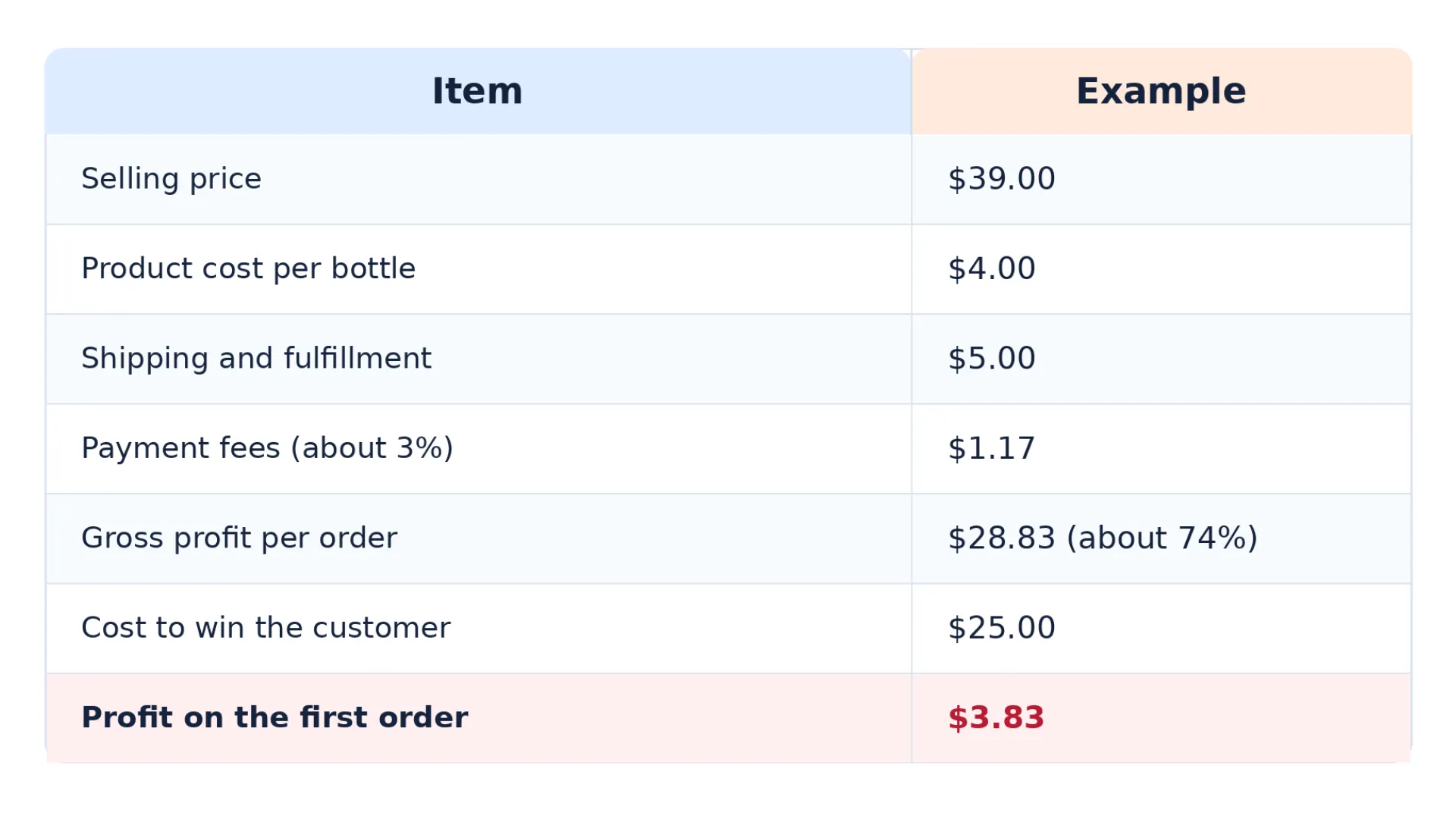
In this example, you keep only $3.83 from the first sale, so you barely break even. The real profit comes from repeat purchases. That is why repeat orders matter more than the first sale.
We used $4.00 as the cost of one bottle. But your real cost will depend on your formula, the format (capsule, powder, or gummy), and the minimum order quantity (MOQ).
Wrapping Up
White label supplements are one of the fastest ways to break into the supplement market. If you want help with marketing your product, we are a supplement marketing agency that works with supplement brands on ads, email, and ecommerce.
Still comparing options? When you're ready, book a free consultation, and we'll look at your launch plan with you.
FAQs
1. What is the difference between white label and private label supplements?
White label supplements use a stock formula that the manufacturer sells to many brands, and you add your own label.
Private label supplements are adjusted or made exclusive to you, with changes to the formula, dose, flavour, or packaging. The terms overlap, so ask each manufacturer what they mean and get exclusivity in writing.
2. How much does it cost to start a white label supplement brand?
A full launch costs between $15,000 and $80,000 or more. That includes manufacturing, an NPN consultant, packaging, a website, and marketing. A stock formula keeps formulation costs low.
One manufacturer's guide to liquid supplements says white label MOQs can start at 150 to 500 units, while many Canadian contract manufacturers start at 1,000 to 5,000 units.
3. Are white label supplements legal to sell in Canada?
Yes, if they meet Health Canada's rules. Most supplements are natural health products, and each needs a product licence with an NPN on the label before you can sell it.
Canadian sites that manufacture, package, label, or import them need site licences, and products made abroad need a licensed Canadian importer. The label must also be bilingual, in English and French.
4. Can you make health claims on white label supplements?
Yes, within limits. In the US, you can make structure/function claims if you can support them, notify the FDA within 30 days of first marketing, and include the required disclaimer.
You cannot claim to treat, cure, or prevent disease. In Canada, you can only make the claims approved on your product licence. Your manufacturer's claims do not cover you, because you are responsible for your own label and marketing.
5. Is a white label supplement business profitable?
It can be. Profit depends on your margin per bottle, your cost to win a customer, and how often customers reorder.
Some brands only break even on the first order and earn their profit on repeat purchases. Start with a small first order, keep your price high enough to cover ads, and track your numbers each month.