
%20in%20Canada%20(2026).webp)
TABLE OF CONTENTS
What Is an NPN Number in Canada?
What Products Require an NPN in Canada?
The Benefits of an NPN for Your Brand
It gives you credibility with distributors and partners
How to Get an NPN Number in Canada: Step by Step
Step 1: Determine Whether Your Product Needs an NPN
Step 2: Determine Your Application Class
Step 3: Build Your Evidence Package
Step 4: Prepare Your Product Licence Application
Step 5: Submit Your Application
Step 6: Receive Your Product Licence and NPN
NPN Application Timelines: What to Realistically Expect
How Much Does an NPN Application Cost in Canada?
Common Reasons NPN Applications Get Rejected
Insufficient evidence of efficacy for the specific health claim
Dose outside the evidence base
Can International Companies Apply for an NPN?
- How long does it take to get an NPN in Canada?
- How much does an NPN application cost in Canada?
- What products require an NPN in Canada?
- Can international companies apply for an NPN?
- Can I sell a supplement in Canada without an NPN?
- What health claims can I make in my marketing once I have an NPN?
- What happens if I sell my product without an NPN?


Share via:
Quick Answer: A Natural Product Number (NPN) is a licence issued by Health Canada that allows you to legally sell a natural health product in Canada. To get one, you submit a product licence application through Health Canada's NNHPD portal, including your product formulation, label, health claims, and manufacturer information. Processing times range from 60 days to over a year, depending on product classification. Without an NPN, you cannot legally sell your product in Canada.
If you want to sell a supplement, vitamin, herbal product, or any natural health product in Canada, you need a Natural Product Number (NPN).
Canada classifies most supplements as Natural Health Products (NHPs) and regulates them under the Natural Health Products Regulations.
Every NHP sold in Canada must carry a licence number on the label, either an NPN for most products or a DIN-HM (Drug Identification Number-Homeopathic Medicine) for homeopathic medicines. Selling without one violates the Food and Drugs Act.
The good news is that the NPN application process is not so difficult. Thousands of brands have done it successfully. But it requires the right documentation and the right approach.
This article will explain what an NPN is, how to get NPN number in Canada, who needs one, how to apply, what Health Canada reviews, and how long the whole process takes. You will also discover the most common mistakes that slow down applications and how to avoid them.
What Is an NPN Number in Canada?
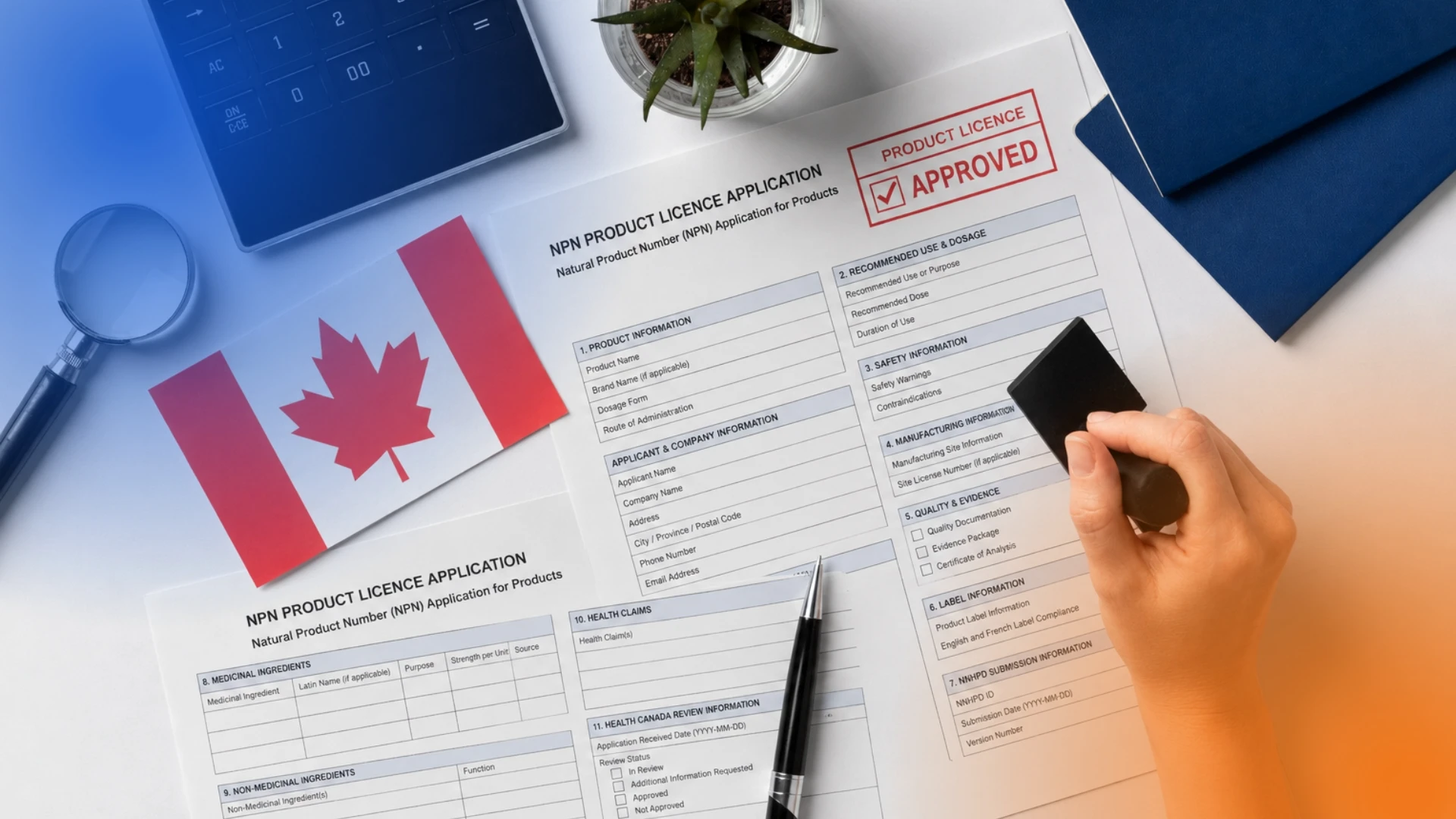
NPN stands for Natural Product Number. It is an eight-digit licence number issued by Health Canada that confirms a natural health product has been reviewed and approved for safety, efficacy, and quality.
Every natural health product sold in Canada must display this number on its label before it can be legally sold.
When a customer sees an NPN on a supplement bottle, it tells them that the product has gone through a formal government review. The ingredients are what the label says they are. The health claims are supported by evidence. And the product was made under proper quality controls.
That is the NPN Canada meaning. It is not just a registration number. It is a licence. And without it, your product cannot legally be on any shelf or website selling to Canadian consumers.
What Products Require an NPN in Canada?
Products that need an NPN include:
- Vitamins and minerals
- Herbal remedies
- Probiotics
- Sports nutrition products
- Amino acids
- Essential fatty acids, like omega-3 supplements
- Traditional medicines, including Ayurvedic and Traditional Chinese Medicine
- Homeopathic medicines
- Certain topical products that make therapeutic claims
- Sunscreens
- Therapeutic toothpastes that make specific health claims
Products that do not require an NPN include standard cosmetics making no health claims, conventional foods, and prescription drugs.
In simple terms, if you are making a health benefit claim on the label, if you are selling a face cream and calling it moisturizing, or antibacterial, or saying it supports wound healing, that is a therapeutic claim, and an NPN is required.
If you are not sure whether your product needs an NPN, you should work with or consult a regulatory consultant before you invest in manufacturing and packaging.
The Benefits of an NPN for Your Brand
Here are some of the most important commercial benefits of an NPN that supplement brands should understand.
It opens retail doors
Most Canadian retailers, including major pharmacy chains, health food stores, and natural grocery retailers, will not stock a natural health product without an NPN.
If retail distribution is any part of your growth plan, then you must get an NPN. Even major ecommerce platforms and marketplaces are increasingly requiring NPN documentation before listing supplement products in the Canadian market.
It builds consumer trust
Canadian consumers are more supplement-savvy than most brands expect. Many actively look for the NPN on a label before purchasing.
It is a visible signal that the product has been reviewed by Health Canada (an important regulatory body that exists to prevent label fraud and quality inconsistencies).
It protects your brand
A product without an NPN is always one enforcement action away from being removed from shelves, seized at the border, or flagged publicly by Health Canada.
The reputational and financial damage of that happening is much worse than the cost of getting compliant before you launch.
It gives you credibility with distributors and partners
If you want to work with Canadian distributors, brokers, or retail partners, they will ask for your NPN documentation.
Having it in place before those conversations makes you a serious business partner rather than a compliance risk.
How to Get an NPN Number in Canada: Step by Step
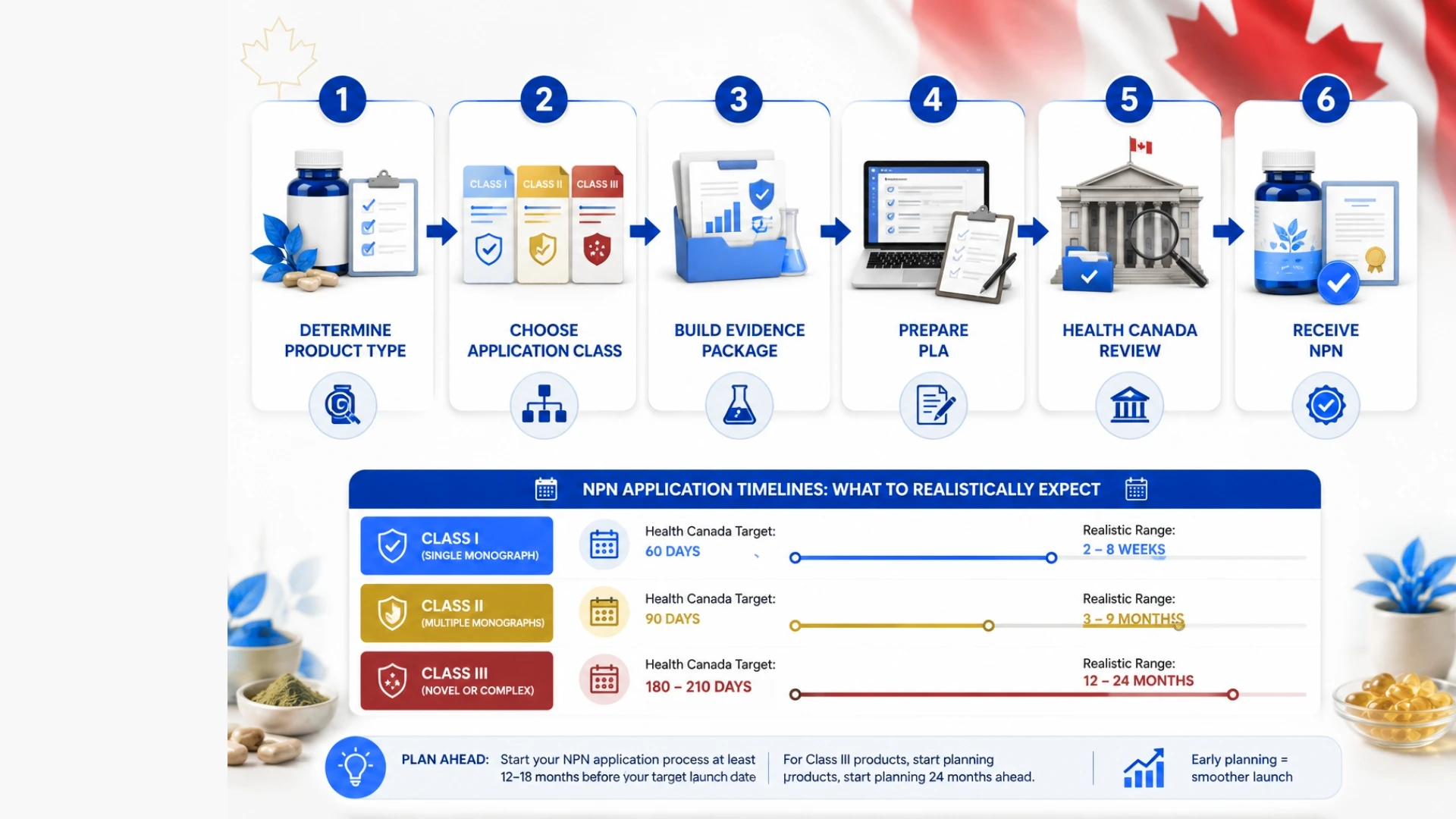
Step 1: Determine Whether Your Product Needs an NPN
Before you start the application, confirm that your product is classified as a Natural Health Product under Canada's Natural Health Products Regulations.
If it is, you need an NPN. If there is any ambiguity about your product's classification, consult a regulatory specialist before proceeding.
Step 2: Determine Your Application Class
This is one of the most important decisions in the NPN registration Health Canada process because it determines your timeline, your evidence requirements, and how complex your application will be.
There are three classes of Product Licence Applications (PLAs):
Class I:
All medicinal ingredients in your product are fully covered by an existing Health Canada monograph.
A monograph is a pre-established standard that defines acceptable ingredients, doses, and health claims for a product category.
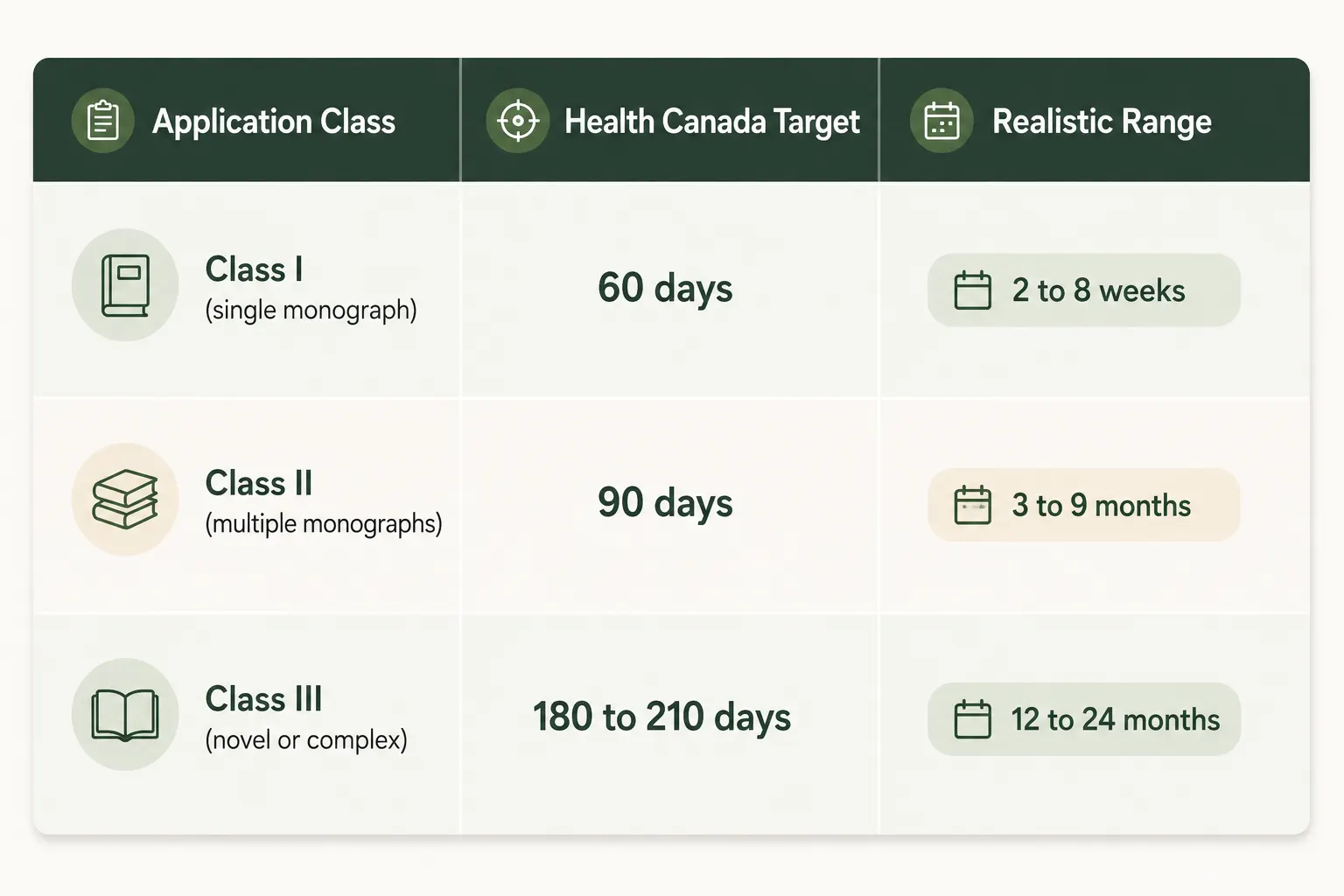
If your product fits entirely within one or more monographs, the application is simpler and faster. The target review time is 60 days, though real-world timelines are longer.
Class II:
Your product's ingredients are covered by multiple Health Canada monographs, not just one. Moderate complexity. Target review time is 90 days.
Class III:
At least one of your medicinal ingredients is not covered by any Health Canada monograph. This means you need to submit independent external evidence to support that ingredient's safety and efficacy.
This is the most complex and time-consuming class. Target review time is 180 to 210 days, with real-world timelines frequently running 12 to 24 months for complex products.
Knowing which class your product falls into before you begin preparation is important for setting a realistic launch timeline.
Step 3: Build Your Evidence Package
The evidence package is the major part of your NPN application Canada submission. What Health Canada requires depends on your application class, but you’ll most likely be asked about these:
Safety evidence
This includes toxicological data for each medicinal ingredient, safety data for your specific dose and target population, and documentation of any contraindications, warnings, and potential drug interactions.
Health Canada wants to know that your product is safe for the people who will use it at the dose you are recommending and for the duration you are suggesting.
Efficacy evidence
You need evidence that specifically supports your exact health claim, at your exact dose. Clinical trials, systematic reviews, meta-analyses, or traditional use evidence, depending on your product category.
If your label says "supports cardiovascular health," your evidence needs to support that specific claim at your specific dose. Evidence that an ingredient has some general health benefit is not enough.
Quality evidence
This includes your ingredient specifications, Certificates of Analysis for each ingredient, a description of your manufacturing process, finished product specifications, and stability data or a commitment to conduct stability testing.
Step 4: Prepare Your Product Licence Application
NPN application Health Canada submissions are made through the Natural and Non-prescription Health Products Directorate (NNHPD) online portal. Your application needs to include the following.
- Your company information, including name, address, and contact details
- Your product name and dosage form
- All medicinal ingredients with exact quantities per dosage unit
- All non-medicinal ingredients
- Your recommended use and purpose, which is your health claim
- Your recommended dose, duration of use, and route of administration
- Any cautions, warnings, and contraindications. Your complete evidence package
- And a draft of your product label
Your label must meet Health Canada's NHP labelling requirements at the time of submission. This includes bilingual presentation in both English and French, your NPN placement, recommended use statement, cautions, medicinal and non-medicinal ingredient lists, and company contact information.
NOTE: Label errors are one of the most common reasons for delays and rejections.
Step 5: Submit Your Application
Once your application is complete, you submit it through Health Canada's NNHPD portal. After submission, Health Canada may issue a Notice of Deficiency (NOD) requesting additional information or clarification on parts of your application.
Common NOD triggers include:
- Insufficient efficacy evidence for your specific health claim
- Missing or inadequate safety data for a particular ingredient or dose
- Labelling issues, such as missing required elements or non-compliant claims
- Quality documentation gaps, such as missing Certificates of Analysis or incomplete ingredient specifications.
Step 6: Receive Your Product Licence and NPN
If Health Canada approves your application, you will receive a Product Licence with your NPN. The licence specifies your:
- Approved product name
- Medicinal ingredients
- Dose
- Recommended use
- Any required label statements
Your NPN must appear on all product labels before you can legally sell in Canada. You cannot print labels, begin selling, or make any public health claims about your product until you have this number in hand.
NPN Application Timelines: What to Realistically Expect
One of the biggest mistakes supplement brands make when planning a Canadian launch is underestimating how long the NPN registration Health Canada process takes.
Health Canada's published targets are exactly that. Targets. Actual review times are frequently longer due to application volume, NOD responses, and the complexity of individual submissions.
If you are planning a Canadian market launch, start your NPN application process at least 12 to 18 months before your target launch date for Class II products.
For Class III products, start planning 24 months ahead.
Brands that try to rush this process almost always end up delaying their launch, but with more money spent and more frustration along the way.
How Much Does an NPN Application Cost in Canada?
The NPN application is no longer free to submit to Health Canada. Health Canada will charge pre-market evaluation fees based on the class of your product.
Here is what you should expect to pay:
- Government application fees (proposed 2025 rates): Class I applications cost $1,124. Class II applications cost $2,761. Class III applications cost $7,209. Class III novel applications cost $58,332
- Small business mitigation: If your business has fewer than 100 employees or between $30,000 and $5 million in annual revenue, you may qualify for fee remissions (refunds or reductions on fees you have already paid or are required to pay). Your first-ever NPN product submission is eligible for a 100% remission on pre-market evaluation fees. All subsequent submissions receive a 50% remission. Site licence and right to sell fees receive a 25% remission
- Regulatory consultant fees: For most brands, especially those applying for the first time, hiring a regulatory consultant is highly recommended. Consultant fees range from $1,500 to $5,000 for Class I and Class II applications and can exceed $15,000 for complex Class III products that require ingredient evidence packages
- Testing costs: Your evidence package must include Certificates of Analysis and quality documentation for your ingredients. If existing testing from your manufacturer does not cover everything Health Canada requires, you will need to commission additional laboratory testing. Testing costs differ by product and test type but can add $1,000 to $5,000 or more to your total budget
- Translation costs: Your label must be bilingual. Professional translation and bilingual label design add $300 to $1,000 to your preparation costs, depending on the complexity of the label
- Total realistic budget: For a standard Class II supplement with an established ingredient profile, a total budget for the NPN application process including the government fee, consultant fees, testing, and translation is approximately $5,000 to $13,000. Complex Class III products with novel ingredients or extensive health claims can cost more
Common Reasons NPN Applications Get Rejected
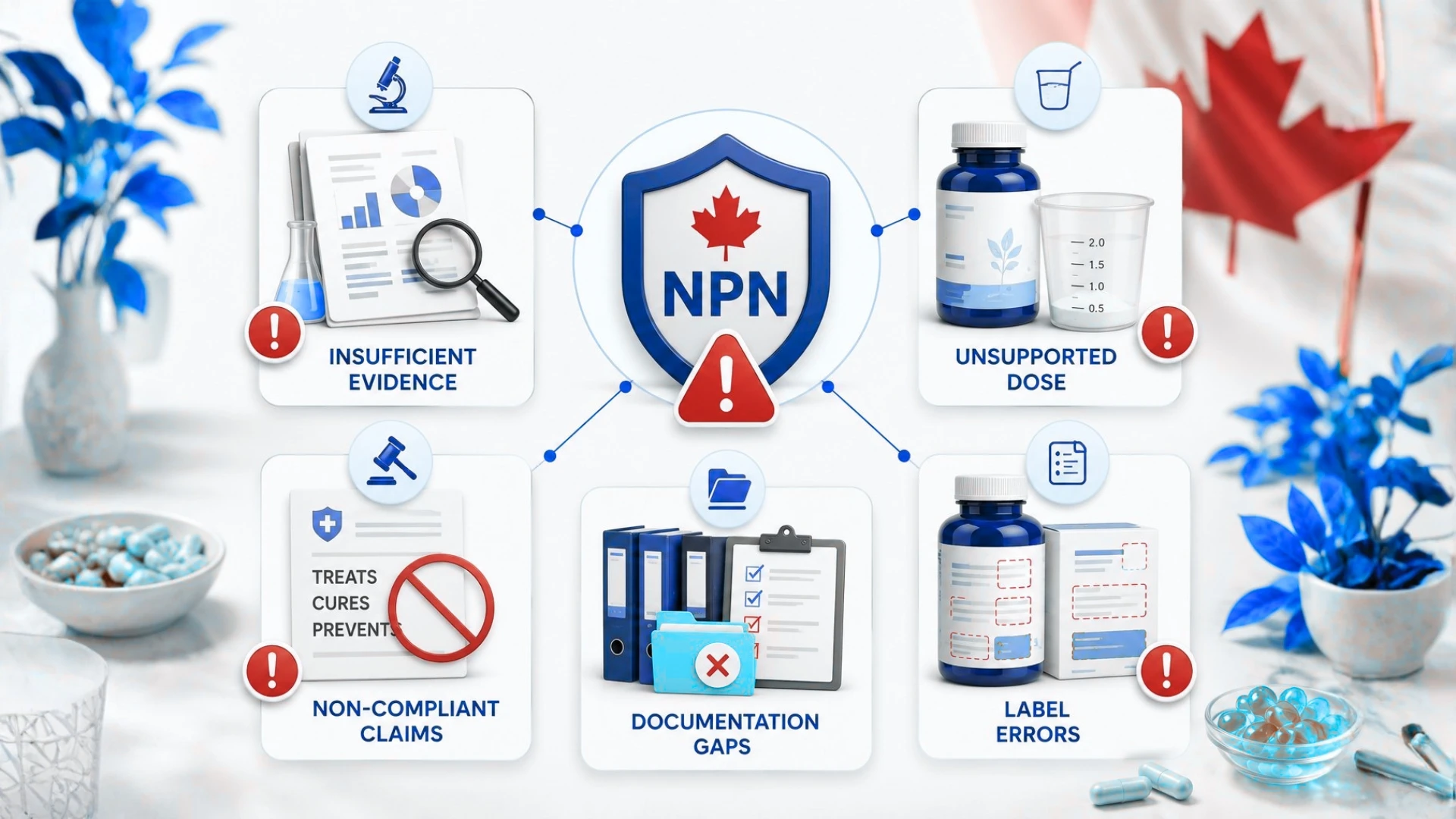
Most NPN application rejections and delays happen due to the following reasons:
Insufficient evidence of efficacy for the specific health claim
This is the most common reason for rejection. Health Canada requires evidence that directly supports your recommended use statement at your specific dose.
General evidence that an ingredient has health benefits is not enough. Your claim needs to be matched by your evidence at the level of specificity Health Canada expects.
Dose outside the evidence base
If the clinical research supporting your claim used 500mg per day and you are recommending 1,000mg per day, Health Canada will ask for evidence at the higher dose.
Your recommended dose must be within the range supported by your evidence.
Non-compliant health claims
Some claims are not permitted for NPNs. Disease treatment and prevention claims require drug approval, not an NHP licence.
Your claims must be carefully worded to fit within the NHP regulations. A regulatory consultant can help you identify which claims are compliant and how to word them in a way that Health Canada will accept.
Quality documentation gaps
Missing Certificates of Analysis, incomplete ingredient specifications, inadequate stability data, or missing manufacturing documentation are common reasons for Notices of Deficiency.
A complete, well-organized quality package reduces your risk of an NOD.
Label non-compliance
Missing required label elements, non-compliant health claims on the label, incorrect bilingual formatting, or failure to meet the specific NHP labelling requirements are frequent triggers for delays.
Your label should be reviewed against Health Canada's current NHP labelling requirements before submission.
Can International Companies Apply for an NPN?
Yes. International companies can apply for an NPN in Canada. However, specific requirements make the process more complex for non-Canadian businesses.
If your manufacturing facility is located outside Canada, it must hold a valid Site Licence issued by Health Canada, or you must work with a licensed Canadian importer of record.
The importer of record assumes regulatory responsibility for the product in Canada, and this legal and commercial relationship must be properly established before your application can proceed.
US supplement brands entering the Canadian market face additional complexity because an FDA-compliant formulation does not automatically qualify for an NPN.
Health Canada evaluates safety and efficacy independently. Your US label will need to be revised to meet Canadian requirements, including bilingual presentation and NHP-specific claim standards.
And your US testing documentation may need to be supplemented with additional laboratory testing that meets Health Canada's requirements.
If you are a US or international brand planning to enter the Canadian market, you need to start the regulatory process 18 to 24 months before your intended launch date.
Final Thoughts
The NPN process is one of the most important regulatory steps in launching a supplement brand in Canada. It protects consumers, builds trust with retailers, and positions your brand as a legitimate, compliant business in one of the most regulated natural health product markets.
If you are building a supplement brand in Canada and want to make sure your ecommerce and marketing strategy is set up to scale once your NPN is approved, book a free consultation with Pro Marketer.
We work with supplement brands at every stage of growth and will show you exactly what it takes to build a profitable, scalable business online in Canada.
FAQs
1. How long does it take to get an NPN in Canada?
It depends on your application class. Class I applications targeting a single Health Canada monograph have a target review time of 60 days, but take 2 to 8 weeks in practice.
Class II applications take 3 to 9 months from submission to approval. Class III applications involving complex evidence packages can take 12 to 24 months or longer.
These are all estimates. Incomplete submissions, Notices of Deficiency, and application volume at Health Canada all affect timelines. Plan for the longer term rather than the shorter, and start your NPN application well before your intended launch date.
2. How much does an NPN application cost in Canada?
Class I applications cost $1,124. Class II applications cost $2,761. Class III applications cost $7,209. Class III novel applications cost $58,332.
Small businesses with fewer than 100 employees or under $5 million in annual revenue may qualify for fee remissions, including a full waiver on their first-ever NPN submission.
On top of government fees, regulatory consultant fees range from $1,500 to $5,000 for standard applications and can exceed $15,000 for complex Class III products. Additional costs include laboratory testing, professional translation, and bilingual label design.
The total budget for a standard Class II supplement application, including the government fee, consultant fees, testing, and translation, is $5,000 to $13,000. More complex products will cost more.
3. What products require an NPN in Canada?
Most supplements require an NPN. This includes vitamins and minerals, herbal remedies, probiotics, sports nutrition products, omega-3 and other essential fatty acid supplements, amino acids, traditional medicines, homeopathic medicines, certain topical health products making therapeutic claims, sunscreens, and therapeutic toothpastes.
If your product makes a health benefit claim and contains naturally derived ingredients, it almost certainly needs an NPN. When in doubt, confirm with a regulatory consultant before investing in manufacturing and packaging.
4. Can international companies apply for an NPN?
Yes. International companies can obtain an NPN, but the process is more complex. Foreign manufacturers must hold a valid Health Canada Site Licence or work with a licensed Canadian importer of record.
US brands should also be aware that an FDA-compliant formulation does not automatically satisfy Health Canada's requirements. The evidence standards, label requirements, and claim standards are different. Start the process early and work with a consultant who has specific Health Canada NHP experience.
5. Can I sell a supplement in Canada without an NPN?
No. Selling a natural health product in Canada without an NPN when one is required is illegal under the Food and Drugs Act. Health Canada can seize your product, issue fines, and publicly publish enforcement actions against your company.
Retailers will not stock your product without an NPN, and major ecommerce platforms are increasingly requiring documentation before listing Canadian supplement products.
Get your NPN before you sell.
6. What health claims can I make in my marketing once I have an NPN?
Your NPN product licence specifies the exact health claims Health Canada has approved for your product. You can use those approved claims on your label, in your advertising, on your website, and on your social media.
You cannot make claims beyond what your licence authorizes. Disease treatment and prevention claims require drug approval and are not permitted under an NHP licence.
Stick to your approved language and consult a regulatory specialist if you want to expand your claim.
7. What happens if I sell my product without an NPN?
Health Canada can take enforcement action against your business. This includes seizing your product, issuing compliance orders, imposing fines, and publishing your company's name on Health Canada's public non-compliance database.
Aside from the regulatory consequences, selling without an NPN damages your brand's credibility with retailers, distributors, and consumers. Most Canadian retailers will immediately remove products from shelves if they discover that an NPN is missing or invalid.

.svg)

.avif)

.svg)