
.webp)
TABLE OF CONTENTS
Why Google Ads for Peptides Is Different From Every Other Category
The Three Types of Peptide Businesses and What Google Allows Each
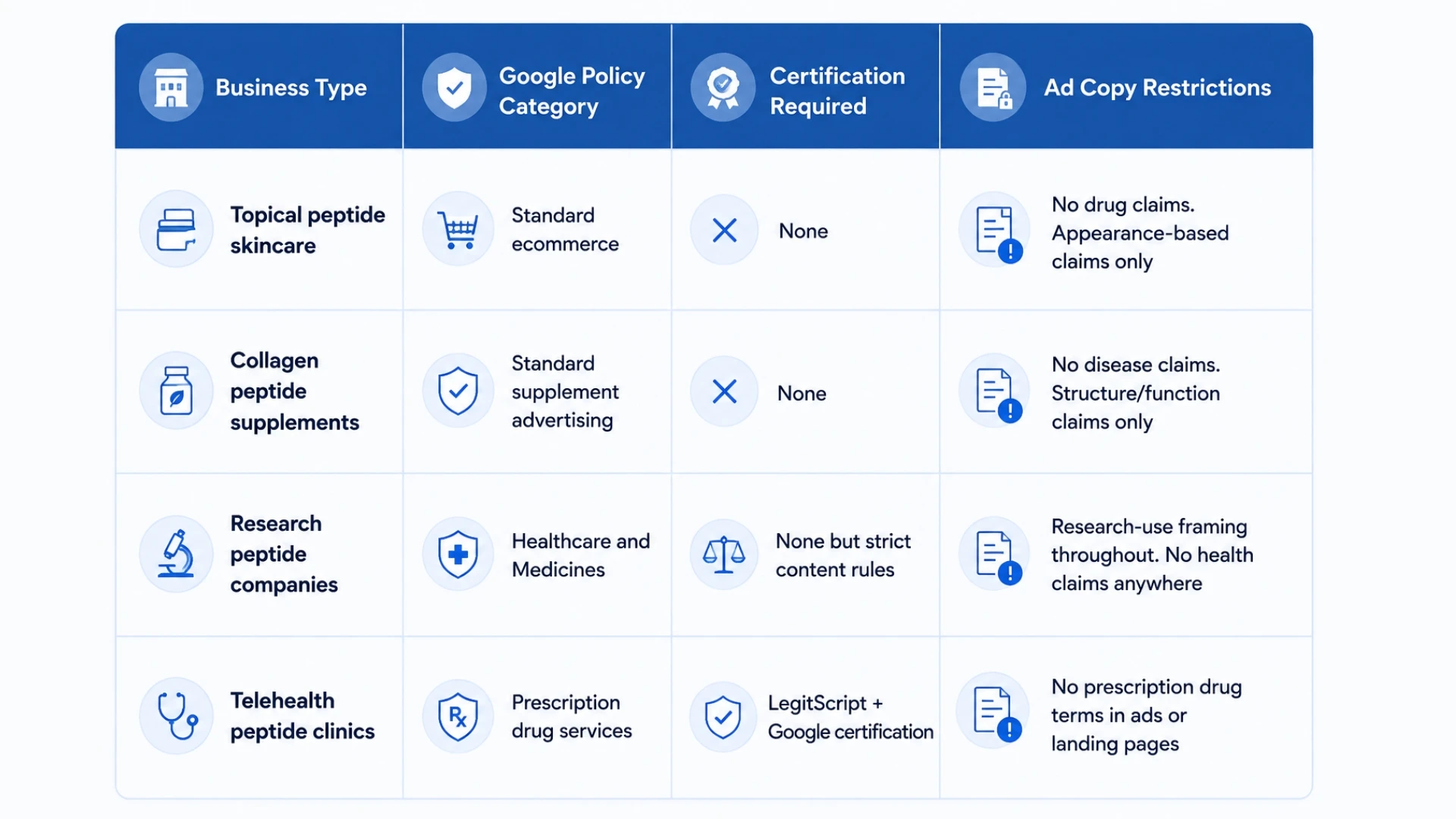
Topical peptide skincare and collagen peptide supplements
What Gets Peptide Ads Banned on Google
Ad copy that implies human use or therapeutic benefit
Landing pages that contradict your ad copy compliance posture
Using restricted compound names as keywords without proper account structure
Account history and trust signals
Not responding quickly to disapprovals
How to Write Compliant Ad Copy for Peptide Brands
For Topical Peptide Skincare Brands
For Collagen Peptide Supplement Brands
For Research Peptide Companies


Share via:
Quick Answer: Running Google Ads for peptides in 2026 is possible, but the rules are strict and vary by the type of peptide brand you operate. Topical peptide skincare and collagen supplement brands can advertise with standard compliance. Research peptide companies can advertise in approved locations with strictly controlled language. Telehealth peptide clinics must hold LegitScript Healthcare Merchant Certification and a separate Google certification before running any ads. Get any of this wrong, and your account gets suspended.
Most peptide brands find out how Google Ads works a little too late. They build a website, set up their campaigns, write what they think is good ad copy, and launch.
Within days, their ads are disapproved. Within weeks, their account is under review, and in the worst cases, the account is suspended entirely, and they are told they will not be allowed to advertise with Google again.
This does not mean that Google is targeting peptide brands unfairly. It means that most peptide brands do not understand which category Google puts them in before they start spending money.
In this guide, we’ll show you how to advertise peptides on Google Ads without getting banned. You’ll learn the rules that apply to your specific type of peptide business, the types of ad copy that get approved, and how to structure campaigns without putting your account at risk.
Why Google Ads for Peptides Is Different From Every Other Category
Before you write a single ad, you need to understand why peptide advertising is different from almost every other consumer product on Google:
- Most ecommerce brands worry about Google's standard policies around misleading claims, trademark violations, or destination requirements
- Peptide brands have all of those concerns
- Because of this, Google places peptide advertising within its Healthcare and Medicines policy framework, which is one of the most tightly enforced categories on the entire platform
For instance, when you run ads for a t-shirt brand and Google disapproves one, you get a notification, fix the copy, and resubmit.
When you run ads in a restricted healthcare category and Google identifies a policy violation, the consequences are more serious.
Google operates a strike system for repeat policy offenders. Minor first-time violations result in a disapproval notice that you can fix or appeal. Repeat violations accumulate strikes.
The most serious egregious violations, however, result in immediate account suspension upon detection and without prior warning.
Google's own policy states that egregious violations are only reinstated in compelling circumstances.
Not every disapproval leads directly to suspension, but repeated violations or a single egregious violation in the healthcare category can.
Google treats this category so strictly because many peptides are unapproved drugs under FDA definitions.
Google's Unapproved Substances policy explicitly prohibits the promotion of non-government-approved products that are marketed in a way that implies they are safe or effective for use in:
- Preventing, curing, or treating a particular disease or ailment
- Products subject to any government or regulatory action or warning
- Products with names that are confusingly similar to an unapproved pharmaceutical or controlled substance
BPC-157, TB-500, CJC-1295, Ipamorelin, Melanotan, and GLP-1 compounds all fall under this definition. They are not FDA-approved drugs. It is important to note that not all GLP-1 compounds fall into this category.
Semaglutide and tirzepatide are FDA-approved GLP-1 drugs and can be advertised by certified telehealth providers through the proper certification process. Unapproved GLP-1 compounds, however, cannot be advertised for human use on Google regardless of how they are framed.
As of 2026, despite the FDA removing 12 peptides, including BPC-157 and TB-500, from the Category 2 bulk substances restriction list in April 2026, these compounds remain unapproved new drugs that cannot legally be sold for human use.
Google also maintains a public list of unapproved pharmaceuticals and supplements at support.google.com/adspolicy/answer/2423645. Check the list before launching any campaign to confirm whether any compound you plan to reference in your ads or on your landing pages appears on it.
None of this means you cannot run Google Ads for peptide brands. It means you need to understand exactly which category your business falls into before you start, and then build your campaigns around the rules that apply to that specific category.
The Three Types of Peptide Businesses and What Google Allows Each
There are three distinct categories, and each one has a different path to running compliant ads.
Topical peptide skincare and collagen peptide supplements
Topical peptide serums, creams, and moisturizers classified as cosmetics, and collagen peptide supplements including:
- Powders
- Capsules
- Drinks
- Gummies marketed with appearance-based or structure/function claims are not subject to Google's pharmaceutical or unapproved substances policies when marketed correctly
For these brands, running Google Ads is the same as any other consumer ecommerce brand. Standard Google Ads policies on misleading claims, destination requirements, and editorial quality still apply here.
The compliance issue is keeping your ad copy and landing pages within cosmetic and supplement claim boundaries.
If you make a drug claim in your ad copy or on your landing page, Google's automated systems will flag your campaign. So, it’s always best to stay within appearance-based claims for skincare and structure/function claims for supplements.
Research peptide companies
This category is more complex. Google's official Healthcare and Medicines policy states that bulk drug manufacturers, medical professional suppliers, and antibody, peptide, and compound suppliers for commercial labs may advertise, but only in approved locations and only with strictly controlled language and landing page compliance.
This means research peptide companies supplying legitimate laboratory buyers can run Google Ads. But the compliance bar is higher than for skincare or supplement brands.
Your landing page must carry a visible "For Research Use Only. Not for Human Consumption" disclaimer:
- No health claims
- No dosage instructions
- No before and after content
- No language implying human use can appear anywhere on the destination page, Google reviews
Campaign settings should designate the healthcare and compound category with research use only as the product type. And your entire account needs to be built with the assumption that Google's automated policy scanners are reading every word of every page your ads point to.
Note: Google's AI review systems are now flagging accounts that are directly linked to peptide product pages without compliant research-use disclaimers.
Telehealth peptide clinics
This is the most restricted category in advertising.
Google explicitly requires LegitScript Healthcare Merchant Certification for telemedicine providers before they can run any ads in the United States and Canada. This is confirmed directly in Google's Healthcare and Medicines policy for both countries.
It is important to understand that LegitScript certification alone is not sufficient. The process has two steps. You must first obtain LegitScript Healthcare Merchant Certification, and then separately apply for and receive Google's own healthcare certification. Both are required before your ads will run.
A telehealth peptide clinic that has LegitScript certification but has not completed Google's separate certification process cannot run ads.
The best way to advertise is to get certified first and then build your campaigns. Trying to advertise before certification will only get you suspended or banned.
What Gets Peptide Ads Banned on Google
Google's peptide enforcement operates on two levels. There is automated review, which happens within hours of your ads going live.
It scans your ad copy, keywords, and destination URLs against Google's healthcare and medicines policy database.
And there is the manual review, which happens when automated systems flag an account for investigation. Most peptide advertisers who get banned are first caught by automated reviews. Manual review is what turns a campaign disapproval into an account suspension.
Here is exactly what triggers each outcome.
Ad copy that implies human use or therapeutic benefit
This is the most common reason peptide ads get disapproved. Google's automated systems scan every word of your headline, description, and display URL.
The following types of language trigger red flags in research peptide, supplement, and telehealth categories:
- Medical condition references such as "for inflammation," "joint healing," "tendon repair," "gut health treatment"
- Clinical outcome claims such as "proven to reduce," "clinically tested," "shown to improve"
- Pharmaceutical language including dosage, prescription, treatment protocol, injection, or vial
- Before and after claims with specific metrics
- Language implying FDA approval or safety for human consumption
- Compound names like BPC-157, TB-500, CJC-1295, or Ipamorelin used in ads
Landing pages that contradict your ad copy compliance posture
Google does not just review your ad. It reviews where your ad sends people.
A research peptide brand with an ad copy but links to a product page with dosage instructions, before-and-after testimonials, or health condition references has a non-compliant destination regardless of how careful the ad copy was.
Google's policy states explicitly that ads and destinations are expected to follow appropriate laws and industry standards. Your landing page is part of your ad according to Google. Every page your ads point to needs to meet the same compliance standard as the ad itself.
For research peptide companies, this means:
- The "For Research Use Only. Not for Human Consumption" disclaimer must be visible
- No checkout flow should appear to bots reviewing the page
- Product descriptions must not contain health claims
- COA (Certificate of Analysis) documentation should be visible and accessible
Using restricted compound names as keywords without proper account structure
Running keywords like "buy BPC-157," "TB-500 for sale," or "peptide injections" signals human use intent to Google's automated systems regardless of how your ad copy is written.
The keyword itself tells Google what someone searching it is looking for..
Targeting mismatches
Running peptide PPC campaigns that target consumer audiences rather than research or professional audiences is a red flag.
Google's policy allows peptide and compound suppliers for commercial labs to advertise, but your messaging needs to be consistent throughout.
A campaign that targets general consumer wellness keywords while running research-use ad copy creates a contradiction that causes an automated review.
Account history and trust signals
New accounts with no advertising history that launch directly into peptide campaigns have more scrutiny than established accounts with good compliance records. This simply means that a new account running peptide ads is treated with a higher level of suspicion than an old one.
So, you need to build account trust by running compliant campaigns before launching peptide-specific campaigns. If you don’t know how to do this, consider reaching out to a peptide PPC manager to reduce your disapproval rates.
Not responding quickly to disapprovals
Leaving disapproved ads in your account without resolving them signals to Google's systems that your account may be intentionally operating in a non-compliant category.
Experienced peptide advertisers run a 24-hour disapproval response protocol, reviewing every disapproval and either fixing the issue or pausing the ad within one business day.
If you believe a disapproval was made in error, you can appeal the decision directly from your Google Ads account. Account suspension decisions can also be appealed. Always review the reason for the disapproval carefully before appealing.
How to Write Compliant Ad Copy for Peptide Brands

Compliant ad copy for peptide brands is about framing your value proposition around what you can say rather than what you cannot.
To successfully run Google Ads for peptide businesses in 2026, you have to figure out how to communicate:
- Credibility
- Quality
- Relevance to the target audience without using the language that triggers suspension
Here is exactly how to do it for each business type.
For Topical Peptide Skincare Brands
You should follow the FDA cosmetic claims standard. Every claim in your ad copy must be appearance-based, not structural or therapeutic.
Ask yourself whether the claim describes how something looks or feels, or whether it describes a change in how the body works. The first is a cosmetic claim. The second is a drug claim.
Copy that consistently gets approved:
- "Visibly reduces the appearance of fine lines"
- "For firmer, smoother-looking skin"
- "Copper peptide serum for radiant skin"
- "Peptide-powered skincare that works"
- "Your skin's daily defence against visible aging"
Copy that consistently gets flagged:
- "Stimulates collagen production"
- "Repairs your skin barrier"
- "Clinically proven to reverse aging"
- "Rebuilds elastin and collagen"
- "Regenerates skin cells"
For Collagen Peptide Supplement Brands
You should follow the DSHEA structure/function claim standard.
You can describe what your product supports. You cannot describe what it treats, prevents, or cures.
Copy that consistently gets approved:
- "Support your joints with hydrolyzed collagen peptides"
- "Collagen peptides for skin, hair, and nail support"
- "Fuel your recovery with premium collagen protein"
- "Grass-fed collagen peptides for daily wellness"
- "The collagen supplement serious athletes trust"
Copy that consistently gets flagged:
- "Cures joint pain"
- "Treats leaky gut"
- "Reverses signs of aging"
- "Clinically proven to rebuild cartilage"
- "Reduces arthritis symptoms"
For Research Peptide Companies
You are advertising to an audience that understands what your products are and why they want them. But your ad copy and landing page need to maintain research-use positioning throughout without any language that implies human consumption.
Copy that consistently gets approved:
- "Research-grade BPC-157 for laboratory use. COA verified. GMP manufactured"
- "Premium research peptides for serious labs. Third-party tested"
- "High-purity peptide compounds. Custom labelling available. RUO only"
- "Performance-focused research peptides for bioscience applications"
- "Certified research compounds. Fast dispatch. Lab-verified purity"
Copy that consistently gets flagged:
- "BPC-157 for healing tendons and joints"
- "TB-500 for faster recovery"
- "Peptides that work, see results in weeks"
- "Research peptides used by athletes"
- "Anti-aging peptide stack"
- Any compound name paired with a health outcome in the same ad
For Telehealth Peptide Clinics
Google's policy for certified telemedicine providers in the US and Canada states that certified advertisers cannot promote prescription drugs in their ads or on their landing pages, even after certification.
This means your copy needs to advertise the service, not the specific prescription compounds you offer.
Copy that consistently gets approved:
- "Online peptide therapy consultations with licensed providers"
- "Telehealth wellness programs. Board-certified physicians. Fast intake."
- "Personalized health programs with licensed medical professionals"
- "Online consultations for men's and women's health optimization"
Copy that should be avoided even after certification:
- Specific compound names like semaglutide, tirzepatide, BPC-157 in ad headlines
- Dosage information in any ad element
- Before and after claims with specific outcome metrics
- Language implying guaranteed results
Wrapping Up
Running Google Ads for peptides in 2026 is not impossible. The brands doing it successfully are running compliant campaigns with clean ad copy, compliant landing pages, proper account architecture, and, in the case of telehealth models, the certifications that Google requires before allowing them to advertise at all.
If a disapproval happens, remember that you have the right to appeal it directly from your Google Ads account if you believe it was made in error. Not every disapproval is final, and not every disapproval leads to suspension. The important thing is to respond quickly, understand the reason behind it, fix what needs to be fixed, and monitor your account consistently going forward.
If you want help building a compliant Google Ads strategy for your peptide brand, one that is created for your specific business model, product category, and the certification requirements that apply to you, book a free consultation with Pro Marketer.
We work with peptide brands across skincare, supplements, and telehealth to build paid media systems that grow revenue without putting your account at risk.
FAQs
1. Can I advertise peptides on Google?
Yes, but it depends on what type of peptide business you run.
Topical peptide skincare and collagen supplement brands can run Google Ads as long as their copy stays within appearance-based and structure/function claim boundaries.
Research peptide companies can advertise in approved locations if they maintain strict research-use positioning throughout their ads and landing pages.
Telehealth peptide clinics can advertise after getting LegitScript certification and a separate Google healthcare certification.
What you cannot do on any Google Ads account is promote unapproved peptide compounds like BPC-157, TB-500, or CJC-1295 for human use. Note that FDA-approved GLP-1 drugs like semaglutide and tirzepatide are in a different category and can be advertised by certified telehealth providers through the proper certification process.
2. Why do peptide Google Ads keep getting disapproved?
Your ad copy might contain health claims, clinical language, or dosage information, or the compound names are written with therapeutic benefits.
Your landing page might contain health claims or dosage instructions that Google flags.
Your keywords might signal human use intent by combining compound names with health conditions or outcomes.
Your targeting might send research-use ad copy to consumer wellness audiences, which creates a contradiction Google catches automatically. Or your account might be new and launching peptide campaigns, which draws more scrutiny from Google.
If you receive a disapproval you believe was made in error, you can appeal it directly from your Google Ads account. Google will review the decision. Always read the disapproval reason carefully before appealing and address any genuine compliance issues before resubmitting.
3. Do I need LegitScript certification to run peptide ads on Google?
If you run a telehealth peptide clinic, yes. The process involves two steps. You must first obtain LegitScript Healthcare Merchant Certification, and then separately apply for and receive Google's own healthcare certification.
Both are required before your ads will run in the US and Canada. Having only one of the two certifications is not enough. This is confirmed directly in Google's official Healthcare and Medicines policy.
If you sell topical peptide skincare or collagen supplements and stick to compliant claims, no certification is required.
If you run a research peptide company supplying commercial labs, certification is not technically required, but your account still needs to meet strict research-use compliance standards on every ad and landing page.

.svg)

.avif)

.svg)