
Top Trends for Pet Brands
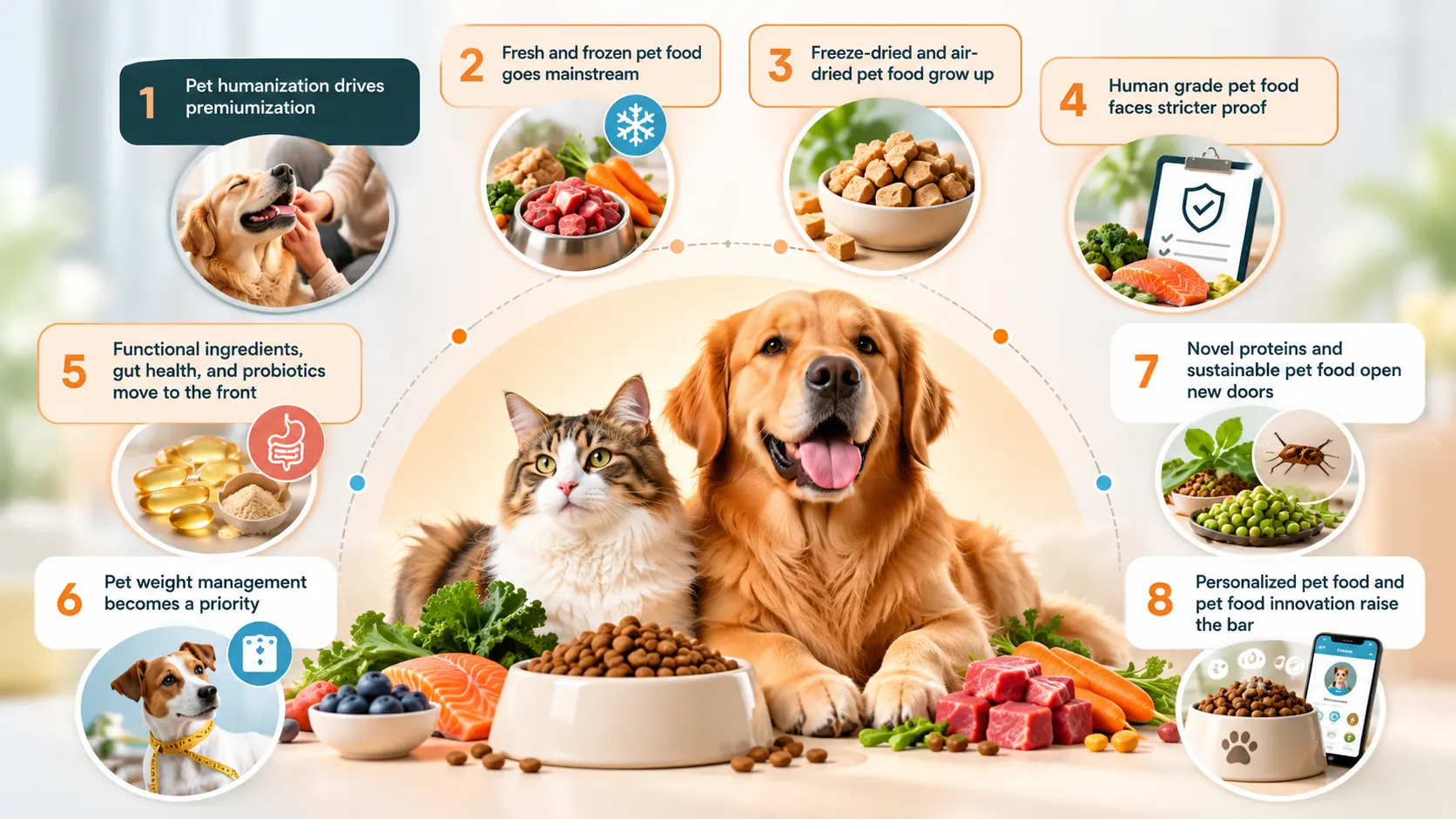
The future of pet food is fresher, healthier, and more personal. Eight trends will influence what pet owners buy next, from fresh and freeze-dried formats to gut health, pet weight management, novel proteins, and personalized pet food.
Pet owners today see their pets as family. So they read labels, question ingredients, and pay more for food they trust.
Pet food is also the biggest slice of pet spending. In the US, pet food and treats brought in $68.3 billion in 2025, which is 43.2% of all pet industry sales, according to the American Pet Products Association (APPA). That is a big market, and a crowded one.
This guide covers the eight biggest pet food industry trends going into 2027. For each shift, you will see what is changing, what it means for your brand, and what to do next. We checked the numbers against named sources, and we flag where a claim is still a company's own.
The 8 Pet Food Trends at a Glance
Here are the eight trends, in the order we cover them. These trends feed each other. Select one to see what it drives.
These shifts feed each other. Pet humanization pushes owners toward fresh, human grade, and functional food. That pushes brands toward better proof, new proteins, and food tailored to each pet. So the first step is to see where the market stands today.
Where the Pet Food Industry Stands Now
Pet food is a big category, and it is still growing. But effective growth is no longer easy to achieve.
Pet Food Industry Trends: The Key Numbers
| Metric | Figure | Source |
|---|---|---|
| US pet industry spending, 2025 | $158 billion | APPA |
| US pet food and treats sales, 2025 | $68.3 billion | APPA, via Pet Food Processing |
| US households with a pet | 95 million | APPA |
| Fresh and frozen share of US pet food sales, 2024 | 3.6% | NielsenIQ, via Petfood Industry |
| Freeze-dried share of US pet food sales, 2024 | 1.1% | NielsenIQ, via Petfood Industry |
| Fresh and frozen value sales growth, 2024 | 16.1% | NielsenIQ, via Petfood Industry |
| Canadian pet food market, 2025 | USD 5.38 billion | Mordor Intelligence, as cited in our guide |
Shift 1: Pet Humanization Drives Premiumization
Pet humanization means owners treat their pets like family. Premiumization means they pay more for better food. Together, they power almost every trend in this guide.
What it means for your brand
Owners will pay more, but only when you give them a reason. APPA found that 22% of pet owners spent less on their pets in 2025. So humanization raises what buyers expect, not just what they will pay.
What to do
- Put your sourcing and country of origin on the front of your pack and your product page.
- Use plain words for ingredients, and skip artificial colours, flavours, and preservatives where you can.
- Offer more than one price point, like a trial size or a topper next to your full recipe.
Shift 2: Fresh and Frozen Pet Food Goes Mainstream
Fresh and frozen pet food is still small. But it is growing faster than most of the category.
What it means for your brand
Fresh will not replace kibble anytime soon. Dry food is still projected to hold about 68% of the global pet food market in 2026. But fresh costs more and needs cold storage, so it asks more of your supply chain and your customer's budget.
What to do
- Pick your route early: frozen subscriptions you ship, or fridge space in stores.
- Sell fresh as a topper on kibble, so owners can start at a lower price.
- Count cold-chain shipping costs before you set your price.
Shift 3: Freeze-Dried and Air-Dried Pet Food Grow Up
Freeze-dried pet food and air-dried pet food give owners a minimally processed option without the freezer. That is why more brands, and more retailers, are paying attention.
What it means for your brand
The price per pound is high, so owners will compare cost per meal, not cost per bag. Raw formats also carry food safety risk. MarketsandMarkets notes that freeze-dried food made from raw meat needs strong protocols against pathogens like Salmonella, Listeria, and E. coli.
Canadian options exist. Our guide to pet food manufacturers in Canada notes that several Canadian manufacturers offer private label services in freeze-dried formats.
What to do
- Start with a mixer or topper, which is a smaller buy than a full freeze-dried diet.
- Show the cost per serving on your product page.
- Ask any manufacturer how they validate food safety for raw products.
Shift 4: Human Grade Pet Food Faces Stricter Proof
Human grade pet food is popular with owners. But the label has a strict meaning, and rivals are checking who uses it.
What it means for your brand
The NAD looked at words and pictures, not only labels. It found that a line about quality "I want in my own food" can imply human grade. So a claim you never meant to make can still become a problem.
Canada is less clear. We could not confirm a Canadian legal definition of human grade. Our guide to pet food manufacturers in Canada says CFIA compliance is mandatory for pet food sold here.
What to do
- Use the words human grade pet food only if you meet every part: ingredients, facility, and handling. Keep the paperwork.
- If you do not qualify, say what is true, like "made with real chicken" or "no artificial preservatives."
- Review your ads, videos, social posts, and product pages, not just your label.
- In Canada, get advice from a regulatory expert before you use the claim.
Shift 5: Functional Ingredients, Gut Health and Probiotics Take the Lead
Owners no longer want food that only fills the bowl. They want functional ingredients that do a job, and digestion is the job they ask about most.
What it means for your brand
Gut health and probiotics are easy to name and hard to do well. GreyB points to three problems: keeping the strain stable during manufacturing, keeping it alive in storage, and getting the right dose for each type of pet.
Claims need care too. In Canada, most pet supplements are Veterinary Health Products (VHPs). Our guide to pet food manufacturers in Canada explains that a VHP is not meant to treat, prevent, or cure disease. Once a product makes that kind of claim, it becomes a veterinary drug.
Supplements show the same pull. In our pet supplements market guide, probiotics and prebiotics are the fastest-growing supplement type.
What to do
- Name the ingredient, the dose, and the benefit in plain words.
- Ask your manufacturer for proof that probiotics stay alive through the end of shelf life.
- Write about supporting digestion, not treating disease.
- If you sell a supplement, check the VHP rules and your ad policies before you launch.
Shift 6: Pet Weight Management Becomes a Priority
Most pets in the US are carrying extra weight, and many owners do not see it. That gap is a big opening for pet brands.
What it means for your brand
The numbers show a real need, but owners are sensitive about it. APOP recommends clear, medically accurate, and compassionate language. Also, obesity is a medical condition, so avoid promising to treat it.
New ideas are coming. GreyB reports that UK brand Omni Pet launched LeanPaws, a supplement that the company says works like a GLP-1 weight-loss drug. It raised £11 million in June 2026. Treat this as a company claim until there is outside proof.
What to do
- Build calorie-controlled recipes, and show the calories per cup or per serving.
- Add a feeding guide or portion calculator to your product page.
- Use kind, plain language, and let vets explain the health risks.
- Check any weight claim against the rules for your product type before you advertise it.
Shift 7: Novel Proteins and Sustainable Pet Food Open New Doors
Owners and brands are looking beyond chicken and beef. Some want a gentler protein for pets with sensitivities. Others want sustainable pet food with a smaller footprint.
What it means for your brand
New proteins need proof. GreyB says the main challenge is showing that insect ingredients are safe, digestible, and nutritionally complete for pets. The approvals so far are narrow, since they cover adult dogs.
Allergy concerns drive new proteins. Stella & Chewy's has added rabbit, duck, and venison recipes to its freeze-dried line. Sustainability is a buying factor too: brands can stand out with biodegradable, plant-based, or upcycled packaging.
What to do
- Start with one novel protein, and explain in simple words why you chose it.
- Be specific about sustainability. Say what you changed, like recycled packaging or upcycled ingredients, instead of just saying "eco-friendly."
- Teach before you sell. Owners need to learn what an insect protein is.
- Confirm regulatory approval for your pet type and life stage first.
Shift 8: Personalized Pet Food and Pet Food Innovation Raise the Bar
Owners no longer want one bag for every dog or cat. They want food that fits their own pet. That is why personalized pet food sits at the centre of pet food innovation.
What it means for your brand
Personalization can build loyalty, but only if it is real. If you say "personalized," owners expect the food to change for their pet. Direct sales and subscriptions help, because owners share the data you need when they sign up.
Innovation goes beyond the recipe. Innova points to resealable and to-go packs, and to meals built around moments like breakfast or snacks. Limited-edition and seasonal claims show up in fewer than 10% of North American launches.
What to do
- Start simple. Sort your recipes by life stage, size, and sensitivity.
- Add a short pet profile quiz to your store, and use the answers to suggest a recipe.
- Set up subscription and replenishment flows so owners reorder on time. Our pet marketing agency team builds these for pet brands.
- Test one limited edition, such as a seasonal flavour.
Which Pet Food Shifts Should You Plan For First?
You do not need to chase all eight shifts at once. Here is how they compare, so you can pick the ones that fit your brand.
A 12-Month Plan for the Future of Pet Food
Here is a simple plan to turn these pet food trends into action.
Time Your Launches to Pet Holidays
Wrapping Up
Pro Marketer's pet marketing agency team builds compliant Meta, Google, and Amazon campaigns, plus SEO, email, and SMS, for pet food, supplement, and supply brands. Comparing partners? Read our list of the best pet marketing agencies.
FAQs
The pet food industry is moving toward fresher, healthier, and more personal food. Pet humanization is the main driver, because owners treat their pets like family. Expect growth in fresh and frozen, freeze-dried, and air-dried formats, plus gut health, pet weight management, novel proteins, and personalized pet food. The market is large, with US pet food and treat sales at $68.3 billion in 2025. But 22% of owners spent less on their pets that year, so brands need to prove their value.
Not anytime soon. Fresh and frozen pet food was 3.6% of US pet food sales in 2024, even though its value sales grew 16.1%. Dry food is still projected to hold about 68% of the global market in 2026. Some owners use fresh food as a topper on kibble instead of switching fully. Fresh will keep taking share, but kibble is not going away.
It can be, when the ingredient is approved for the pet and the brand can prove it is safe. In the US, AAFCO officially approved black soldier fly larvae for adult dog food in 2022. A market report says AAFCO also approved dried mealworm meal for adult dog food in January 2024. These approvals are narrow, and they do not cover every pet or life stage. Brands still need to show that the ingredient is safe, digestible, and nutritionally complete. In Canada, CFIA has approved dried black soldier fly larvae for some poultry and fish feeds, but we could not confirm a pet food approval. Check with CFIA before you launch.
Human-grade is a strict label. Under AAFCO's guidelines, it applies to the whole product. Every ingredient must be fit for human consumption. The product must also be made, packed, held, and shipped under human food rules, in a facility licensed to make human food. Saying "made with human grade ingredients" is misleading unless the full product qualifies. In Canada, we could not confirm a legal definition, so check with CFIA and a regulatory expert before you use the claim.
Start with three things. First, show clear proof of quality, with honest sourcing and claims. Second, pick one functional benefit, like gut health or weight management. Third, choose one format or protein that sets you apart, like a freeze-dried topper or a novel protein recipe. Then add personalization in simple ways, such as recipes by life stage and size, and offer a subscription. Hold off on riskier claims, like human grade or any disease claim, until you have the proof.


Ami Okorie
Content Writer
Ami Okorie
Content Writer
Ami Okorie is a content writer at Pro Marketer. She helps e-commerce and DTC brands blend strategic copywriting with storytelling. With an eye for strategy and storytelling, she builds content engines that boost visibility, engagement, and sales.