
.webp)
TABLE OF CONTENTS
What Is LegitScript Certification for Peptide Brands?
Is LegitScript Required for Peptides?
Benefits of LegitScript Certification for Peptide Brands
You can run ads on major platforms
You can process card payments through mainstream merchant accounts
You build genuine trust with patients and customers
You can attract legitimate business partners
How Much Does LegitScript Certification Cost?
LegitScript Requirements for Peptide Brands
Standard 1: Licensure and business registration
Standard 3: Prior discipline and history
Standard 4: Affiliates and partners
Standard 7: Validity of prescription
How to Apply for LegitScript Certification
Step 1: Check your eligibility
Step 2: Gather your documentation
Step 3: Submit your application
How Long Does LegitScript Certification Take for Peptide Brands?
What Happens After You Get Certified
- Is LegitScript certification legally required to sell peptides?
- Is LegitScript certification hard to get for peptide brands?
- Does LegitScript certification help with Google and Meta Ads approval for peptides?
- What are the most common reasons peptide brands get rejected by LegitScript?
- Can a Canadian peptide brand get LegitScript certified, or is it US-only?
- What is the difference between LegitScript certification for a brand vs. a clinic?


Share via:
Quick Answer: LegitScript certification is a mandatory third-party compliance credential that Google, Meta, Visa, Mastercard, and other major platforms require before allowing peptide and telehealth businesses to advertise or process payments. The application fee is approximately $975 per website, and the annual renewal fee is approximately $2,150. It takes 4 to 8 weeks for most brands to complete documentation.
Out of 807 peptide clinic websites reviewed in July 2026, only 5.9% had LegitScript certification. That means fewer than 6 out of every 100 peptide businesses have the credential that Google, Meta, Visa, and Mastercard check before letting a peptide brand run ads or accept card payments.
If you own a peptide brand or are planning to own one, this guide will explain what LegitScript certification is, who needs it, what it costs, how to apply, how long it takes, and what happens to businesses that try to grow without it.
What Is LegitScript Certification for Peptide Brands?
LegitScript is an independent compliance and certification company. It was built to help the internet's largest platforms identify which healthcare businesses are legitimate and which ones are not.
When a peptide brand applies for LegitScript certification, LegitScript reviews the business against nine core certification standards:
1. Legal compliance
2. Licensing
3. Business registration
4. Affiliates and partners
5. Patient services
6. Privacy
7. Prescription validity
8. Transparency
9. Advertising practices
If the business passes that review, LegitScript issues a certification. That certification is then visible to Google, Meta, Visa, Mastercard, and other platforms through LegitScript's database, which those platforms query when deciding whether to approve an advertiser or a merchant account.
It is important to understand that LegitScript certification is not a medical license. It does not replace your state business registration. It is not a HIPAA certification. And it is not the same as FDA approval for your products.
It is specifically a compliance credential that tells advertising platforms and payment processors that your business has been independently vetted and confirmed as legitimate in its category.
For peptide brands, this certification is very important. Why? Because peptides are one of the most scrutinized product categories on every major ad platform and with every acquiring bank that processes card payments.
Without LegitScript certification, peptide businesses in prescription-adjacent or clinical models are banned or removed from the paid channels and payment infrastructure that most modern ecommerce businesses depend on.
Is LegitScript Required for Peptides?
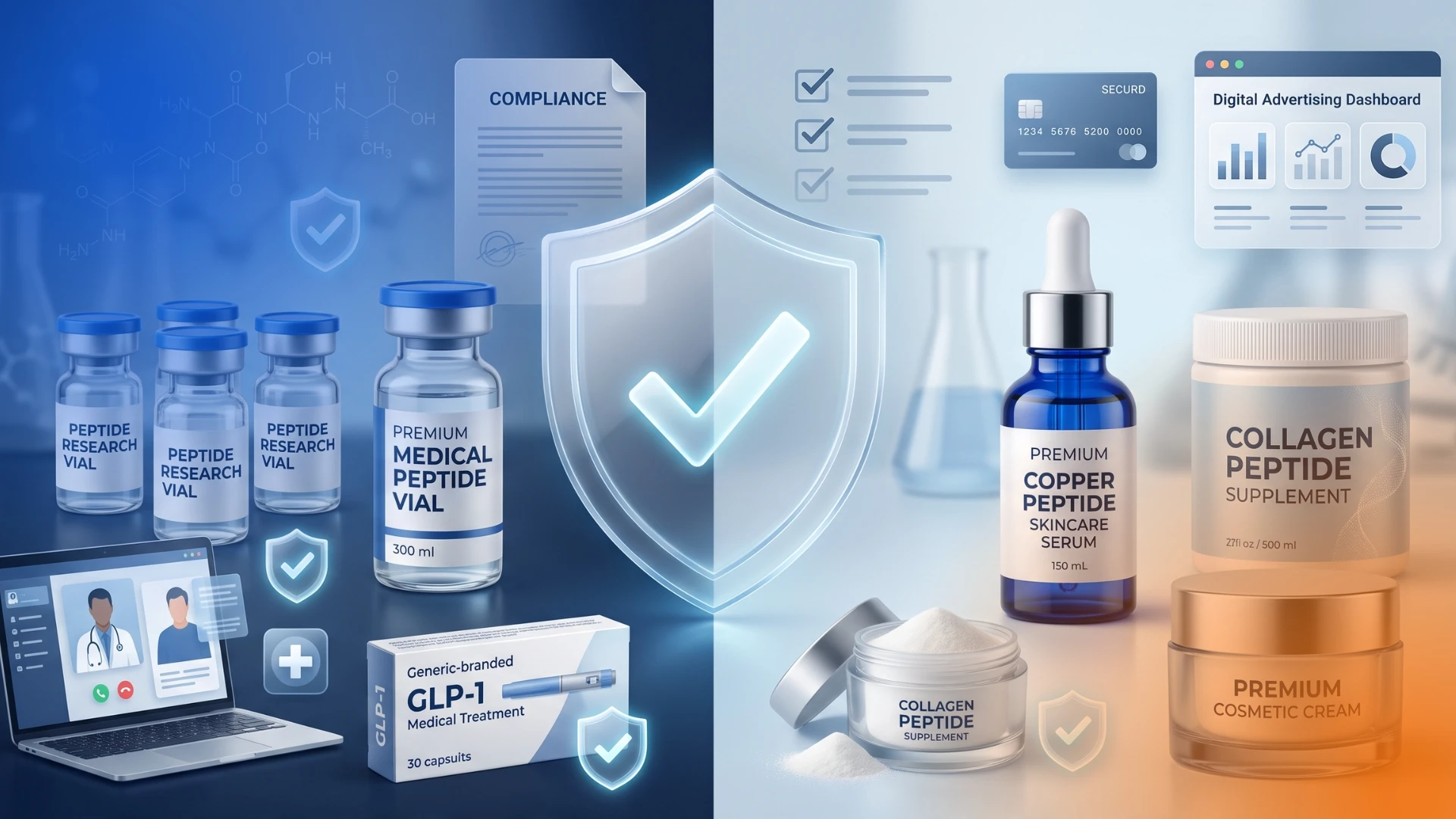
LegitScript certification is not a legal requirement in the same way a business license is. No government agency mandates it. But it is a practical requirement for any peptide business that wants to run paid advertising on Google, Meta, Microsoft, TikTok, LinkedIn, or other major platforms, or that wants to accept card payments through mainstream payment processors.
Those platforms have decided to require LegitScript as a condition of access. So while no law forces you to get certified, operating without it means you cannot use the tools most businesses rely on to grow.
If you run a telehealth peptide clinic, LegitScript certification is mandatory. Any peptide business model that involves licensed providers consulting patients, prescribing treatments, and coordinating fulfillment through licensed pharmacies falls under LegitScript's certification. Without it, you cannot advertise and get a stable merchant account.
If you sell prescription-adjacent peptide products or operate a GLP-1 weight management program, certification is also mandatory in 2026. The increase in GLP-1 demand has led to greater platform scrutiny, and both ad platforms and payment processors have used LegitScript as the required credential.
If you sell research peptides and want to advertise them or run paid campaigns, you need LegitScript certification. Google has been known to require LegitScript for advertisers in certain healthcare categories, including research peptides and supplements, depending on how they are positioned and what claims are made.
If you sell topical peptide skincare or collagen peptide supplements and you are not making prescription claims, LegitScript certification may not be required. Standard collagen powder brands and copper peptide serum brands that stick to appearance-based cosmetic claims and structure/function supplement claims often do not need it. But if your marketing uses clinical language or if your product positioning sounds therapeutic, the platforms will flag it, and certification becomes necessary.
The safest approach is to evaluate your specific peptide business model before assuming you do or do not need it. If your website and marketing look and sound like healthcare advertising, you need to get certified.
Benefits of LegitScript Certification for Peptide Brands
You can run ads on major platforms
This is the most immediate and tangible benefit. Without LegitScript certification, Google will reject campaigns for telehealth, prescription-related services, and many peptide categories. Meta, Microsoft, TikTok, LinkedIn, Netflix, Nextdoor, and Yahoo have similar requirements for health and pharmaceutical advertising.
For most peptide brands, Google and Meta are where their target customers spend time and where paid acquisition is most efficient. Being locked out of those platforms does not just limit your growth; it gives your competitors an advantage.
You can process card payments through mainstream merchant accounts
Visa and Mastercard recognize LegitScript certification for certain payment processing merchant categories in healthcare.
Without certification, peptide businesses are classified as high-risk and either get declined by mainstream processors or get placed with high-risk processors that charge higher fees and impose tighter account controls.
You build genuine trust with patients and customers
LegitScript-certified businesses are listed in LegitScript's publicly searchable directory of legitimate providers.
When a patient or customer searches your business and finds your LegitScript certification, it signals that an independent third party has verified your operation.
In a category where consumer trust is really difficult to earn because of the volume of non-compliant operators, that verification sets you apart from competitors.
You get ahead of enforcement
Businesses that get certified build compliance that protects them. Businesses that delay certification usually find themselves scrambling to get certified after their ad accounts have been suspended or their merchant accounts frozen, which is a far more disruptive and expensive process than certifying.
You can attract legitimate business partners
Pharmacy partners, healthcare technology platforms, and institutional partners check for LegitScript certification before agreeing to work with peptide businesses.
Your certification signals that your operation meets a recognized compliance standard.
How Much Does LegitScript Certification Cost?
LegitScript's fees have two components. There is a one-time application fee and an annual certification fee. Both apply per website domain, meaning if you operate multiple websites, each one is certified and priced separately.
You can include multiple websites in a single application, but each domain requires its own application fee and annual certification fee.
Based on current pricing confirmed directly from LegitScript's official website, the fees are as follows:
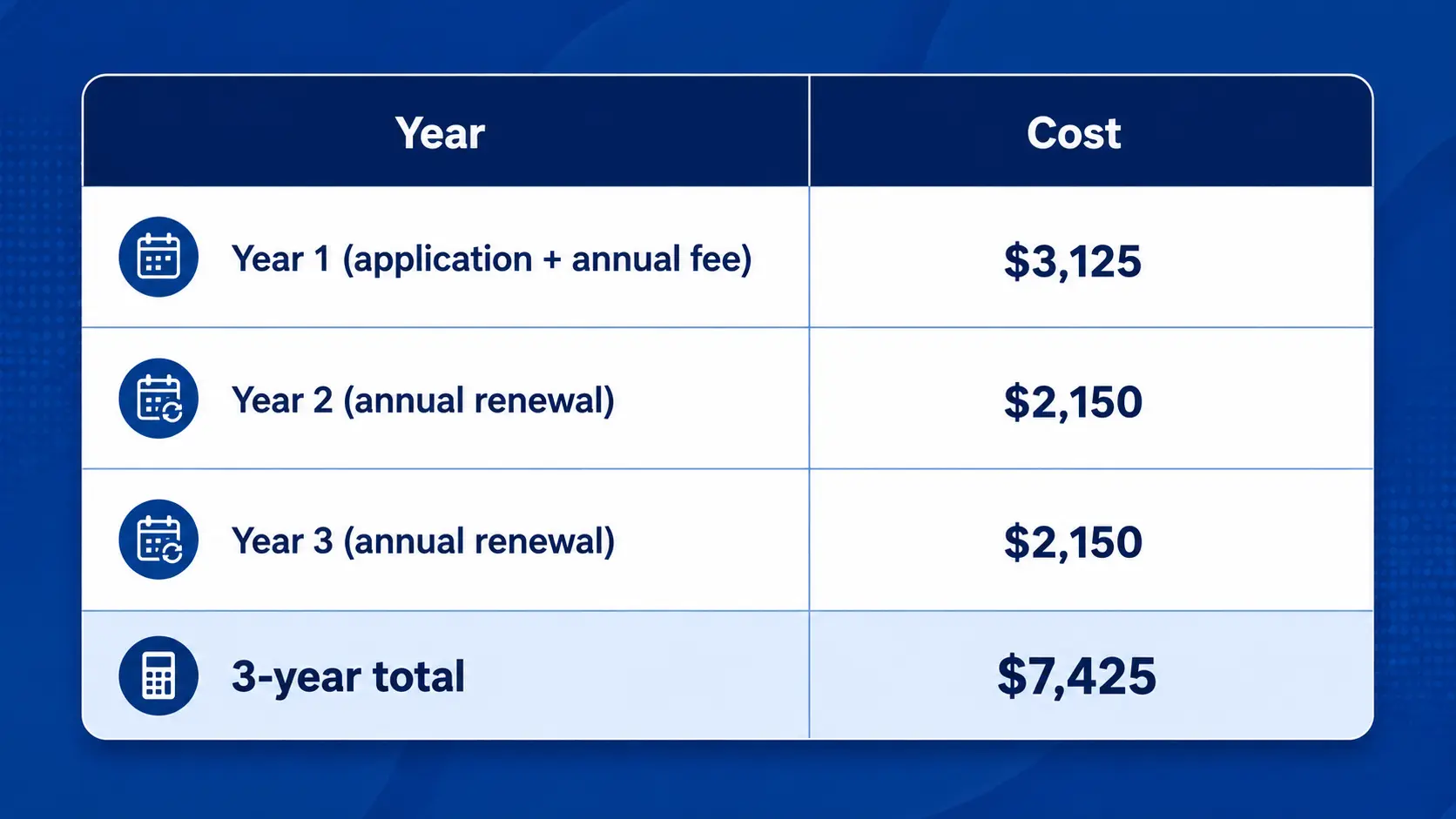
- Application fee: $975 per website, non-refundable regardless of outcome. This payment starts the application process
- Annual certification fee: $2,150 per website. This is due once your application is approved. It is also non-refundable, and no pro-rated refunds are issued for unused portions of the annual certification term
- Expedited review: An optional additional fee of $2,500 per application reduces the review start time to within two business days of submission
- Probationary certification: Businesses with past compliance issues that still meet current certification standards pay an annual certification fee of $3,995 per website. This tier includes more in-depth and frequent monitoring due to compliance history
For a single-website telehealth peptide clinic at the standard tier, the total cost in year one is $3,125 and approximately $2,150 per year.
Getting certified before you need it is almost always cheaper than getting certified after something has gone wrong.
LegitScript revises its fee schedule periodically. Always confirm current pricing directly at legitscript.com before budgeting.
LegitScript Requirements for Peptide Brands
LegitScript's review is based on nine core certification standards. Before you apply, your business needs to meet all of them.
Standard 1: Licensure and business registration
Your business must be adequately licensed for the services it offers, and in the jurisdictions it serves.
This includes the jurisdiction from which medications are prescribed or dispensed and the jurisdiction where the patient is located, except in circumstances permitted by law.
Standard 2: Legal compliance
Your business must comply with all applicable laws and regulations, including all licensing, registration, and authorizations needed to prescribe or dispense medications.
Your website must not facilitate the prescribing or dispensing of medications that lack the necessary approval from the applicable regulatory body.
Standard 3: Prior discipline and history
You must disclose any prior criminal, regulatory, or civil violations, along with any ongoing or resolved litigation involving your business or its principals over the past ten years.
Standard 4: Affiliates and partners
All affiliates and partners must comply with LegitScript's certification standards. This includes partner pharmacies, co-owned companies, staff, associated medical personnel, and any entity promoted on your domain.
More importantly, partner pharmacies responsible for fulfilling prescriptions are generally required to be LegitScript-certified or accredited by another recognized body. You must also disclose all domain names and websites under your control as part of the application.
Standard 5: Patient services
Your website must clearly disclose all states, territories, provinces, and countries where your services are available.
Standard 6: Privacy
You must comply with all applicable privacy laws.
For US-based businesses that collect, store, or transmit Protected Health Information, full HIPAA compliance is required. All transactions must be processed using SSL technology.
Standard 7: Validity of prescription
You may only dispense or offer to dispense prescription drugs after receiving a valid prescription from an authorized prescriber.
No prescription or prescription drug may be dispensed before a licensed medical professional has provided care.
Standard 8: Transparency
All practices and offers must be accurate, transparent, and not misleading to patients or the public.
This includes claims about products or services that have not been supported by a regulatory body such as the FTC or FDA.
Failure to provide full and accurate information during the application process will result in denial.
Standard 9: Advertising
All advertising must be transparent and comply with applicable laws and regulations.
Advertising anything that violates platform terms of service can be grounds for denial or revocation.
Documents you need before you apply:
- All current business and professional licenses for your business, facilities, and staff
- Business registration numbers and documentation
- DEA certificate information if your business involves controlled substances
- HIPAA-compliant or region-specific privacy policy
- Compliance status documentation for all affiliates and partner pharmacies
- Current product and service descriptions, marketing claims, and advertising materials
How to Apply for LegitScript Certification
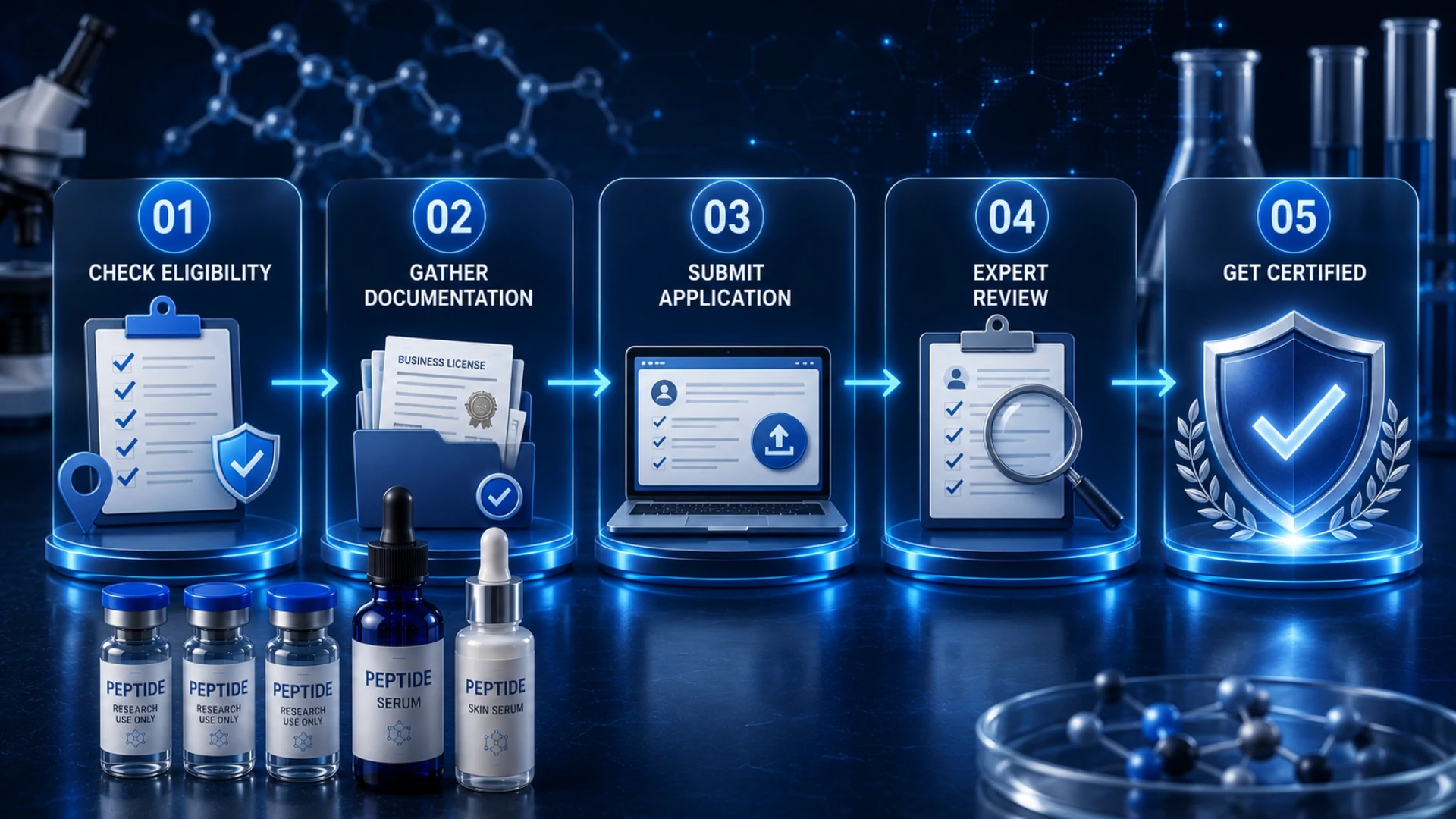
The application process follows five steps as outlined on LegitScript's official website.
Step 1: Check your eligibility
Confirm your location, business type, and scope of services against LegitScript's requirements before you do anything else.
LegitScript provides application checklists by business type on their website, including a standard healthcare certification checklist, a pharmaceutical manufacturer checklist, and a medical spa checklist.
Download the one that fits your business and work through it before you spend any money.
Step 2: Gather your documentation
Prepare all required business licenses, clinical policies, ownership information, and compliance documentation before you open the application portal.
The most common issues that delay applications are inadequate website disclosures, missing prescription-required language for telehealth businesses, incomplete policy pages, health claims in product descriptions, and missing licensing documentation for specific states.
Fix all of these before you submit. The application fee is non-refundable, and the review deadline starts when you submit, so having a good submission saves both money and time.
Step 3: Submit your application
Go to legitscript.com and create a business account. Select the Healthcare Merchant Certification program. Complete the application in LegitScript's secure client portal and upload all required documentation.
Complete every section fully. Partial submissions slow the review and cause follow-up requests that restart the review clock. Also remember to pay the $975 application fee at submission.
Step 4: Expert review
LegitScript's team verifies your business against all nine certification standards. Most applications require at least one follow-up exchange where LegitScript requests additional documentation or clarification.
Respond specifically and promptly. Vague or slow responses are the most common reason the review timeline extends beyond the standard 4 to 8 weeks.
Step 5: Get certified
Once your application passes review, LegitScript issues your certification. You receive a certification badge for your website and are added to LegitScript's publicly searchable directory of certified providers.
Your certification information is shared with Google, Meta, Microsoft, TikTok, LinkedIn, and other platforms that use LegitScript's database, which allows you to create and run ads in previously restricted categories.
How Long Does LegitScript Certification Take for Peptide Brands?
For most telehealth peptide operators with complete documentation prepared in advance, the total timeline from application to approval is 4 to 8 weeks.
Several factors affect this time range:
- Completeness of your application
- Complexity of your business model
- How quickly you respond to analyst requests
- Order of receipt
- Whether your website is live
What Happens After You Get Certified
After you receive your certification, LegitScript conducts continuous monitoring of your business. This includes:
- Periodic website reviews
- Product catalogue checks
- Advertising compliance audits
Your certification must be renewed annually. The renewal fee is $2,150 per website per year and is non-refundable.
You are required to notify LegitScript of significant changes to your business. This includes changes in ownership, new locations, changes in licensure status, and changes to the services you offer.
Failing to notify LegitScript of material changes can result in suspension or revocation of your certification.
If LegitScript identifies a compliance issue during monitoring, they will flag it and give you an opportunity to remediate.
Non-compliance that is not remediated can result in certification suspension or revocation, which means losing access to the advertising channels and payment processing infrastructure that certification unlocked.
Final Thoughts
LegitScript certification is not the most exciting part of building a peptide brand. But it is one of the most important operational decisions you will make if paid advertising and mainstream payment processing are part of your growth plan.
If you want help building the marketing and ecommerce strategy for your peptide brand and your compliance infrastructure, book a free consultation with Pro Marketer. We work with supplement and wellness brands to build the digital systems that turn compliant operations into profitable, scalable businesses.
FAQs
1. Is LegitScript certification legally required to sell peptides?
No government agency legally requires LegitScript certification to sell peptides. But Google, Meta, Microsoft, TikTok, LinkedIn, Visa, and Mastercard have made it a practical requirement for peptide businesses in prescription and clinical categories.
Without it, you cannot run paid ads on those platforms, and you cannot get stable merchant accounts through most mainstream payment processors. So while it is not a law, it is the price of entry for the channels most peptide businesses need to grow.
2. Is LegitScript certification hard to get for peptide brands?
It is not technically difficult, but it is thorough. The process requires meeting all nine core certification standards, detailed documentation, a fully compliant website, and licensing verification across every aspect of your business.
The brands that struggle with LegitScript certification are usually the ones that apply before their compliance is in order.
3. Does LegitScript certification help with Google and Meta Ads approval for peptides?
Yes. Google requires LegitScript certification to run ads for telehealth, prescription-related services, and many peptide categories.
Meta has similar requirements for health and pharmaceutical advertising. Once you have certification, your business is added to LegitScript's database, which those platforms query when evaluating advertiser eligibility.
Certification does not guarantee that every ad you create will be approved, because your ad copy still needs to meet each platform's specific content policies.
But it removes the certification barrier that was blocking you from the category.
4. What are the most common reasons peptide brands get rejected by LegitScript?
The most common reasons are health claims in product descriptions or marketing copy, incomplete or missing policy pages, products in the catalogue that fall outside permissible categories, missing or expired licensing documentation for prescribing providers, non-compliant or unaccredited pharmacy partners, undisclosed prior discipline or litigation history from the past ten years, undisclosed domain names under your control, and partial application submissions with incomplete documentation.
5. Can a Canadian peptide brand get LegitScript certified, or is it US-only?
LegitScript certification is available globally. LegitScript explicitly lists Canada as a country where certification is required for pharmacies, telemedicine providers, and medical spas that want to advertise or process payments through platforms that recognize LegitScript.
Canadian peptide brands applying for certification would need to meet LegitScript's standards within the applicable Canadian regulatory standard.
LegitScript also provides regional application checklists for multiple countries. Confirm current program availability and requirements directly at legitscript.com.
6. What is the difference between LegitScript certification for a brand vs. a clinic?
The certification program is the same, Healthcare Merchant Certification, but the requirements look different depending on your business model.
A peptide supplement brand seeking certification needs to demonstrate product compliance, proper claims language, compliant website policies, and legal business registration.
A telehealth peptide clinic seeking certification needs all of that plus state medical licensing for every prescribing provider in every state where they see patients, pharmacy partnership documentation confirming those pharmacies are LegitScript-certified or accredited, HIPAA-compliant infrastructure for patient data, prescription verification workflows, and disclosure of all affiliates and domain names.

.svg)

.avif)

.svg)