
TABLE OF CONTENTS
The Peptide Market Opportunity in 2026
The Three Types of Peptide Businesses: Choose the Right Lane First
Research Peptide Company vs. Telehealth Peptide Clinic: What Is the Difference?
Peptide Business Compliance Requirements
Topical Peptide Skincare Compliance
Collagen Peptide Supplement Compliance
Licensing Requirements for Peptide Businesses
White Label vs. Private Label Peptides: Which Is Right for Your Brand?
Startup Costs for a Peptide Brand in 2026
Topical Peptide Skincare (White or Private Label)
How Long Does It Take to Launch a Peptide Brand?
Paid Advertising and Peptide Brand Meta Ads


Share via:
Quick Answer: Starting a peptide brand in 2026 is possible but more complex than launching a standard supplement or skincare brand. The compliance requirements, marketing restrictions, and legal structure of your business all depend on one decision: are you selling research peptides or operating a telehealth peptide clinic? You need to be sure of your category, else you might be exposed to FDA enforcement action, banned ad accounts, and legal liability. This guide covers everything you need to know to start a peptide brand the right way.
Peptides are one of the fastest-growing categories in the health and wellness industry. They are used for bodybuilding, anti-aging, weight management, and longevity.
Surprisingly, consumer interest in peptides has exploded in the last three years. And over the years, we’ve realized that where consumer interest goes, business opportunity always follows.
You should know that starting a peptide brand is not like starting a supplement company or a skincare line. The regulatory standards are different, and the marketing restrictions are stricter.
Most founders who get into trouble when starting their peptide businesses do so not because they had bad intentions, but because they did not understand the compliance regulations involved in the business.
This guide provides all the information you need to know before you start a peptide brand, how to structure your business correctly, and what marketing channels are available to you.
The Peptide Market Opportunity in 2026
According to industry projections, the global peptide market is expected to reach over $54 billion by 2028, with growth being driven by advances in biotechnology, telehealth delivery, and an increasing consumer demand for personalized health and wellness products.
There are specific segments showing the most opportunity for growth. These segments include:
- Metabolic health and weight management: This remains the most dominant category. The regulatory standard for GLP-1 compounds changed in 2026. The FDA removed semaglutide from its official drug shortage list in early 2025 and tirzepatide in late 2024. With the shortage resolved, the legal basis for bulk compounding of these compounds has largely ended. The FDA issued 30 warning letters in March 2026 to telehealth companies making false or misleading claims about compounded GLP-1 medications and is now moving to permanently restrict bulk compounding of semaglutide, tirzepatide, and liraglutide. Always consult current FDA guidance and a regulatory attorney before building any business model in this category
- Peptide skincare: This is one of the fastest-growing segments in beauty. The topical peptide skincare market alone is projected to grow from approximately $2.9 billion in 2026 to $8.3 billion by 2035. Consumers are actively seeking peptide-based serums, creams, and treatments that will remove fine lines and improve skin firmness
- Collagen peptide supplements: This segment continues to grow as one of the most mainstream wellness categories. Collagen powders, capsules, drinks, and gummies are widely accepted by consumers
- Longevity and preventive health: This category is gaining attention from consumers who want proactive health solutions. This segment attracts buyers willing to invest in long-term wellness programs and supports subscription-based revenue models
To succeed in any of these categories, you have to build a compliant operation and execute marketing in a way that reaches your target customer without triggering platform enforcement.
The Three Types of Peptide Businesses: Choose the Right Lane First
Before you spend a single dollar on branding, manufacturing, or marketing, you need to understand that the word "peptide" includes three completely different types of businesses.
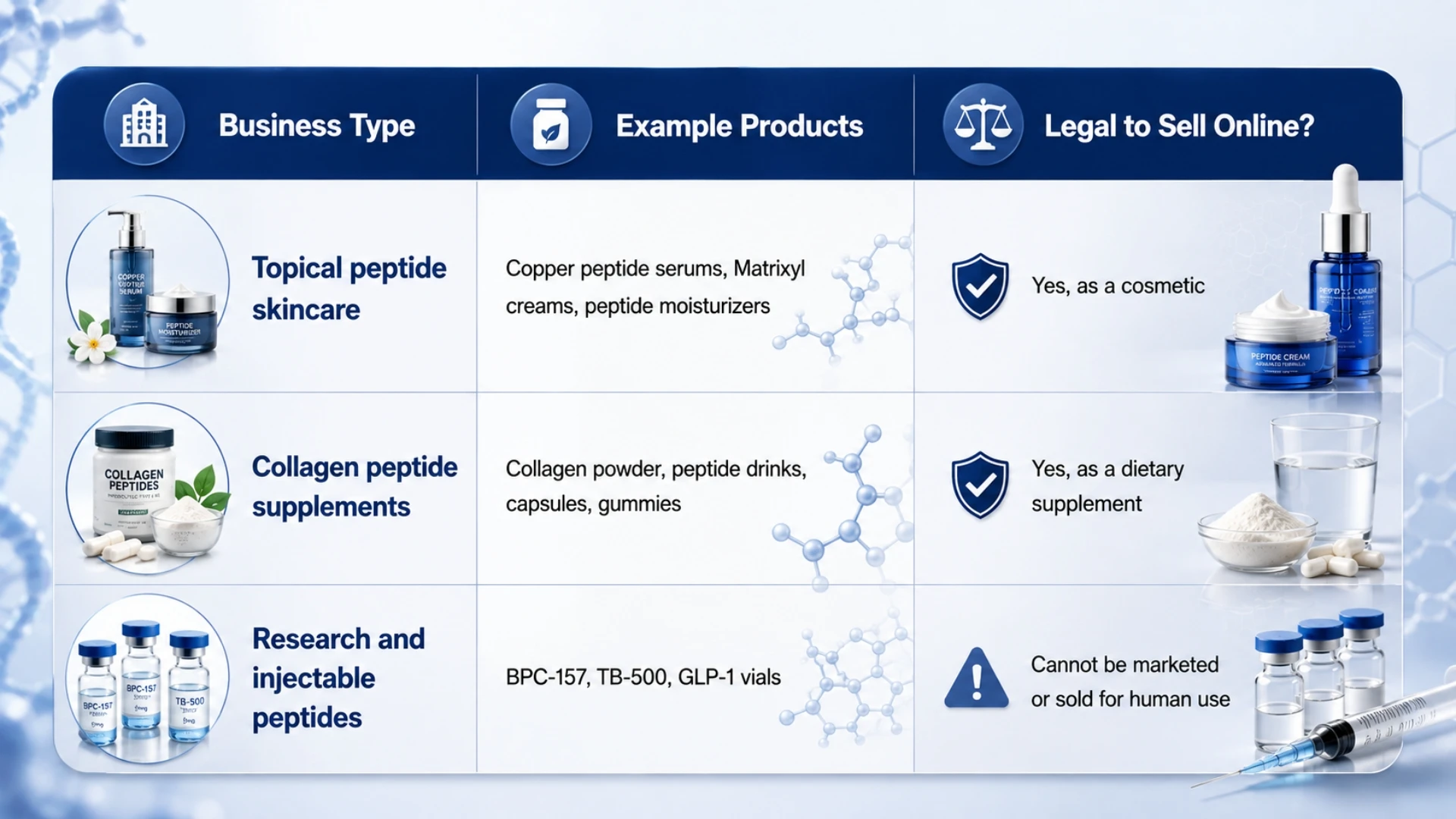
Research peptides can legally be sold for laboratory research purposes to qualified buyers such as universities, labs, and research organizations. However, they cannot legally be marketed or sold for human consumption. Many are unapproved drugs under FDA definitions, and enforcement primarily targets sellers who make human use claims or sell to consumers rather than legitimate research buyers.
On February 27, 2026, HHS Secretary RFK Jr. announced that approximately 14 of 19 peptides previously restricted on the FDA's Category 2 list would move back to Category 1 status. On April 23, 2026, the FDA removed 12 peptides, including BPC-157 and TB-500, from the Category 2 bulk substances list.
The FDA's Pharmacy Compounding Advisory Committee (PCAC) formally reviewed BPC-157, TB-500, KPV, and MOTS-C on July 23 to 24, 2026, for 503A compounding eligibility.
However, removal from Category 2 is not the same as FDA approval. These compounds remain unapproved drugs that cannot legally be sold for human use over the counter. Legitimate access still happens through a licensed physician and a licensed compounding pharmacy under medical supervision.
In fact, mainstream payment processors, Google, Meta, and every major ad platform prohibit the promotion of unapproved drugs, research-use compounds, and certain prescription-related products.
Research Peptide Company vs. Telehealth Peptide Clinic: What Is the Difference?
It’s important you understand the difference between these two business models before you make any structural decisions.
Research peptide companies sell compounds for laboratory research purposes to qualified researchers, labs, and universities. Products cannot be marketed for human consumption and must carry research-use-only disclaimers.
Your website structure, product descriptions, and all marketing language must avoid any implication of medical benefit or human use.
This business model comes with a huge compliance risk. Mislabeling products, implying medical benefits in product descriptions, or building a website that implies human use while technically disclaiming it are all ways to trigger an enforcement action.
Also, regulatory systems and advertising platforms now use automated scanning tools to detect restricted terms. So, you really cannot outsmart the system with clever wording.
Telehealth peptide clinics operate within a completely different regulatory standard. Telehealth businesses provide healthcare services remotely through appropriately licensed healthcare professionals. This is coordinated through licensed pharmacies, which may include traditional pharmacies for FDA-approved medications or licensed compounding pharmacies where legally permitted under applicable state and federal law.
Patients complete intake forms online, consult with providers via video, and receive products shipped to their homes.
This model requires licensed medical professionals, HIPAA-compliant data handling, prescription verification workflows, pharmacy partnerships, and secure patient record management.
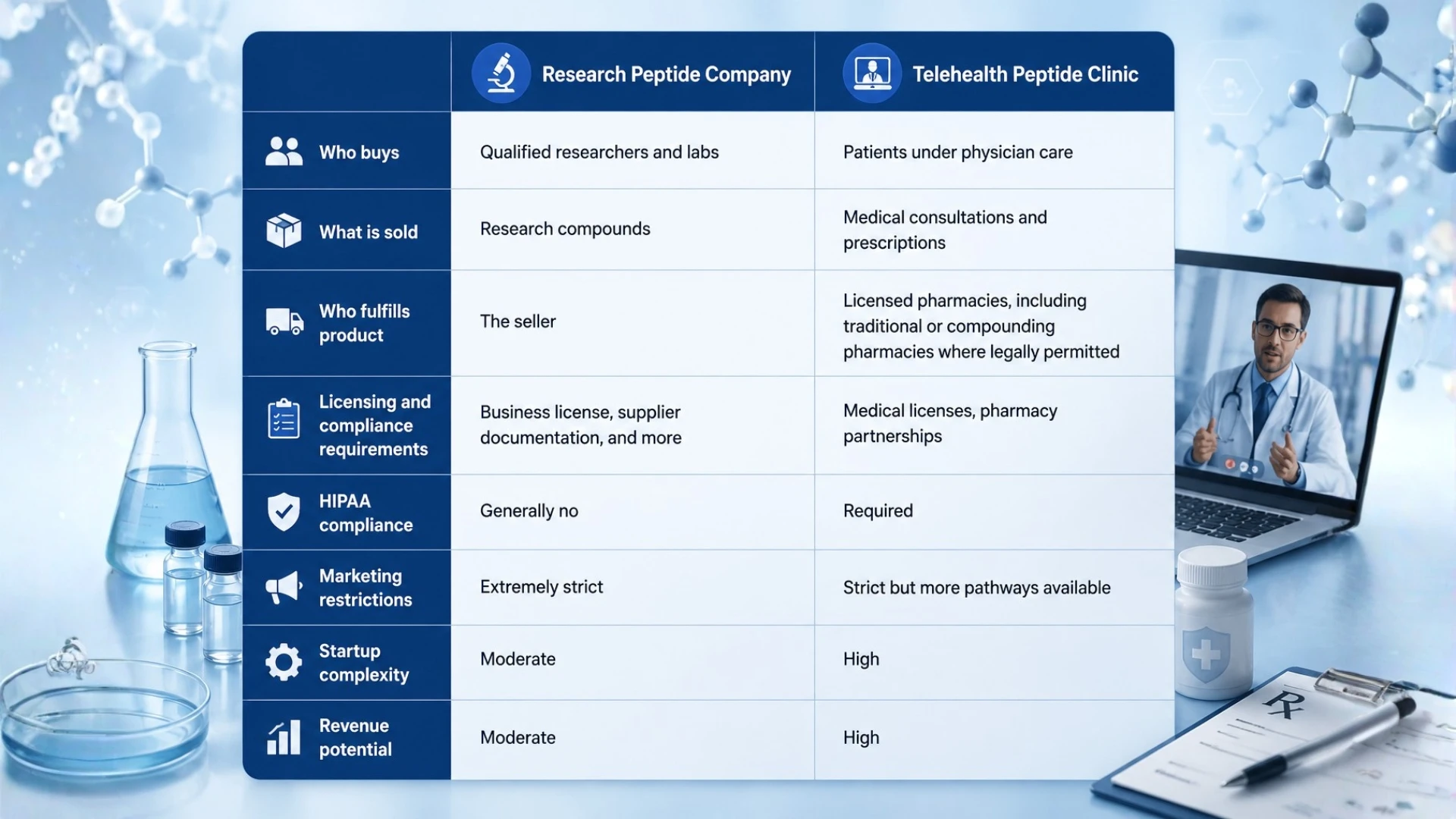
Explore the image below for a direct comparison between both models:
Peptide Business Compliance Requirements
In the peptide industry, compliance is the foundation of your entire business.
The decisions you make about what to say, how to label your products, and how to structure your website determine whether you have a sustainable business or an expensive legal problem.
Topical Peptide Skincare Compliance
If your product is classified as a cosmetic, the FDA does not approve cosmetics before sale, but you are responsible for product safety and labelling.
Under the Modernization of Cosmetics Regulation Act of 2022 (MoCRA), certain businesses must register their facilities and list their products with the FDA.
Under MoCRA, certain qualifying small businesses may be exempt from some requirements, including facility registration and product listing. Generally, those with under $1 million in average annual gross sales of cosmetics in the US over the previous three years may be exempt. However, the small business exemption does not apply to all businesses under that revenue threshold.
The exemption is specifically excluded for businesses that manufacture or process cosmetic products that regularly come into contact with the mucus membrane of the eye under customary conditions of use (including eye shadow, as clarified in December 2024 FDA guidance), products that are injected, products intended for internal use, and products intended to alter appearance for more than 24 hours where removal by the consumer is not part of normal use.
Additionally, qualifying small businesses under MoCRA are also exempt from Good Manufacturing Practice (GMP) compliance requirements, as well as facility registration and product listing.
Review the current FDA guidance or consult a regulatory professional to confirm whether your business qualifies before assuming you are exempt.
Generally acceptable appearance claims:
- "Reduces the look of fine lines"
- "For firmer-looking skin"
- "Visibly smooths and hydrates"
- "Supports the appearance of a healthy skin barrier"
Claims that are more likely to trigger drug classification concerns:
- "Rebuilds collagen"
- "Repairs damaged DNA"
- "Heals wounds or scars"
- "Stimulates cell regeneration"
NOTE: The FDA has become more permissive with appearance-framed barrier language, but it is still strict about structural or functional repair claims. Saying "supports the appearance of a healthy skin barrier" or "helps skin feel more resilient" is generally treated differently from "repairs the skin barrier" or "restores barrier function," which imply structural change. When you are in doubt about specific phrasing, review current FDA cosmetic labeling guidance or work with a cosmetic regulatory consultant before publishing any claims.
Collagen Peptide Supplement Compliance
Your product is a dietary supplement, governed by the Dietary Supplement Health and Education Act (DSHEA). There are three non-negotiable requirements for this:
- Structure/function claims only, no disease claims: You can claim your product supports skin elasticity, joint comfort, or muscle recovery. You cannot claim it treats arthritis, reverses aging, or cures any condition. Disease claims make your supplement an unapproved drug
- Required disclaimer: Every supplement label must include this exact statement in bold: "This statement has not been evaluated by the Food and Drug Administration. This product is not intended to diagnose, treat, cure, or prevent any disease."
- Evidence for claims: The Federal Trade Commission (FTC) requires competent and reliable scientific evidence for every claim you make in marketing. If you say "studies show," you need to be able to point to the actual studies
Your supplement must also be manufactured at a facility that follows supplement Good Manufacturing Practices (GMP).
When you work with a private label lab that is already GMP-certified, they handle most of the manufacturing compliance for you.
Licensing Requirements for Peptide Businesses
All peptide businesses need:
- State business registration
- Seller's permit or sales tax permit if applicable in your state
- Product liability insurance (approximately $500 to $2,000 per year for a $1 million policy)
Telehealth peptide clinics also need:
- Licensed medical professionals authorized to prescribe in each state where they see patients
- HIPAA-compliant data infrastructure
- Pharmacy partnership agreements including compounding pharmacies where legally permitted
- State-specific telehealth licensing depending on the states where you operate
If you plan to run Google Ads or advertise prescription-related services, LegitScript certification is required before Google will approve healthcare-related campaigns.
The process requires a detailed application, compliance audit, and ongoing monitoring. Because fees change periodically, check current pricing directly at LegitScript.com before budgeting.
Treat this as a meaningful line item in your startup cost planning for any business model that intends to run paid search advertising.
White Label vs. Private Label Peptides: Which Is Right for Your Brand?
White and Private label are often used interchangeably, but they describe different things:
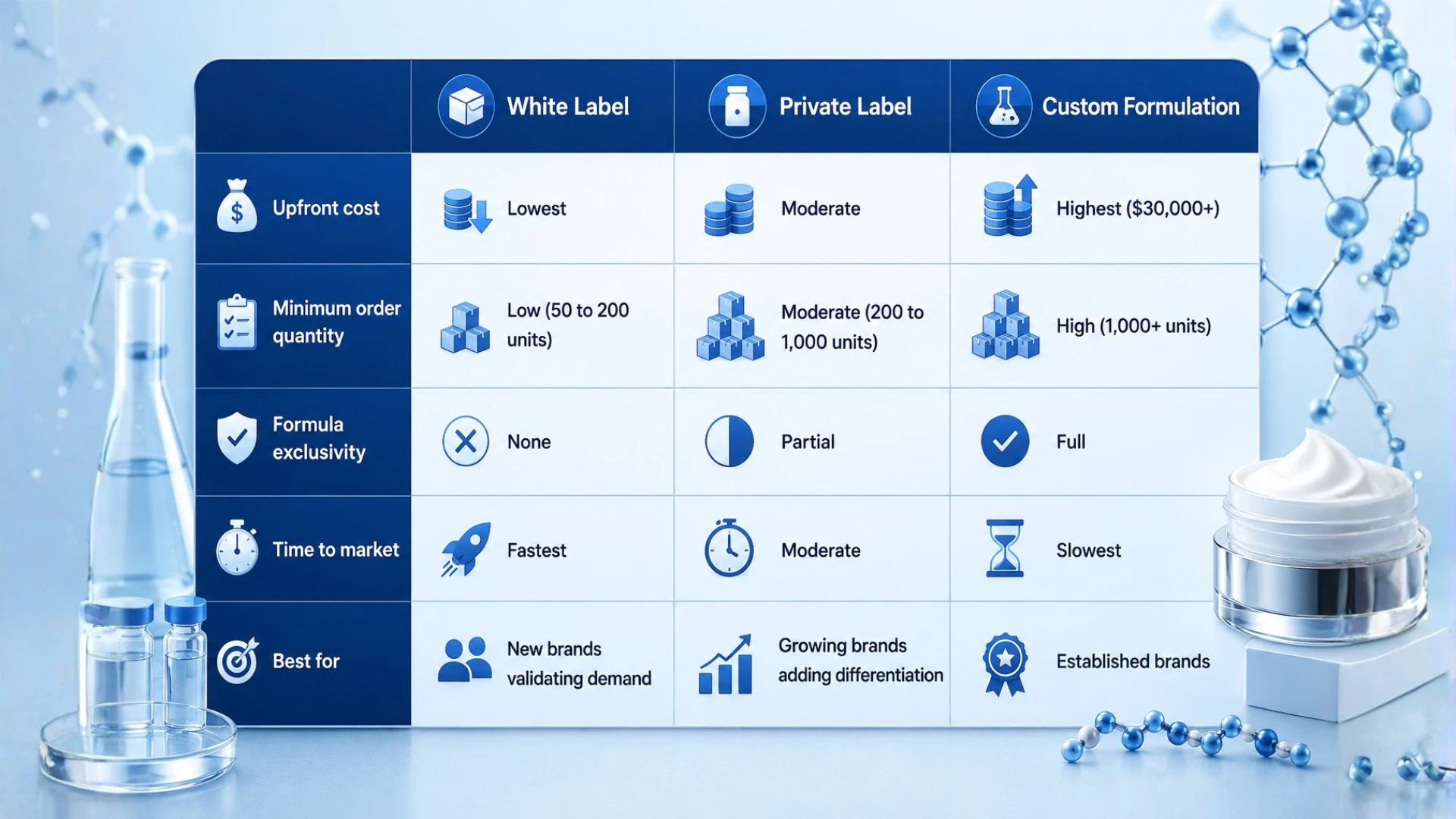
White label peptides
These are standardized, pre-formulated products that multiple brands purchase from the same manufacturer and sell under their own branding.
The formula is identical across all brands that buy it. You are essentially purchasing the same serum or collagen powder that other brands are also selling, just with your label on it.
White label is the fastest and lowest-cost entry point. Minimum order quantities can be as low as a few dozen to a few hundred units for skincare. The product has usually already been tested and documented, which means you get to the market quickly.
The limitation is differentiation. If your formula is identical to multiple other brands, your only competitive advantage is branding, pricing, and marketing.
Private label peptides
This category allows for better customization. You get to work with the manufacturer to modify a base formula, select specific ingredient concentrations, add or remove components, or develop a product to your specification. The formula may not be completely exclusive, but it is customized to your brief.
Full custom formulation, where you develop a completely proprietary formula from scratch, is the most expensive route.
In this category, you should expect minimum orders of thousands of units and total investment of $30,000 or more before your first sale, including formulation, testing, and documentation fees.
Startup Costs for a Peptide Brand in 2026
One of the most common reasons peptide businesses struggle in their first year is that founders underestimate what it costs to launch.
Below is a cost analysis of how much it costs to run a peptide brand. But keep in mind that actual costs will vary depending on your location, supplier relationships, product complexity, and the specific vendors you work with.
Topical Peptide Skincare (White or Private Label)
.webp)
Collagen Peptide Supplements (Private Label)
.webp)
Telehealth Peptide Clinic
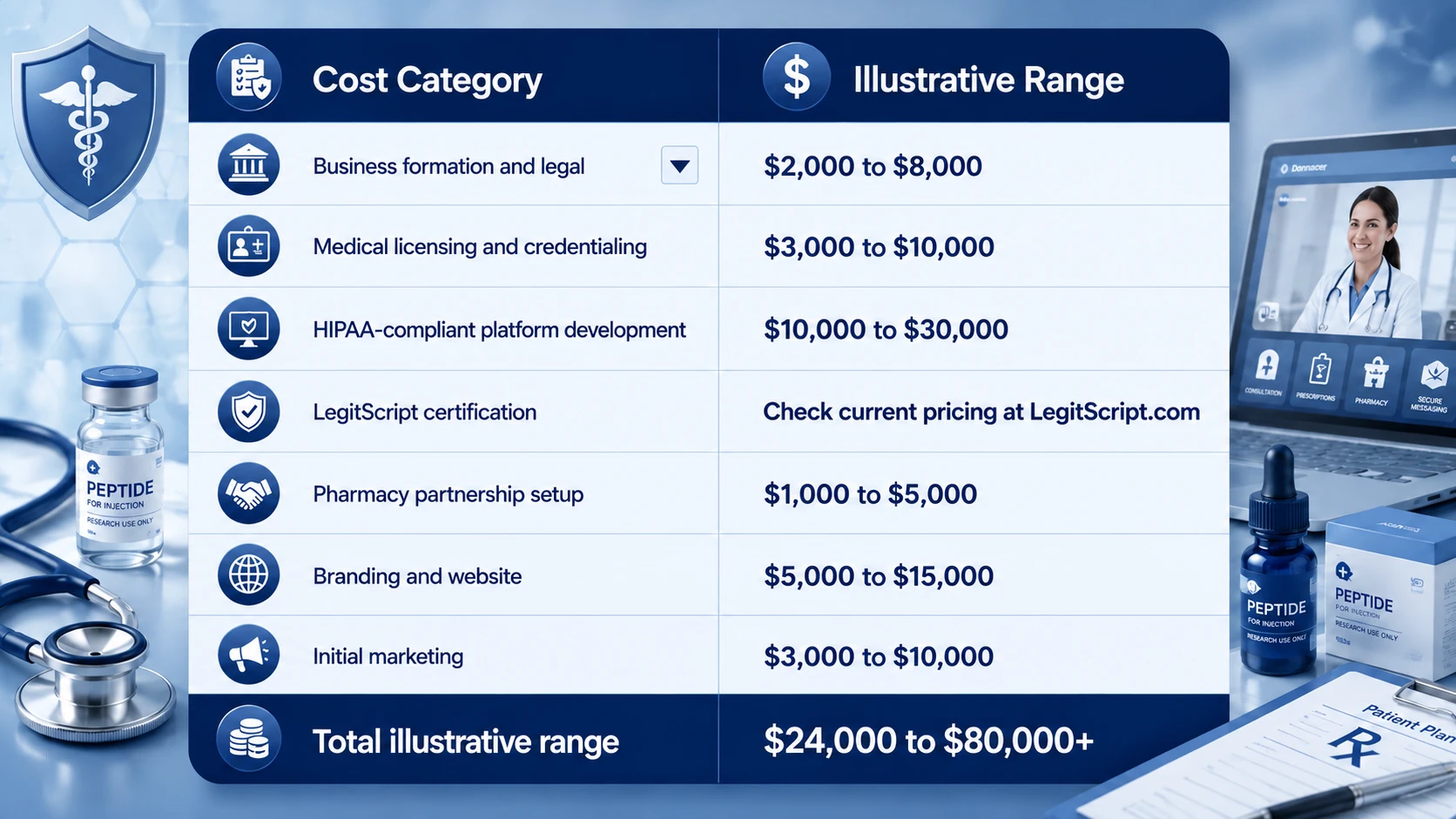
None of these models break even in the first three months. This means that you should plan for 12 to 18 months of cash flow before your business reaches profitability.
How Long Does It Take to Launch a Peptide Brand?
The timeline varies depending on your business model and how prepared you are at each stage. Check the image below for an estimated timeline:
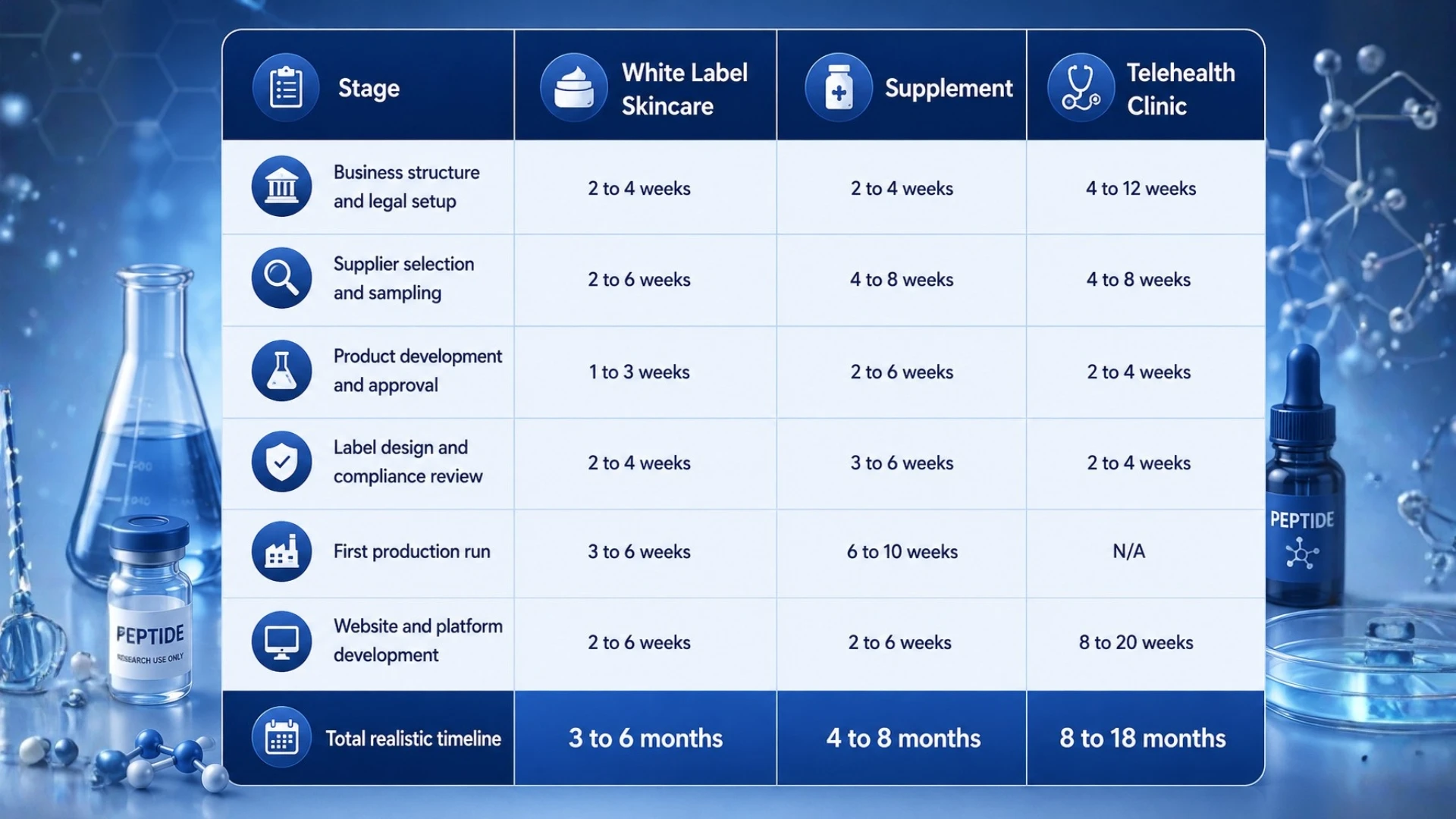
The biggest delay factors are:
- Supplier sampling rounds
- Label compliance reviews
- Platform development for telehealth models
To avoid these delays, you’d need to have your business structure, branding direction, and compliance strategy ready before you start sourcing.
How to Market a Peptide Brand
Marketing a peptide brand is harder than marketing most consumer products. Platform restrictions on health claims, supplement advertising, and anything that sounds like a drug claim mean you need a very thoughtful approach to every marketing and sales channel.
Organic Content and SEO
This is the highest-value long-term channel for peptide brands. Consumers intensely research peptides before buying.
They search terms like "copper peptides vs retinol," "best collagen for joints," "peptide serum for fine lines," and "how do peptides work." An educational content strategy that answers these questions builds organic visibility that pays you dividends for years.
Learn to build your content around what your target customer is searching for, not around what you want to say about your product.
Micro-Influencer Marketing
Peptides are trust-driven. People want to see real results from real people before they buy something they are putting on their skin or in their body.
Sending free products to 20 to 30 micro-influencers in the 5,000 to 50,000 follower range who engage directly with your target customer is usually the highest-return marketing investment available to a new peptide brand under $10,000 in revenue.
The most important thing is specificity. A creator who talks specifically about anti-aging skincare for women in their 40s is worth more to a copper peptide serum brand than a general beauty creator with ten times the following.
Make sure any influencer content complies with FTC endorsement guidelines, including clear disclosure that the product was received for free.
Email Marketing
Collect every email and build a simple automated sequence. Use the following:
- A welcome email that explains your brand and why peptides are important
- A follow-up with educational content
- A third email with a specific offer is a functional starting sequence
Email is the most profitable marketing channel for most consumer brands once you have customers, and it is entirely within your control in a way that social platforms are not.
Paid Advertising and Peptide Brand Meta Ads
Running peptide brand Meta ads is possible, but it requires careful management, because Meta and Google both flag health-related advertising language.
What tends to get peptide ads approved:
- Appearance-based claims for skincare such as "for smoother-looking skin"
- General wellness language for supplements such as "supports your daily routine"
- Lifestyle-focused creative that shows the product in context without making explicit health claims
- Educational angles that inform rather than claim
What commonly triggers rejection or account review:
- Language implying treatment, cure, or clinical effect
- Before-and-after imagery in health-related categories. This does not automatically result in rejection but frequently triggers ad review and increased scrutiny. Use with caution and ensure all imagery complies with current platform policies and FTC guidelines
- Terms like "anti-inflammatory," "healing," "repair," or "regeneration" in ad copy
- Promoting specific peptide compound names associated with restricted substances
The safest approach to paid advertising for peptide brands is to test organic content first, identify what resonates with your audience, and then use paid budget to boost the content that people are already organically engaged with. This reduces the risk of building campaigns on copy that will trigger compliance flags.
TikTok and Instagram
Effective content formats include product demonstrations showing how and when to use the product; skincare routines that feature your product naturally; testimonials and personal experiences that comply with FTC endorsement guidelines, including clear disclosure of any gifted or sponsored relationship; and educational content explaining what peptides are and how they work.
Exercise caution with before-and-after content. Platform policies and FTC guidelines require that testimonials reflect results and include appropriate disclosures. Content that implies clinical or medical results can be removed and may affect your account standing.
Product demonstrations, skincare routines, and educational explainers are usually better formats and are more effective for building long-term audience trust than before-and-after content.
Common Mistakes Founders Make When Starting a Peptide Brand
- Choosing the wrong model: Attempting to build a consumer brand in research or injectable peptides without understanding the regulatory requirement is the single most expensive mistake in this industry
- Making prohibited claims: Claiming your peptide serum "rebuilds collagen" or your supplement "reverses aging" risks turning your product into an unapproved drug. Review your marketing copy against current FDA and FTC claim guidelines before you publish anything. When in doubt, consult a regulatory professional
- Skipping validation: Ordering 1,000 units of a product before confirming anyone wants to buy it is a fast way to lose $10,000. Validate with a waitlist, pre-orders, or sample testing before you commit to a full production run
- Underestimating startup costs: Most founders budget for product and website and forget to account for insurance, compliance review, photography, shipping, returns, and marketing. Use the illustrative cost breakdowns above as your planning baseline
- Choosing suppliers based on price alone: Reliable peptide suppliers provide Certificates of Analysis, batch testing documentation, clear manufacturing records, and reliable fulfillment timelines. Suppliers that cannot provide complete documentation create compliance problems and quality inconsistencies that damage your brand
- Trying to scale too quickly: Validate your core product and marketing channel before expanding your SKU range or entering new markets. Controlled growth produces better long-term outcomes than aggressive early expansion
- Ignoring digital infrastructure: For telehealth peptide clinics especially, the website is the operational center of the entire business. Intake forms, patient data, scheduling, and fulfillment coordination all go through it, so you need to build it properly
Delaying compliance planning. Some founders focus heavily on branding and product sourcing while assuming regulatory requirements can be addressed after launch. In the peptide space, this is dangerous. Compliance affects your website structure, marketing language, provider workflows, patient communication systems, and data storage.
Fixing compliance problems after launch also requires rebuilding major parts of your business, so it’s always best to prioritize compliance from the very first day.
Wrapping Up
If you want help building the marketing and ecommerce strategy for your peptide brand, book a free consultation with Pro Marketer.
We work with supplement and wellness brands at every stage of growth to build the digital systems that turn compliant products into profitable, scalable businesses.
FAQs
1. Can you dropship peptides?
Dropshipping peptide skincare or collagen supplements is technically possible, but you have to remain legally responsible for product safety, labelling, and claims regardless of whether you hold inventory.
Your supplier must provide Certificates of Analysis, GMP documentation, and compliant labelling for every product.
For skincare brands, MoCRA facility registration and product listing requirements may apply depending on your business size. The small business exemption (under $1 million average annual gross sales) may apply, but only if your products do not fall into excluded categories such as eye cosmetics, injectable products, or products that alter appearance for more than 24 hours.
Always review current FDA guidance or consult a regulatory professional before assuming you are exempt.
2. Is it legal to sell peptides in the US?
Yes, with important distinctions. Topical peptide skincare products classified as cosmetics and collagen peptide dietary supplements are both legal to sell in the US under their respective regulatory frameworks.
Research peptides can legally be sold for laboratory research purposes to qualified buyers, but they cannot legally be marketed or sold for human consumption. Many are unapproved drugs under FDA definitions.
The regulatory standards for specific compounds like BPC-157 and TB-500 are actively changing in 2026, with the FDA's Pharmacy Compounding Advisory Committee reviewing several peptides for 503A compounding eligibility.
3. How do you market a peptide brand without getting ad accounts banned?
Avoid language implying treatment, healing, repair, or clinical results. Use before-and-after imagery cautiously in health and wellness categories, as it frequently triggers increased ad review and scrutiny even when it does not automatically result in rejection.
Ensure any results shown comply with FTC guidelines. And never promote compound names associated with restricted substances.
For telehealth or prescription services, obtain LegitScript certification before running paid search campaigns. Build educational and lifestyle content organically first before using paid budget.
4. What is the difference between a research peptide company and a telehealth peptide clinic?
A research peptide company sells compounds for laboratory research purposes to qualified researchers, labs, and universities. Products cannot be marketed for human consumption, and enforcement primarily targets sellers making human use claims or selling to consumers rather than research buyers.
A telehealth peptide clinic is a licensed medical practice where providers consult patients remotely, prescribe treatments, and coordinate fulfillment through licensed pharmacies. This includes traditional pharmacies for FDA-approved medications and licensed compounding pharmacies where legally permitted under applicable law.

.svg)

.avif)

.svg)