
TABLE OF CONTENTS
Hair Transplant Market Size in 2026: What the Numbers Say
What Is Driving Hair Transplant Market Growth in 2026
More people are losing their hair
Younger patients are not waiting
Women are a growing part of the market
Social media has normalized the procedure
Technology has made the procedure better and faster
Medical tourism is reshaping where patients get treated
Investment in aesthetic healthcare is increasing
Hair Transplant Market Segmentation
By Procedure: Follicular Unit Extraction (FUE) Is Leading the Market
By Gender: Males Dominate, But Female Growth Is Accelerating
By Service Provider: Clinics Lead, But Surgical Centers Are Growing Fast
Regional Analysis: Where the Hair Transplant Market Is Growing
North America: Largest Revenue Share
Asia-Pacific: Fastest-Growing Region
Europe: Good Medical Tourism Dynamics
Middle East and Africa: Growing Market With Turkey as the Global Hub
So, What Do All These Mean for Supplement and Wellness Brands?
- How big is the global hair transplant market in 2026?
- What is the hair transplant market growth rate in 2026?
- Which procedure dominates the hair transplant market?
- Which region leads the global hair transplant market?
- Why is Turkey so important to the global hair transplant industry?
- What is driving hair transplant market growth?
- What is the hair transplant market forecast through 2030 and beyond?
- Who are the key players in the hair transplant market?


Share via:
The global hair transplant market is valued at approximately $10.74 billion to $12.55 billion in 2026, depending on the research methodology used. The market is growing at a CAGR of between 19.4% and 22.1% and is projected to reach $25.72 billion to $54.90 billion by 2030 to 2034. Follicular Unit Extraction (FUE) is the dominant procedure type, North America leads by revenue, and Asia-Pacific is the fastest-growing region. Medical tourism, particularly through Turkey and India, is reshaping how and where patients access hair restoration globally.
Hair loss is one of the most common medical concerns in the world. Up to 80% of men and up to 50% of women will experience androgenetic alopecia (the clinical term for pattern hair loss), at some point in their lifetime.
In the United States alone, androgenetic alopecia affects an estimated 50 million men and 30 million women. Two-thirds of American men show noticeable hair loss by age 35.
For decades, most people lived with it. They tried topical treatments, switched shampoos, or simply accepted what was happening. Hair transplant surgery existed, but it was expensive, the results were usually uneven, and the stigma around cosmetic procedures kept many people away.
But that has changed dramatically.
This article covers everything you need to know about the hair transplant market size in 2026, the trends driving that growth, where the biggest opportunities are geographically, and what the forecasts say about where the industry is headed.
Hair Transplant Market Size in 2026: What the Numbers Say
Before looking at the hair transplant statistics, here is what you need to know about how the market is measured.
Different research firms arrive at very different numbers depending on whether they measure only surgical procedures, the broader hair restoration market (including non-surgical treatments and products), or the entire aesthetic hair category. That is why you will see figures ranging from $6.98 billion to $12.55 billion in 2026 depending on which report you read.
The most widely cited valuation of the global hair transplant market size in 2026 comes from The Business Research Company, which places the market at $12.55 billion in 2026, up from $10.51 billion in 2025. This figure includes surgical procedures, hair restoration products such as serums, drugs, and multivitamins, and supporting therapies including platelet-rich plasma, laser, and stem cell treatments.
Fortune Business Insights places the hair transplant market size at $11.11 billion in 2026, growing to $54.90 billion by 2034 at a CAGR of 22.10%.
Towards Healthcare estimates the market at $10.74 billion in 2026, projecting growth to $59.89 billion by 2035 at a CAGR of 21.04%.
The hair transplant industry statistics below summarizes the key data points across major research sources:
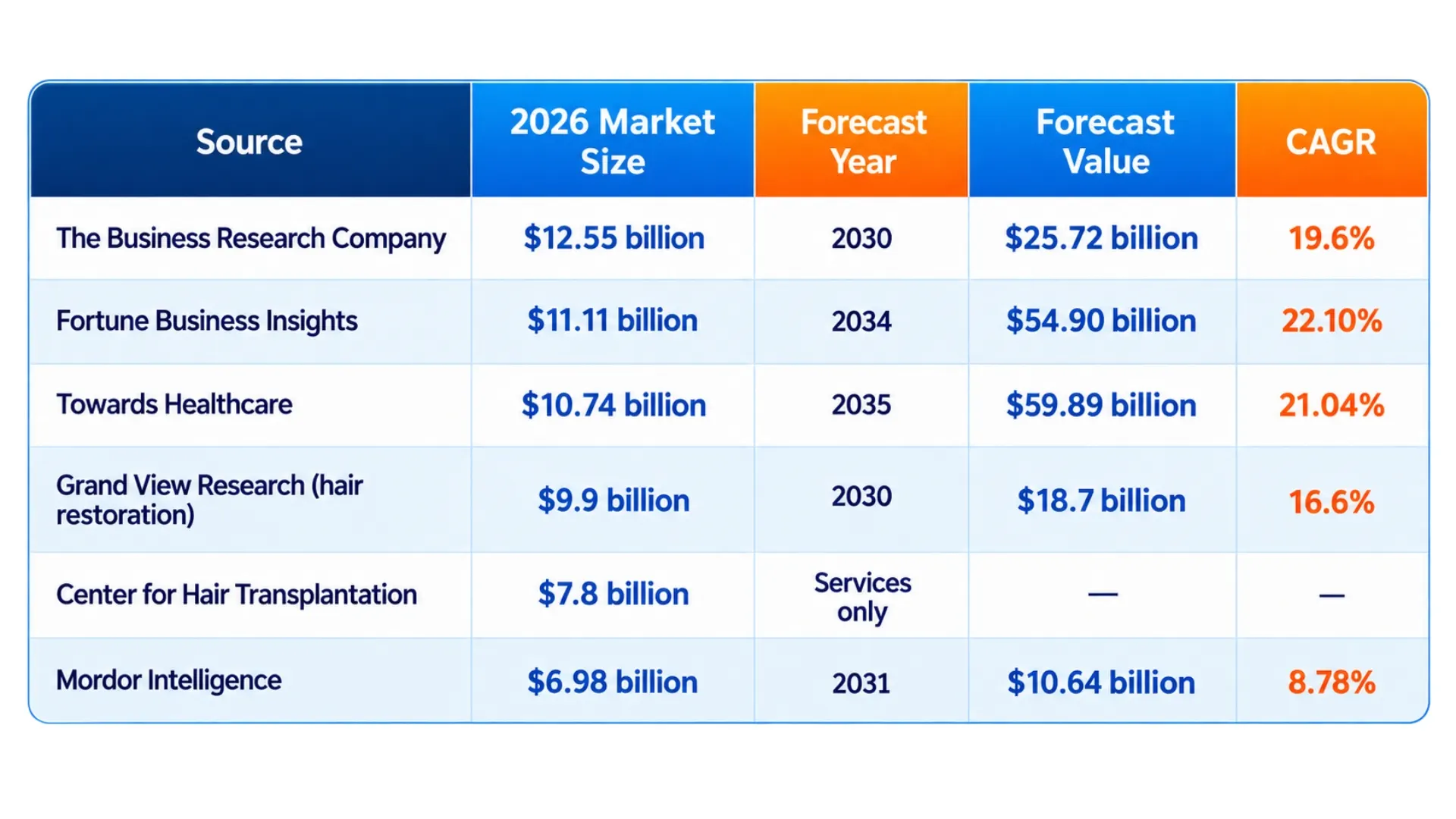
Numbers vary depending on who you ask and what they measure. But every single forecast points in the same direction: The global hair transplant market is growing fast.
What Is Driving Hair Transplant Market Growth in 2026

The hair transplant market is growing because of multiple trends. Several forces are happening at the same time, and each one strengthens the others. These trends include:
More people are losing their hair
By age 50, about 85% of men and 40% of women experience noticeable hair loss. Around 6.5 million men and 8 million women in the UK are currently experiencing it.
As global populations age and environmental factors, including pollution and chemical exposure, continue to play a role, the number of people looking for a solution grows every year.
Younger patients are not waiting
One of the biggest changes in the hair transplant industry in recent years is who is actually getting the procedure. Millennials now represent 46% of first-time consultations and 51% of completed surgeries in the United States. This proves that the mindset has changed.
Younger men are no longer waiting until hair loss is severe before seeking treatment. They are addressing it early, before it advances to a stage that is harder to treat. This change toward preventive restoration is expanding the total addressable market.
Women are a growing part of the market
Hair transplants were historically a male-dominated category. But now, women make up 20 to 30 percent of hair transplant patients at many clinics.
At some point in their lives, one in three women experiences hair loss. For many women, hair loss carries a heavier psychological burden than it does for men, which is creating stronger demand for permanent solutions.
The hair restoration market is responding with techniques and clinic experiences designed specifically for female patients.
Social media has normalized the procedure
Nearly 80% of patients report being influenced by celebrity endorsements and online testimonials when deciding on hair restoration. It means that the biggest driver of patient acquisition for most clinics is not traditional advertising. It is organic peer content.
People share their results. Celebrities talk openly about their procedures. Before-and-after content on TikTok and Instagram reaches audiences in ways conventional marketing never could.
The stigma around cosmetic procedures has essentially collapsed in the past five years, and the hair transplant industry is one of the biggest beneficiaries.
Technology has made the procedure better and faster
The average number of sessions needed to achieve a patient's desired result dropped from 3.4 in 2019 to 1.4 in 2021, showing major advances in technique and planning.
FUE with sapphire blades and micromotor punches has become the new standard because they provide better incisions, less scalp trauma, and improved grafting. Robotic systems, including the ARTAS iX, now speed up graft implantation to up to 1,000 grafts per hour while reducing surgery time by about 25% compared to traditional methods.
AI-driven imaging tools also help surgeons design hairlines and plan graft placement with a level of precision previously impossible.
These better outcomes mean more satisfied patients, more referrals, and better overall market growth.
Medical tourism is reshaping where patients get treated
Turkey and India offer hair transplant packages at prices 50 to 70% lower than in Western nations.
Turkey alone generates approximately $2.5 billion in annual revenue from hair transplant procedures and receives over 1.2 million international patients every year for aesthetic procedures, with hair restoration accounting for roughly 30% of all medical tourism arrivals.
Istanbul hosts more than 500 licensed clinics. As of 2026, 58% of European hair transplant patients now travel abroad for their procedure, and the overwhelming majority choose Turkey. That is a 7-point increase in Turkey's market share since 2023.
Investment in aesthetic healthcare is increasing
Clinics are expanding, new specialized transplant centers are opening, and technology companies are investing in robotic and AI-driven solutions.
In April 2024, Insparya partnered with IGHS to bring advanced hair health services to the Oman International Hospital. In November 2024, Assure Clinics raised Rs 15 crore in seed funding. In February 2025, HairOriginals closed a $5 million Series A round.
Capital is flowing into the industry because the demand is high, the margins are attractive, and the global patient pool keeps growing.
Hair Transplant Market Segmentation

Understanding the hair transplant industry means looking at how it is divided by procedure, patient group, and service setting.
By Procedure: Follicular Unit Extraction (FUE) Is Leading the Market
Follicular Unit Extraction (FUE) is the dominant procedure in the global hair transplant market. FUE accounts for approximately 65% of global procedure volume in 2026, according to the Center for Hair Transplantation. Mordor Intelligence places FUE's market share at 58.62% in 2025, while Persistence Market Research estimates it at 61.7% for 2026.
FUE dominates because:
- It doesn't leave the linear scar associated with the older strip-harvesting method, known as Follicular Unit Transplantation
- Recovery is faster
- Results look more natural
- Patients can also return to normal activity sooner
For anyone researching hair transplant options today, FUE is almost always the first option clinics recommend.
But keep in mind that Follicular Unit Transplantation still has its own role. It is more cost-effective for patients who need a large number of grafts in a single session, and it remains a practical choice when donor hair density allows it.
Combining FUT and FUE is the fastest-growing procedure segment, projected to grow at a CAGR of 14.88% through 2031, according to Mordor Intelligence, because it gives surgeons maximum flexibility when treating patients with complex or advanced hair loss.
Direct Hair Implantation (DHI) is gaining traction as a variation of FUE that uses a specialized implantation tool called a Choi pen. It allows surgeons to extract and implant follicles in a single step without creating recipient sites first, which can reduce trauma to the scalp and improve graft survival in experienced hands.
Robotic FUE is the fastest-growing sub-segment of FUE. Over 30% of clinics worldwide now use robotic systems. The ARTAS iX, launched by Venus Concept, can place up to 1,000 grafts per hour and speeds up harvesting by approximately 25% compared to traditional manual extraction.
Robotic adoption is concentrated in North America and Western Europe, where the capital investment is more accessible, but the technology is spreading to high-volume medical tourism markets as well.
By Gender: Males Dominate, But Female Growth Is Accelerating
According to ISHRS data cited by Fortune Business Insights, 85.7% of male patients underwent surgical transplantation in 2026, while 61.8% underwent non-surgical procedures.
The female segment is smaller but growing faster. Mordor Intelligence projects the female cohort will expand at a CAGR of 10.74% through 2031.
At some point in their lives, one in three women experiences hair loss. By age 50, approximately 40% of women are affected by androgenetic alopecia. Historically, the barrier has been cultural rather than medical.
Hair loss in women carries psychosocial effects, which have kept many women away from seeking treatment even when effective options were available. This is changing as social media normalizes female hair restoration and as clinics develop techniques and patient experiences designed specifically for women.
By Service Provider: Clinics Lead, But Surgical Centers Are Growing Fast
Dermatology clinics held 54.93% of the hair transplant services market in 2025, according to Mordor Intelligence, and are growing at 11.34% annually.
According to both Fortune Business Insights and Towards Healthcare, patients mostly used hospitals for hair-loss surgeries because of their established infrastructure, access to advanced technology, and the trust patients have in them when considering surgical procedures.
However, surgical centers are becoming the fastest-growing service provider segment. They focus exclusively on hair restoration, allowing them to invest in specialized equipment, develop unique patient experiences, and build the volume and expertise that produce consistently good results.
As the market matures and awareness grows, more patients are seeking specialist surgical centers rather than general hospitals.
Regional Analysis: Where the Hair Transplant Market Is Growing

The global hair transplant market varies widely by region. Revenue concentration, growth rates, and patient profiles vary across different geographies.
North America: Largest Revenue Share
North America was the largest region in the global hair transplant market in 2025 and 2026, according to all major research sources.
The reasons are because:
- High disposable incomes support cosmetic spending
- A large population with high prevalence of androgenetic alopecia creates strong demand
- Advanced medical infrastructure and a high concentration of board-certified hair restoration surgeons give patients confidence in outcome quality
- The regulatory guidelines, while demanding, have created a high standard of clinical care, making the US one of the most trusted places globally for patients looking for surgical hair restoration
Hair transplant procedure costs in the United States range from $6,000 to $15,000 depending on graft count, technique, and surgeon experience.
Canada has a similarly strong market, with several world-class clinics offering a range of procedures at prices that are competitive with the US. The Canadian market also benefits from proximity to the large US patient base, thereby attracting some cross-border patients.
Asia-Pacific: Fastest-Growing Region
Asia-Pacific is the fastest-growing region in the global hair transplant market. Mordor Intelligence projects Asia-Pacific will grow at a CAGR of 12.41% through 2031, the highest of any region. Fortune Business Insights placed Asia-Pacific as the dominant region by market share at 31.65% in 2025, generating $1.88 billion.
Several forces are driving Asia-Pacific's growth. Hair loss is prevalent across the region, especially androgenetic alopecia, which affects large populations in China, India, and South Korea.
Over 200 million people in China alone report hair loss unrelated to aging, and 41.9% of those affected are aged 26 to 30.
India conducts over 350,000 hair transplant procedures annually, many of which are from international medical tourists. India and Thailand see 20 to 25% annual growth in cosmetic procedure inflows.
Medical tourism infrastructure across India, Thailand, and South Korea is expanding rapidly, attracting patients from the Middle East, Africa, and Europe.
Europe: Good Medical Tourism Dynamics
Europe is a highly important region in the global hair transplant market. The European hair transplant market was valued at $1.8 billion in 2026 and is projected to reach $3.81 billion by 2035 at a CAGR of 8.70% according to MarkWide Research.
The UK and Germany are the largest individual markets within Europe. More than 15.4 million people in the UK are currently dealing with hair loss, affecting approximately 6.5 million men and 8 million women.
Germany also attracts medical tourists from across Europe and beyond, thanks to its advanced clinics and reputation for technical precision.
The most significant dynamic in the European hair transplant market is outbound medical tourism. 58% of European hair transplant patients now travel abroad for their procedure, mostly to Istanbul.
Middle East and Africa: Growing Market With Turkey as the Global Hub
Turkey generates approximately $2.5 billion in annual revenue from hair transplant procedures, receives over 1.2 million international patients every year for aesthetic procedures, and hosts more than 500 licensed clinics in Istanbul. Hair restoration procedures account for roughly 30% of all medical tourism arrivals in the country.
Turkey is the default destination for European patients looking for affordable hair restoration because of the combination of:
- Highly specialized surgical teams, competitive pricing
- AI-assisted planning
- An all-inclusive patient experience that includes accommodation and logistics.
These all-inclusive packages in Istanbul range from €2,990 to €4,500, compared to $6,000 to $15,000 for equivalent procedures in the United States.
Approximately 38.1% of the male population in the UAE has male pattern baldness. Saudi Arabia has the highest number of bald men in the Middle East and Africa, at 39.75% of the total male population.
So, What Do All These Mean for Supplement and Wellness Brands?

Hair transplant market statistics show how people feel about hair loss and how much they are willing to spend to fix it.
Hair loss is one of the most emotionally charged health concerns a consumer can face. Research shows it affects confidence, self-image, and quality of life in ways that drive real purchasing decisions. And the data shows those purchasing decisions are getting bigger.
For supplement brands, this means 49% of potential hair transplant patients who cite cost as a barrier aren't giving up on their hair. They are looking for alternatives.
The 37% hesitant about surgery are doing the same. These are motivated, high-intent consumers who want a solution but haven't committed to surgery. Hair health supplements, like biotin, collagen peptides, saw palmetto, zinc, and DHT-blocking formulations, can be provided as a remedy for this category of people.
The same social media environment driving awareness of hair transplant procedures is also driving awareness of hair supplements. The same demographic change bringing younger patients into clinics is bringing younger consumers into the supplement category. The same shift toward preventive health management that is pushing people to seek treatment earlier is also creating demand for supplements that support healthy hair before loss occurs.
So, if you are building or growing a supplement brand in the hair health industry and want help with the paid media, email, and content systems that reach this audience, book a free consultation with Pro Marketer. We help supplement and wellness brands build marketing systems that drive consistent, scalable revenue.
FAQs
1. How big is the global hair transplant market in 2026?
Estimates range from $6.98 billion to $12.55 billion, depending on the research firm and what they measure. The variation reflects different market definitions rather than conflicting data. All sources agree the market is growing rapidly.
2. What is the hair transplant market growth rate in 2026?
The hair transplant market CAGR ranges from 8.78% to 22.10% depending on the source and forecast period. Every major research firm agrees the hair transplant industry is one of the fastest-growing segments in aesthetic healthcare.
3. Which procedure dominates the hair transplant market?
Follicular Unit Extraction (FUE) accounts for approximately 65% of global procedure volume in 2026. It is preferred because it leaves no linear scar, offers faster recovery, and produces more natural-looking results than the older FUT strip method. Robotic FUE is the fastest-growing sub-segment.
4. Which region leads the global hair transplant market?
North America leads by revenue with approximately 33.29% of market share. Asia-Pacific is the fastest-growing region, projected to grow at a CAGR of 12.41% through 2031.
5. Why is Turkey so important to the global hair transplant industry?
Turkey generates approximately $2.5 billion in annual hair transplant revenue, hosts over 500 licensed clinics in Istanbul, and receives over 1.2 million international patients annually for aesthetic procedures.
All-inclusive packages range from €2,990 to €4,500, compared to $6,000 to $15,000 in the US. As of 2026, 58% of European hair transplant patients travel abroad, and the majority choose Turkey.
6. What is driving hair transplant market growth?
The main drivers are rising prevalence of androgenetic alopecia, younger patients seeking earlier treatment, social media normalizing cosmetic procedures, advances in robotic and AI-assisted surgical technology, expanding medical tourism infrastructure, and growing investment in aesthetic healthcare globally.
7. What is the hair transplant market forecast through 2030 and beyond?
The Business Research Company projects it to reach $25.72 billion by 2030. Fortune Business Insights projects it to reach $54.90 billion by 2034. Towards Healthcare projects $59.89 billion by 2035. All major forecasts point to sustained double-digit growth.
8. Who are the key players in the hair transplant market?
Major players include Venus Concept, Bosley, Bernstein Medical, DHI Medical Group, Hair Club, NeoGraft, Asmed Hair Transplant Center, HLC Hair Transplant Center, and Insparya. The market is fragmented with no single dominant player.

.svg)

.avif)

.svg)