TABLE OF CONTENTS
Why TikTok Are Strict About Supplement Ads
What Changed for Supplement TikTok Ads in 2026
Can You Advertise Supplements on TikTok?
What You Cannot Say in TikTok Supplement Ads
Disease treatment or cure claims
Exaggerated or guaranteed results
FDA or regulatory endorsement claims
Completely prohibited supplement categories on TikTok Shop
What You Can Say in TikTok Supplement Ads
Structure/function claims with substantiation
Ingredient claims tied to normal function
How to Write a Compliant TikTok Supplement Ad Script
The ingredient education structure
- Can you advertise supplements on TikTok?
- How do TikTok supplement ads differ from Meta supplement ads?
- What is the TikTok Healthcare and Pharmaceutical Advertising Policy?
- How much do TikTok supplement ads cost?
- What happens if your TikTok supplement ad gets rejected?
- Do TikTok supplement ads need the DSHEA disclaimer?


Share via:
Quick Answer: You can advertise supplements on TikTok in 2026, but the rules are strict and different from every other platform you have used. Structure/function claims like "supports immune health" are allowed. Disease claims like "cures inflammation" are not. Before-and-after images are banned for supplements. GLP-1 mentions in any supplement ad are prohibited. And before you can run a single ad, you need to complete a category qualification process and submit product documentation.
What happens when you run a supplement TikTok ad, and it gets rejected within 24 hours?
Your answer would be to resubmit it, maybe with a tweaked headline. But what if it's rejected again and again? After repeated policy flags, TikTok will put your account under review. That means your product launch, supposed to happen within the month, is now on hold indefinitely.
Unfortunately, this scenario happens every week to supplement brands that treat TikTok like a cheaper version of Meta. It is not. TikTok is a completely different platform, with its own rules, enforcement systems, and standards for health and supplement advertising.
This article will tell you everything your supplement brand needs to know about running TikTok ads for supplements in 2026. You’ll learn what you can say, what you cannot, what changed this year, how the qualification process works, and how to write ad copy that converts without putting your account at risk.
Why TikTok Are Strict About Supplement Ads
TikTok's Healthcare and Pharmaceutical Advertising Policy, last updated August 2026, governs all health-related advertising on the platform, including supplements.
This means the rules governing your protein powder ad are closer to those governing a pharmaceutical company's ad than to those governing a clothing brand's ad. Why? Because of the following reasons:
- TikTok has a younger audience than platforms like Google, Meta, and YouTube: The platform has a duty-of-care obligation around health content reaching young people. A 19-year-old watching supplement content on their For You Page is different from a 45-year-old researching supplements on Google. TikTok's enforcement reflects that difference
- The platform's unique content format: On Google, your ad and your landing page are separate. On TikTok, everything appears in the same feed alongside organic content. An ad that looks like a creator testimonial has more influence than a clearly labelled banner ad. TikTok knows this and regulates supplement advertising accordingly
- Regulatory pressure: The Federal Trade Commission (FTC) issued its first six-figure fines against individual creators for inadequate disclosure in social commerce contexts in 2026. That enforcement reached TikTok directly and accelerated policy tightening across every health category, supplements included
To advertise supplements on TikTok, you need to be extremely careful with your claims to avoid suspension.
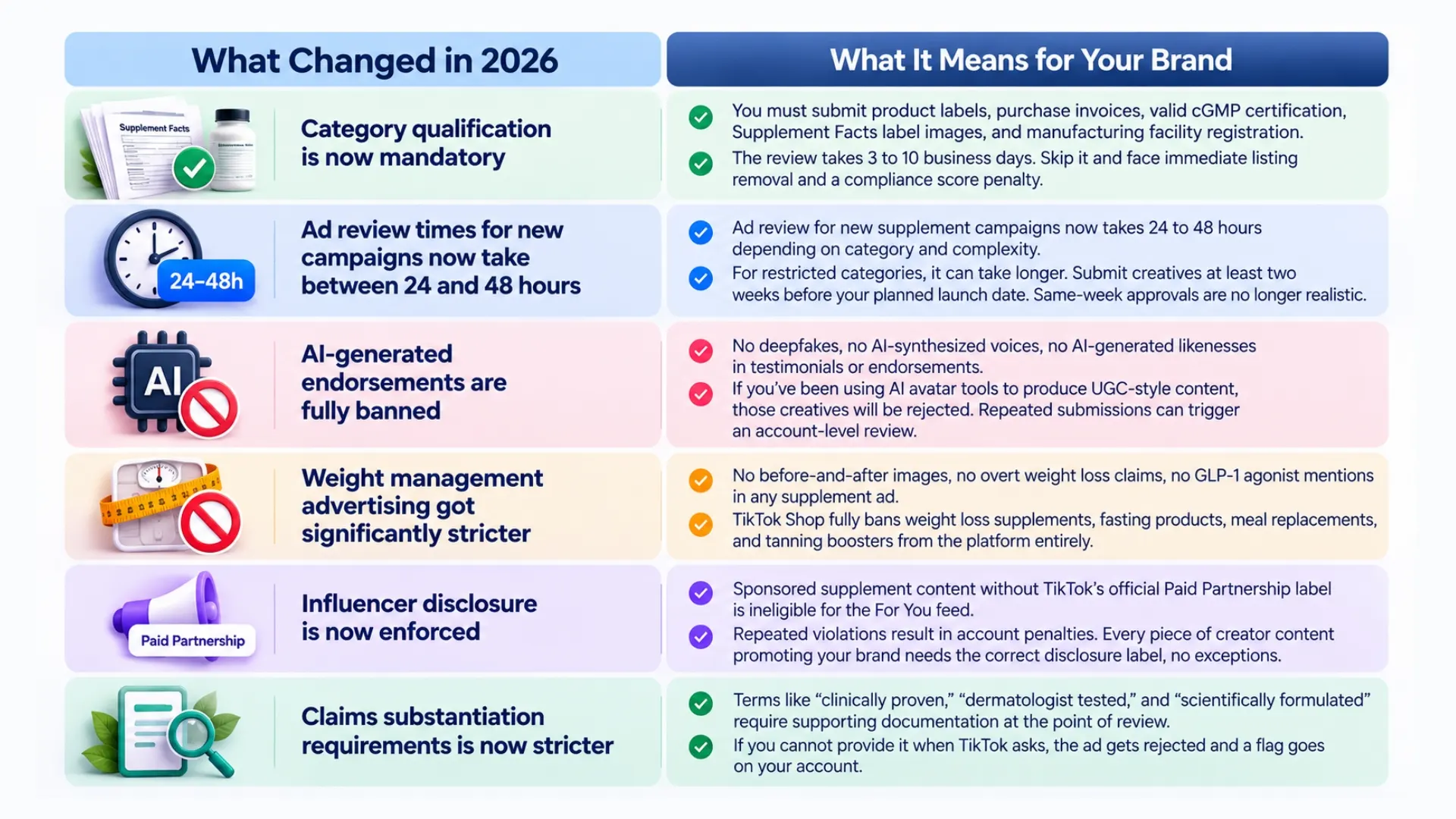
What Changed for Supplement TikTok Ads in 2026
If you ran supplement TikTok ads before 2026 and are just getting back into the platform, here is what has changed:
Can You Advertise Supplements on TikTok?
Yes. But it comes with conditions.
TikTok does not ban supplement advertising outright. It bans irresponsible supplement advertising.
The platform's Healthcare and Pharmaceutical Advertising Policy, last updated August 2026, allows supplement brands to run paid campaigns if they:
- Meet the qualification requirements
- Stay within the permitted claim framework
- Produce creative that doesn't trigger TikTok's automated content moderation system
Structure/function claims are permitted because they describe what a nutrient or ingredient does to support a normal body function. These claims include:
- "Supports immune health"
- "Promotes healthy digestion"
- "Helps maintain cardiovascular function"
These phrases describe an ingredient's role in a healthy body without implying your product treats, prevents, or cures anything.
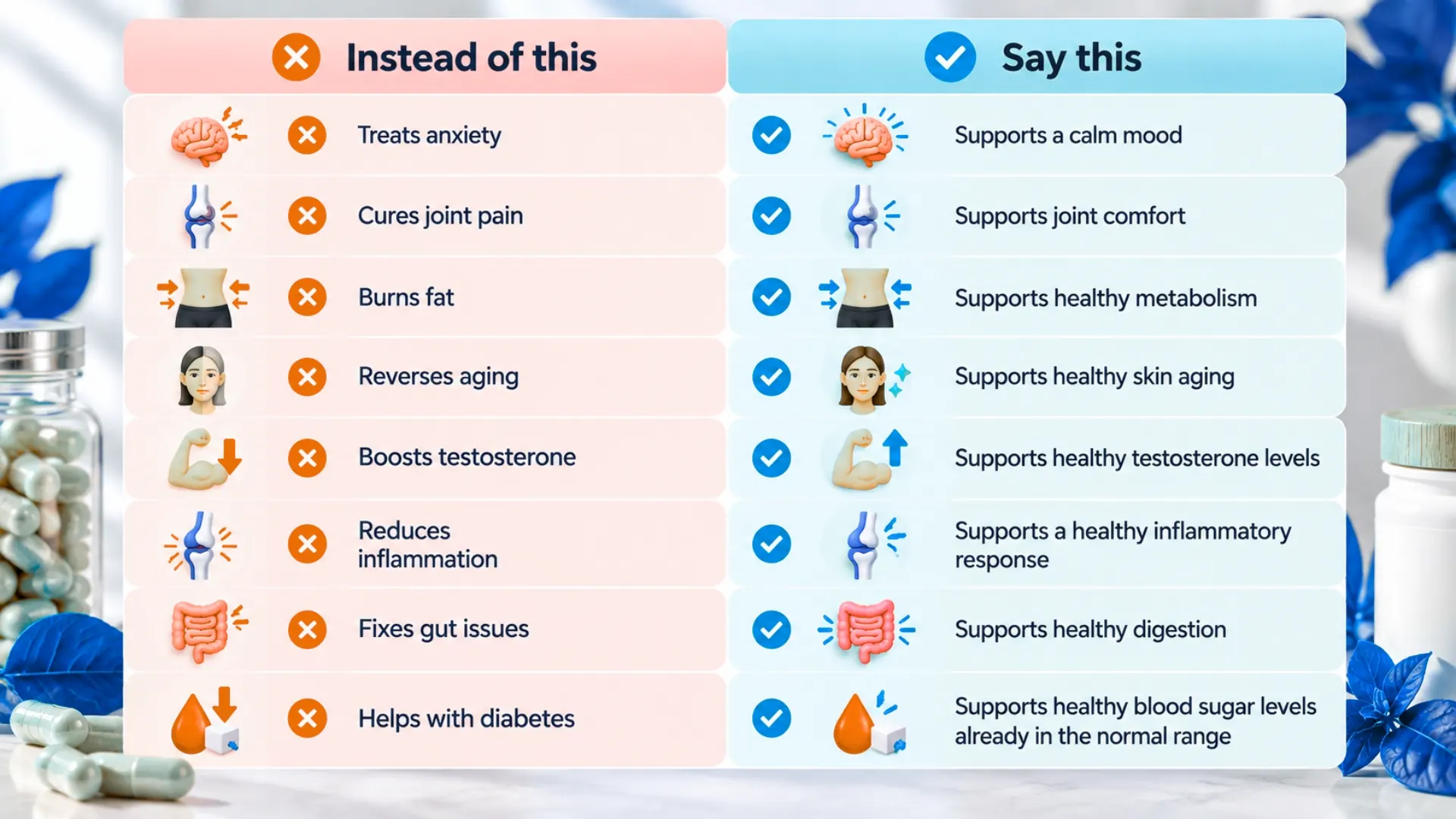
A disease claim does the opposite. It implies your product affects a disease or health condition and is therefore prohibited. These claims include:
- "Reduces inflammation"
- "Treats anxiety"
- "Helps with arthritis"
- "Cures gut issues"
These phrases turn your supplement into an unapproved drug in the eyes of both the FDA and TikTok's policy framework. TikTok's automated content moderation scans for this language specifically, and it is one of the most common reasons supplement ads get rejected before they ever reach a human reviewer.
Here is a simple test you can apply to every claim in your ad before you submit it. Ask yourself: does this claim describe a normal body function, or does it reference a disease or medical condition? If it references a disease, rewrite it.
The claim rewriting framework is straightforward once you understand the pattern. You are swapping a medical verb for a maintenance verb and describing normal function rather than a condition.
NOTE: Every supplement ad in the US must include the statement: "These statements have not been evaluated by the Food and Drug Administration. This product is not intended to diagnose, treat, cure, or prevent any disease." This must appear in your ad, either on screen as text or in a clearly readable disclaimer. It is both a Federal Trade Commission (FTC) requirement and a TikTok policy requirement. Missing it is one of the fastest ways to get a supplement ad rejected.
What You Cannot Say in TikTok Supplement Ads
This is where most supplement brands get into trouble. Not because they are trying to mislead anyone, but because the language that feels natural when describing a supplement is exactly what TikTok's automated system flags.
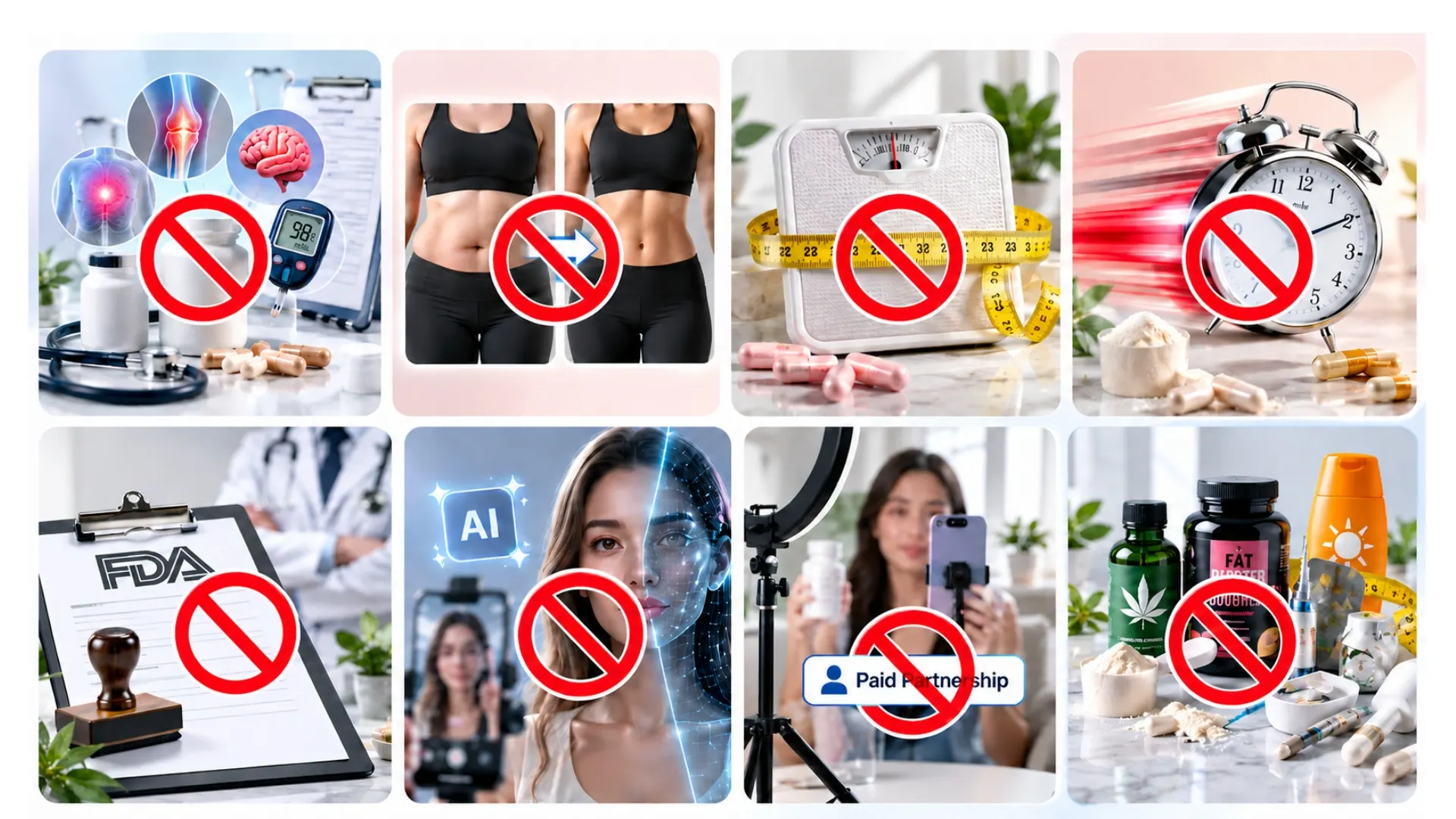
Here is a complete breakdown of what is prohibited.
Disease treatment or cure claims
Any statement that a product can cure, treat, mitigate, or prevent a specific disease or medical condition will result in immediate listing removal and a compliance score penalty.
This includes obvious examples like "cures diabetes" or "eliminates arthritis pain," but it also includes subtle language like "great for people with IBS" or "perfect for anyone dealing with inflammation."
If your ad references a named medical condition in connection with your product's benefits, it is a disease claim regardless of how carefully it is worded.
Before and after images
This is one of the most flagged content formats for supplement brands on TikTok.
Side-by-side comparison images showing physical body changes, whether weight, skin condition, or muscle mass, imply that your product caused the change, and that is a therapeutic claim in visual form.
TikTok's automated content moderation system looks for this format. This applies to your own images, repurposed customer testimonial images, and any visual that shows a physical transformation, even when no claim is made in the caption or script.
Weight loss claims
Any promise of weight loss, weight gain, fat reduction, or targeted body changes is prohibited. This includes guaranteed results, language implying effortless outcomes, and any reference to permanent results.
It also includes mentioning GLP-1 agonists in any supplement ad context, which TikTok added explicitly to its TikTok Shop Prohibited Products Policy in 2026.
Exaggerated or guaranteed results
Phrases like "works in 24 hours," "100% effective," "guaranteed results," and "permanent results" are prohibited. So are words that TikTok's automated system flags as engagement bait or misleading language.
Specific words that consistently trigger flags include "miracle," "cure," "secret," "hack," and "detox."
Swap them for words that pass the compliance check; examples include "experience," "story," "journey," "routine," "tutorial," and "real life." All these perform better and do not trigger automated flags.
FDA or regulatory endorsement claims
Implying that your product has been approved, endorsed, or certified by the FDA or any equivalent regulatory body when no such approval exists is prohibited.
This includes language like "FDA approved formula," "doctor endorsed," or "clinically approved."
It also covers implying regulatory validation through white-coat imagery, which carries the same implied claim as explicit language even without a direct statement.
AI-generated endorsements
TikTok's 2026 policy explicitly bans synthetic endorsements in advertising content.
If your creative uses an AI-generated face, an AI-synthesized voice, or an AI-generated likeness to simulate a customer testimonial or creator endorsement, TikTok will reject it.
This applies even if you disclose the AI-generated nature of the content in the caption.
Undisclosed paid partnerships
Any creator or influencer content promoting your supplement brand without TikTok's official Paid Partnership label is ineligible for the For You feed and subject to content suppression or removal. This applies to gifted product content as well as paid partnerships.
The FTC requires creators to disclose any material connection to a brand, which includes receiving free products, discounts, or any other benefit, not just cash payments. If a creator receives your supplement for free and posts about it without disclosing that relationship, both the creator and your brand are at risk.
TikTok enforces this directly through content suppression and account penalties, so gifted product campaigns carry the same disclosure requirement as paid ones.
Completely prohibited supplement categories on TikTok Shop
Some supplement categories cannot be sold or advertised on TikTok, regardless of how the content is framed. These include weight loss supplements, fasting products, prescription drugs, CBD products, meal replacements, tanning boosters, anabolic steroids, DHEA, ephedra, HGH, and products claiming to be as effective as prescription drugs.
What You Can Say in TikTok Supplement Ads
Here is what you can say on TikTok and how to use it effectively.
Structure/function claims with substantiation
You can describe what an ingredient or nutrient does to support normal body function, provided you can substantiate the claim with competent and reliable scientific evidence.
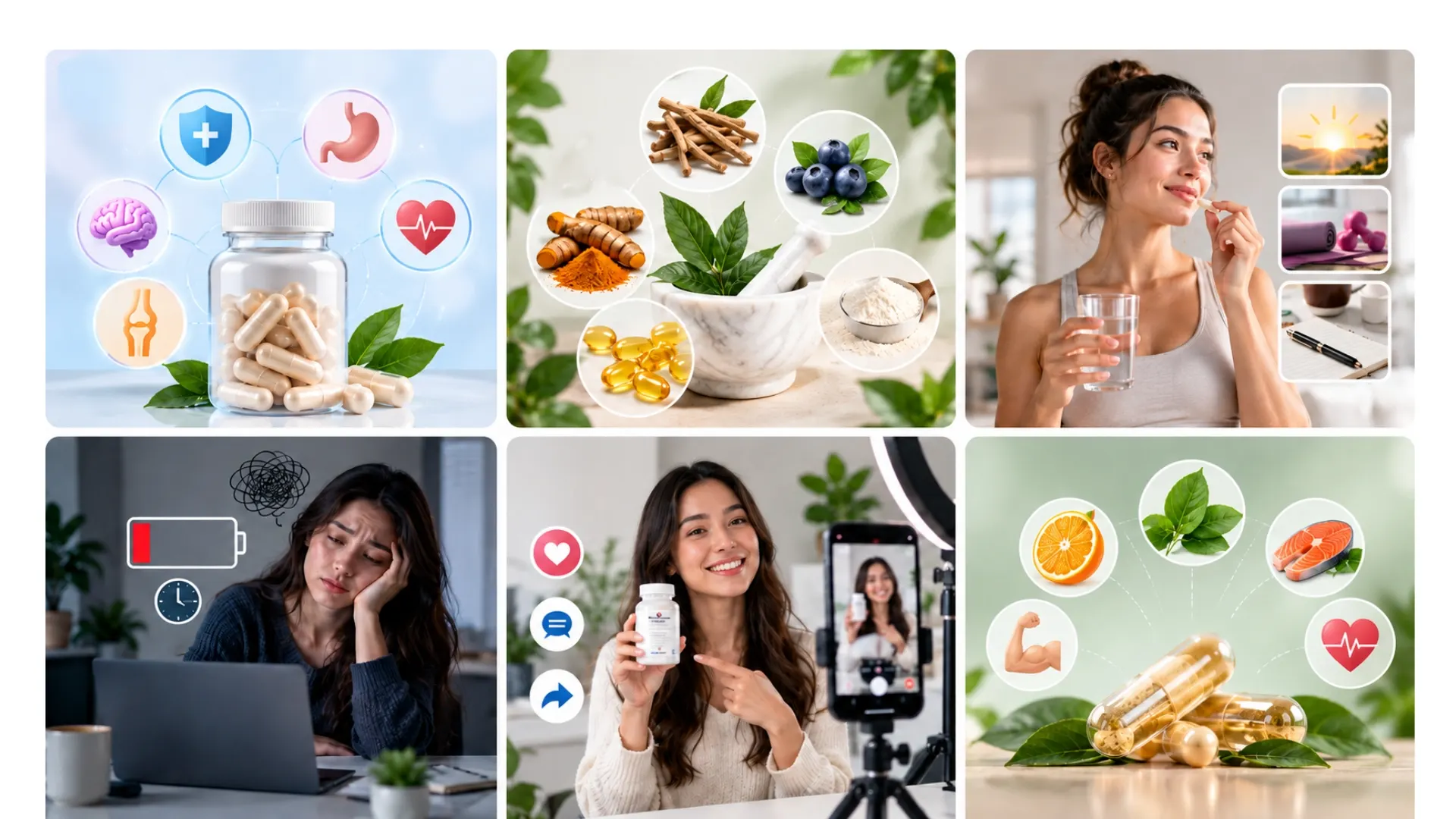
Examples of phrases that pass TikTok's review include "supports immune health," "promotes healthy digestion," "helps maintain cardiovascular function," "supports healthy metabolism," "supports a calm mood," and "supports joint comfort."
Ingredient education content
Ingredient-first videos perform well on TikTok and have lower compliance risk than benefit-focused content.
A 15-second video explaining the origins and traditional uses of ashwagandha, the source of your collagen, or the mechanism behind your probiotic strain is more compliant than a video promising anxiety relief or improved gut health.
It also tends to perform better with TikTok's health-conscious audience, who respond to education over marketing.
Lifestyle integration content
Showing the experience of using your supplement, rather than its claimed effects, is one of the most effective and compliant creative approaches on TikTok.
A person going through their morning routine after taking your magnesium supplement can show their audience the benefit without making any prohibited claim. This approach, confirmed by multiple 2026 campaign analyses, connects with TikTok's audience more authentically than direct benefit claims.
Problem-first hooks
Opening your ad with the problem your audience feels, rather than the solution your product provides, is both a compliance and conversion strategy.
"Tired of that 3 pm energy crash?" is more effective and more compliant than "Our energy booster gives you four hours of sustained power."
The first speaks to a relatable experience. The second makes a specific efficacy claim that will trigger an automated review.
UGC and Spark Ads
Authentic creator content running through TikTok Spark Ads outperforms brand-produced content for supplement brands on the platform.
If you run ads through a creator's handle with proper disclosure, you’d reduce your cost per click by up to 50% compared to when you run brand account ads.
The main compliance requirement is to include the Paid Partnership label on all sponsored content, with no exceptions.
Ingredient claims tied to normal function
Claims that reference the relationship between a food, dietary ingredient, or supplement and the maintenance of normal health are generally permitted.
Examples include: "Vitamin C supports a healthy immune system." "Magnesium supports normal muscle function." "Omega-3 fatty acids support heart health."
These claims follow the FDA's structure/function claim framework and pass TikTok's content review when properly accompanied by the required DSHEA disclaimer.
How to Write a Compliant TikTok Supplement Ad Script
There are three ways to write a compliant TikTok supplement ad. The first is the problem-first structure, the second is the ingredient education structure, and the third is the skeptic structure.
The problem-first structure
Open with the problem your audience faces. Then offer your product as a solution. And finally, end with a soft call to action. This is the most consistently compliant and highest-converting structure for supplement TikTok ads in 2026.
Example for an energy supplement:
- Hook (0 to 3 seconds): "Why do I always crash at 3 pm even when I sleep eight hours?"
- Body (3 to 12 seconds): "I started adding this to my morning routine six weeks ago. I use it every day now"
- Close (12 to 15 seconds): "Find it in TikTok Shop. Link below"
Notice what is not in that script. No efficacy claim. No before and after. No disease reference. No guaranteed result. Just a relatable problem, an authentic personal experience, and a soft CTA.
The ingredient education structure
Talk about the ingredient. Explain its origin or traditional use. Connect it to a normal body function. End by introducing the product.
Example for an ashwagandha supplement:
- Hook (0 to 3 seconds): "Ashwagandha has been used in Ayurvedic practice for over 3,000 years"
- Body (3 to 12 seconds): "It is an adaptogen, which means it supports your body's natural stress response. I add it to my morning smoothie"
- Close (12 to 15 seconds): "Our blend uses KSM-66 ashwagandha. Learn more about the ingredients below"
The skeptic structure
This format uses skepticism, reluctant trial, and honest result.
Example for a collagen supplement:
- Hook (0 to 3 seconds): "I thought collagen supplements were a complete waste of money"
- Body (3 to 12 seconds): "I tried this one anyway because my friend would not stop talking about it. I have been using it for eight weeks. My nails are stronger. My skin feels different"
- Close (12 to 15 seconds): "Still skeptical, but I keep reordering. Find it below"
Notice the result in the skeptic script is framed as a personal experience, not a clinical outcome. Saying "my nails are stronger" is an individual observation. Saying "this supplement strengthens nails" is a product claim.
Here are words that consistently pass TikTok's automated review for supplement ads: Experience, story, journey, routine, tutorial, how to, community, real life, behind the scenes, six weeks, my morning, I noticed, I felt, part of my routine.
Here are words that consistently trigger TikTok's automated flags for supplement ads: Miracle, cure, secret, hack, detox, guaranteed, permanent, clinically proven, FDA approved, eliminates, reverses, treats, heals, fixes.
Final Thoughts
Brands scaling on TikTok aren't doing anything complicated. They stay within the right claim framework, produce authentic content, and treat compliance as a foundation.
Brands getting suspended are running the same copy they use on Meta and finding out TikTok works differently.
If you want help building a compliant TikTok ad strategy for your supplement brand, book a free consultation with Pro Marketer. We help supplement brands build paid media systems that drive consistent revenue without putting ad accounts at risk.
FAQs
1. Can you advertise supplements on TikTok?
Yes, with conditions. Brands must complete a category qualification process, meet strict claim requirements, and produce creative that does not trigger automated content moderation.
Structure/function claims like "supports immune health" are permitted. Disease claims, before-and-after images, and GLP-1 mentions are not.
2. How do TikTok supplement ads differ from Meta supplement ads?
Both platforms prohibit disease claims, but TikTok enforces them faster and more strictly. TikTok flags supplement ads within hours, bans before-and-after imagery outright, requires a 24- to 48-hour review window for new campaigns, and demands upfront category qualification documentation that Meta does not require.
3. What is the TikTok Healthcare and Pharmaceutical Advertising Policy?
It is TikTok's primary governing document for health-related advertising, last updated August 2026. For supplement brands, it prohibits disease claims, before-and-after imagery, guaranteed results language, GLP-1 mentions, and AI-generated endorsements. It requires category qualification documentation, the DSHEA disclaimer, and proper influencer disclosure.
4. How much do TikTok supplement ads cost?
TikTok ads run on an auction model. For supplement brands in 2026, average CPMs range from $6 to $15, and cost per click falls between $0.50 and $2.00 for well-optimized campaigns. Spark Ads through creator accounts can bring cost per click down to $0.30 to $0.50. The minimum daily budget is $20 at the campaign level and $10 at the ad group level.
5. What happens if your TikTok supplement ad gets rejected?
A single rejection is a notice, not a penalty. Revise and resubmit. After repeated policy violations, TikTok reviews your account, which can lead to advertising suspension or a permanent account ban.
If you believe a rejection was made in error, use TikTok's One Click Appeal process in Ads Manager. Always address the actual compliance issue before resubmitting.
6. Do TikTok supplement ads need the DSHEA disclaimer?
Yes. All supplement ads targeting US audiences must include: "These statements have not been evaluated by the Food and Drug Administration. This product is not intended to diagnose, treat, cure, or prevent any disease."
It must appear clearly on screen or as a readable disclaimer. Missing it is one of the most common reasons supplement ads get rejected.

.svg)
.avif)

.svg)