

TABLE OF CONTENTS
What Is Supplement Stability Testing?
Which Products Need Stability Testing?
What Does Supplement Stability Testing Measure?
Potency and active ingredient levels
The Two Types of Supplement Stability Testing
Accelerated Stability Testing for Dietary Supplements
Real-Time Stability Testing (Ambient Stability)
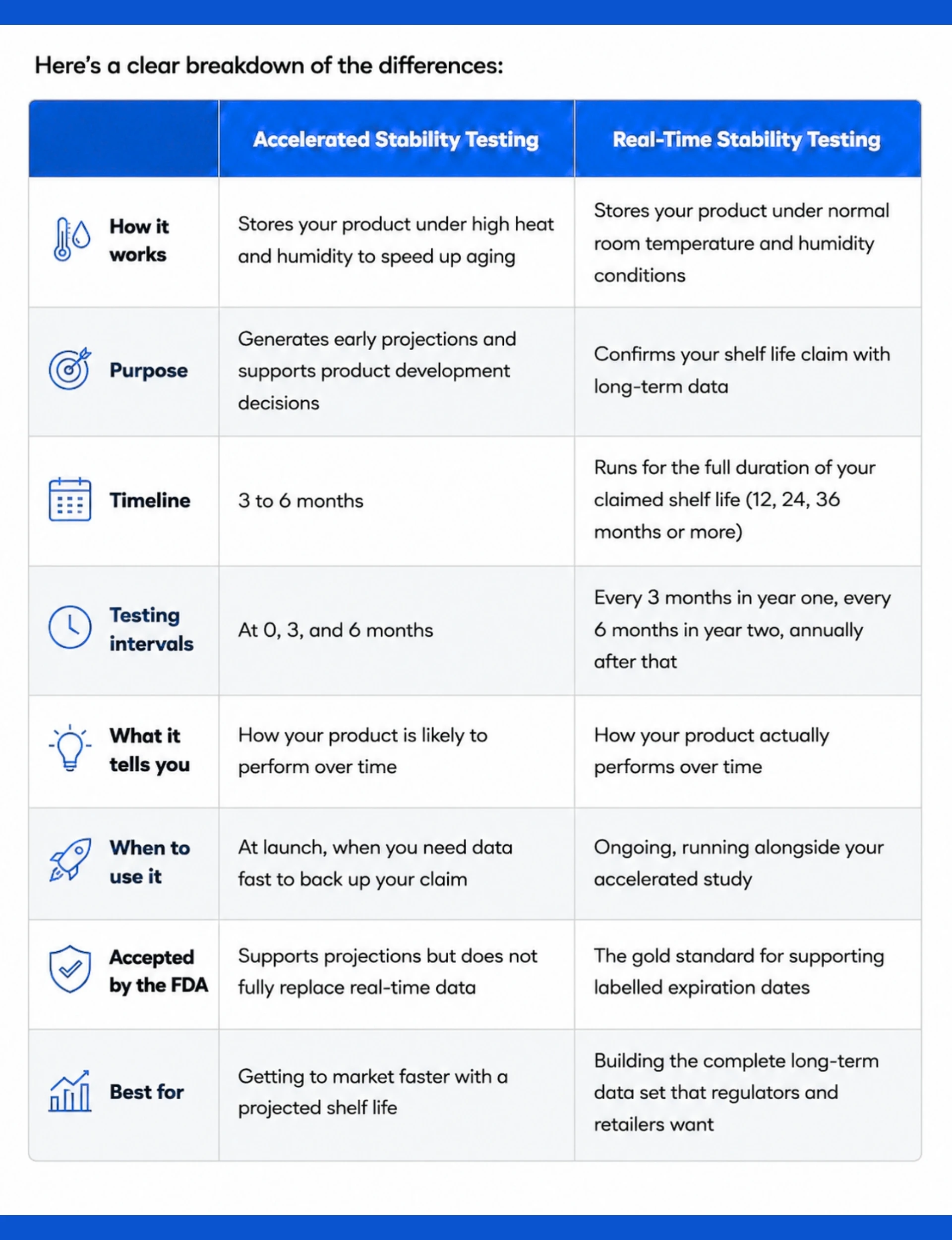
What Is the Difference Between Real-Time and Accelerated Stability Testing?
What Factors Affect Supplement Stability?
How Are Expiration Dates Determined for Dietary Supplements?
Where Is Stability Testing Performed?
How Much Does Supplement Stability Testing Cost?


Share via:
Quick Answer: Supplement stability testing is the process of checking whether a dietary supplement remains safe, effective, and accurately labelled throughout its shelf life. It tells you how long your product can maintain its potency, what expiration date you can legally put on the label, and whether your formula can survive under harsh storage conditions.
So, you’ve worked hard on your supplement formula, found a manufacturer, sorted your packaging, and just launched your Shopify store.
But how do you know your product is still effective six months after shipping it?
Most new supplement brands do not have a good answer to that question. Some of them even completely skip stability testing entirely. While others do not think about it until something goes wrong.
Stability testing for dietary supplements gives you the data to back up your expiration date, prove that your formula holds its potency over time, and show regulators, retailers, and consumers that your product is truly what you say it is.
This article explains what supplement stability testing is, how it works, how long it takes, what it costs, and why every ecommerce supplement brand needs to understand it before going to market.
What Is Supplement Stability Testing?

Supplement stability testing is the process of checking whether a dietary supplement remains safe, effective, and accurately labelled throughout its shelf life.
It basically answers one question: Will your product still work the way you say it would, from the day it ships to the day it expires?
Every supplement contains active ingredients that can break down over time.
- Vitamins lose potency
- Probiotics die off
- Herbal compounds degrade
The rate at which this happens depends on the formula, the packaging, and the storage conditions the product is exposed to.
Stability testing measures all of this, so you know exactly how long your product lasts and what expiration date you can legally put on your label.
This is how expiration dates are determined for dietary supplements. Stability testing generates the data. The expiration date reflects how long the product stays within its labelled specifications based on that data.
Without that data, any date you print on your label is merely a guess. And the FDA (Food and Drug Administration) takes unsupported claims about expiration dates seriously.
Which Products Need Stability Testing?
Any dietary supplement brand that puts an expiration date, best-by date, or shelf life claim on its label needs stability data to back it up.
Here are the dietary supplements that require stability testing if they carry any kind of date-based claim:
- Capsules
- Tablets
- Powders
- Gummies
- Softgels
- Tinctures
- Liquids
If you are launching a new product, you need it. If you are changing your formula, your packaging, or your manufacturing process, you need it again.
Also, if you are expanding into new distribution channels, storage environments, or international markets, additional stability data may be required.
What Does Supplement Stability Testing Measure?
Stability testing for dietary supplements assesses your product from multiple angles to provide a complete picture of its shelf life.
Potency and active ingredient levels
This is the major part of any stability study. The testing you do measures whether your active ingredients still meet their labelled amounts after a certain period.
A vitamin C supplement that starts at 1,000mg per serving but drops to 600mg before its expiration date is not offering what the label promises.
Stability testing catches that before your customers do.
Physical and chemical changes
Colour changes, odour, texture, tablet hardness, powder flowability, and capsule integrity are all evaluated during stability testing.
These physical attributes matter to consumers and can signal degradation, even when your product's potency appears acceptable on paper.
Microbial safety
Supplements are tested for harmful microorganisms, including bacteria, yeast, and mould.
Microbial growth can change over time depending on the storage conditions, so microbiological testing is a standard part of any complete stability study.
Packaging compatibility
Your packaging is part of your product's stability system. Stability testing checks whether your container, closure, and material protect the supplement from moisture, light, and oxygen throughout its shelf life.
A formula that is perfectly stable in a dark glass bottle may degrade quickly in a clear plastic one.
The Two Types of Supplement Stability Testing
There are two main types of stability testing for dietary supplements. Most brands use both. Let’s take a quick look at both of them.
Accelerated Stability Testing for Dietary Supplements
Accelerated stability testing places your product in an environmental chamber that simulates extreme conditions like higher temperatures and higher humidity.
The idea is to increase the natural aging process of your product so you can get useful data faster.
A standard accelerated stability study happens for three to six months and uses testing intervals at zero, three, and six months. Six months of accelerated testing is roughly equivalent to two years of real-time aging.
Accelerated stability testing for dietary supplements is useful for several reasons:
- It gives you early data during product development to assess any formulation problems before you officially launch
- It gives you a shelf life projection to work with while your real-time study is running
- It allows most brands to launch their product without waiting two or more years for full real-time data
Accelerated data supports shelf life projections, but it does not eliminate the need for real-time data. Real-time data is still required to fully confirm your labelled expiration date.
Real-Time Stability Testing (Ambient Stability)
Real-time stability testing, also called ambient stability, stores your packaged product under normal/controlled room-temperature and humidity conditions and tests it at regular intervals over a set period.
This is standard dietary supplement stability testing, and it provides the data that supports your expiration date claim.
For a product with a 24-month shelf life, testing occurs:
- Every 3 months in the first year
- Every 6 months in the second year
- And annually thereafter
For longer shelf life claims, you extend your testing intervals to 36, 48, or 60 months.
What Is the Difference Between Real-Time and Accelerated Stability Testing?
What Factors Affect Supplement Stability?
If you don’t know what affects your supplement's stability, it’ll be hard to design a better formula, choose better packaging, and set realistic shelf-life expectations.
- Temperature: A 10-degree Celsius increase in storage temperature can accelerate ingredient degradation by up to 500%. This is why you need to place clear storage instructions on your supplement package. It is also why supplements shipped or stored in hot conditions can lose potency much faster than laboratory testing predicts
- Humidity: This affects physical structure. High moisture levels can make tablets more porous and fragile. It can also trigger chemical reactions between ingredients and increase microbial growth
- Light: This degrades many active compounds, especially vitamins and botanical extracts. Products packaged in clear containers without UV protection are at higher risk
- Oxygen: This causes oxidation, which breaks down ingredients and creates unwanted byproducts. Supplements containing fats, oils, or oxidation-sensitive compounds need to be carefully packaged to limit oxygen exposure
- pH: This influences chemical reactions inside the formula. Certain pH levels can cause degradation or the premature release of active ingredients
All these factors interact. A formula that is stable at room temperature may degrade quickly when exposed to heat and humidity. Luckily, with good stability testing, you can predict these factors and adjust them accordingly.
How Are Expiration Dates Determined for Dietary Supplements?
Stability testing for dietary supplements expiration dates is quite simple. Here’s how it works:
- Your product is tested at defined intervals under both accelerated and real-time conditions
- At each time point, specific properties like potency, physical integrity, microbial levels, and packaging performance are measured
- As long as the product stays within its labelled specifications at each interval, the shelf life claim would remain true
- The expiration date is set at the point where the product can no longer be guaranteed to meet its specifications
- If your product passes all tests at 24 months but begins to fall outside specifications at 27 months, then you must set your expiration date at exactly 24 months
NOTE: For ingredients that lose their potency over time, manufacturers usually use overages. This means adding a higher concentration of the active ingredient than the label claims requires.
The overage compensates for expected losses, so the product still meets its label claim on its expiration date. Overages can range from 3% to 25% for most nutrients, but it is higher for probiotics, which are among the most unstable supplement ingredients.
Where Is Stability Testing Performed?

Stability testing should be performed at qualified laboratories with the right equipment, expertise, and stability storage capabilities.
This means having:
- Trained analysts
- Documented testing protocols that meet regulatory standards
- Testing chambers that are capable of precisely controlling temperature and humidity
Many contract development and manufacturing organizations (CDMOs) provide in-house stability testing.
This is preferable to outsourcing the testing to a separate lab because the CDMO already has full documentation of your formula, manufacturing process, and ingredients.
If your manufacturer does not offer in-house stability testing, qualified third-party laboratories can perform it. But you have to choose a lab with experience in dietary supplement stability testing, not just a general pharmaceutical or food testing lab.
How Much Does Supplement Stability Testing Cost?
The cost of supplement stability testing depends on several factors:
- The number of products being tested
- The number of test parameters required
- The number of time points in the study
- The storage conditions being evaluated
- The overall duration of the study
There is no single flat rate because every product and study design is different. A simple single-ingredient powder with a 12-month shelf-life claim will cost less to test than a complex multi-ingredient gummy with a 36-month shelf-life claim that requires different storage conditions.
In general, you should expect accelerated stability studies to start at a few thousand dollars per product and to increase with complexity.
You should also know that real-time studies that last 24 months or longer will cost more due to the extended testing period and lab time.
The best way to get an accurate cost estimate is to contact a qualified testing lab directly with your product details and study requirements. Most labs will provide a customized quote based on your specific situation.
What This Means for Your Supplement Brand
The supplement market is getting more competitive every year. Retailers are asking for stability data. Consumers are getting more informed. And the FDA is paying closer attention to brands making claims they cannot substantiate.
It’s time you invest in proper stability testing to protect your supplement brand.
If you are building or scaling a supplement brand and want to make sure your ecommerce is set up to support that growth, book a free consultation with Pro Marketer.
We work with supplement brands at every stage and will show you exactly what it takes to grow profitably online.
FAQs
1. What is the purpose of stability testing?
The purpose of supplement stability testing is to confirm that your product remains safe, effective, and accurately labelled from the day it is manufactured to the day it expires.
It generates data to support your expiration date, verifies that your active ingredients maintain their potency throughout shelf life, and checks that your packaging protects the formula under harsh storage conditions.
2. Who needs supplement stability testing?
Any supplement brand that puts an expiration date, best-by date, or shelf-life claim on its label needs stability data to support that claim.
That includes brands launching new products, changing their formulas or packaging, expanding into retail or international markets, and preparing for FDA inspections or GMP audits.
If your product makes any claim about how long it lasts, you need the data to back it up.
3. What are the two types of stability tests?
The two types of stability testing for dietary supplements are accelerated stability testing and real-time stability testing.
Accelerated stability testing places your product in a controlled chamber under high-temperature and high-humidity conditions to simulate aging quickly.
Real-time stability testing stores your product under normal conditions and tests it at regular intervals throughout its shelf life.
4. Does changing supplement packaging require new stability testing?
Yes, in most cases. Your packaging is part of your product's stability system. It protects the formula from moisture, light, and oxygen.
If you change your container material, closure type, or packaging format, you cannot assume the stability data from your previous packaging still applies.
A new stability study is needed to confirm that the new packaging provides the same level of protection and that your shelf-life claim remains supported.
5. When should a supplement brand conduct a new stability study?
A supplement brand should conduct a new stability study when launching a new product, when making any change to the formula or ingredients, when changing packaging materials or container types, when changing the manufacturing process or facility, and when expanding into new distribution channels or markets with different storage conditions.

.svg)

.avif)

.svg)