
TABLE OF CONTENTS
Why Marketing a Dog Walking Business Is Different
Three Stages of Dog-walking Business Growth
The Best Dog Walking Marketing Ideas for 2026
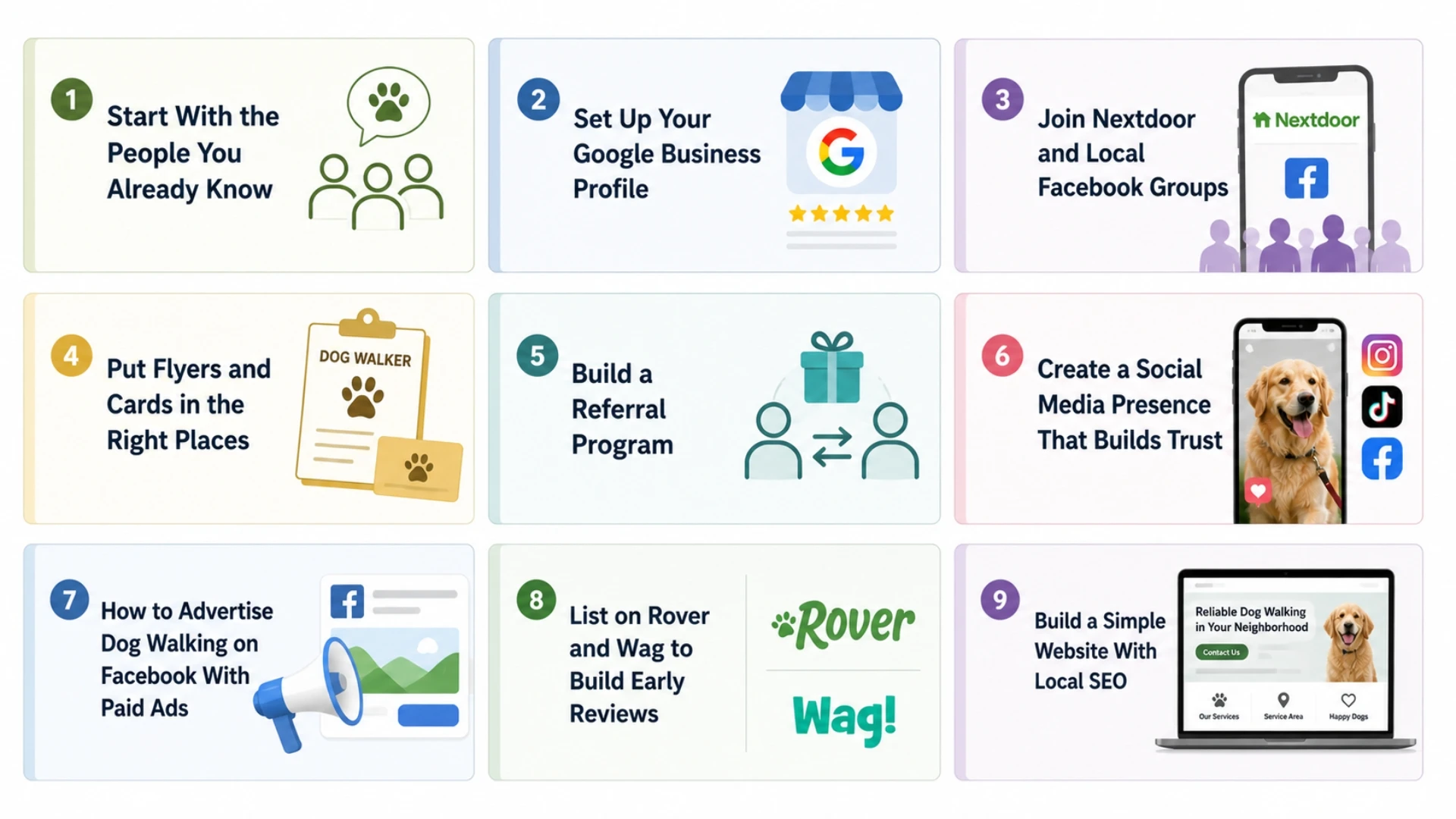
- Start With the People You Already Know
- Set Up Your Google Business Profile
- Join Nextdoor and Local Facebook Groups
- Put Flyers and Cards in the Right Places
- Build a Referral Program
- Create a Social Media Presence That Builds Trust
- How to Advertise Dog Walking on Facebook With Paid Ads
- List on Rover and Wag to Build Early Reviews
- Build a Simple Website With Local SEO


Share via:
Quick Answer: The best ways to advertise a dog walking business are word of mouth, Google Business Profile, local Facebook and Nextdoor groups, flyers at vet offices and pet stores, and a referral program. For businesses with more than 15 regular clients, adding a simple website with local SEO and Instagram content builds long-term visibility. Most early clients come from your personal network and local community, not paid ads.
The US dog walking industry is worth $1.4 billion. There are over 35,000 dog walking businesses across the country, and that number keeps increasing.
More people own dogs than ever before, and more of those dog owners have busy schedules; therefore, they require a walker.
That is good news if you are building a dog walking business. But it also means you are not the only one trying to get their attention.
The dog walking business owners who get the most bookings are the ones who show up consistently in the right places and make it easy for the right people to find them and trust them. Most of that happens long before anyone spends money on advertising.
This article teaches you how to advertise a dog walking business in 2026. Let’s get right in.
Why Marketing a Dog Walking Business Is Different
Most businesses can rely on broad advertising to bring in customers. Dog walking is different. It is a hyper-local, trust-based service.
A dog owner is not just hiring someone to walk their dog. They are handing over a key to their home and trusting a stranger with an animal they love. That changes everything about how dog walking marketing works.
Knowing how to market a dog walking business comes down to understanding two things:
- Where dog owners look when they need help
- What makes them trust someone enough to hand over their key
Generic advertising does not build that kind of trust. What does is visibility in the right community, consistent social proof from people the dog owner already knows or can see, and showing up in the specific places dog owners look when they need help.
The other thing that makes dog walking advertising different from most businesses is the stage of growth you are in.
A walker with zero clients needs a completely different marketing approach than one with 10 regular clients trying to get to 25.
Using the wrong strategy for your stage wastes time and money. The right strategy for your stage costs relatively little and produces faster results.
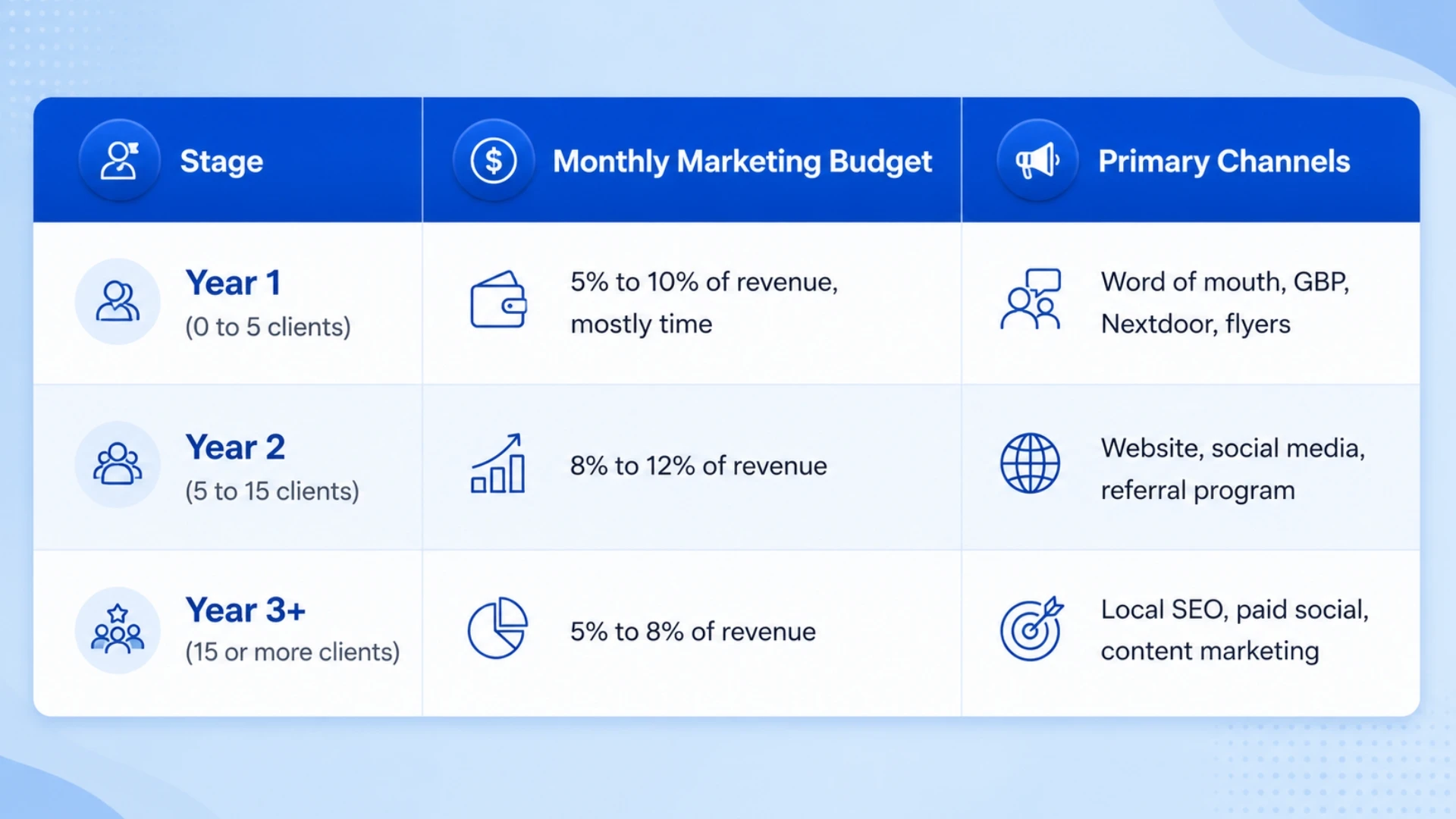
Three Stages of Dog-walking Business Growth
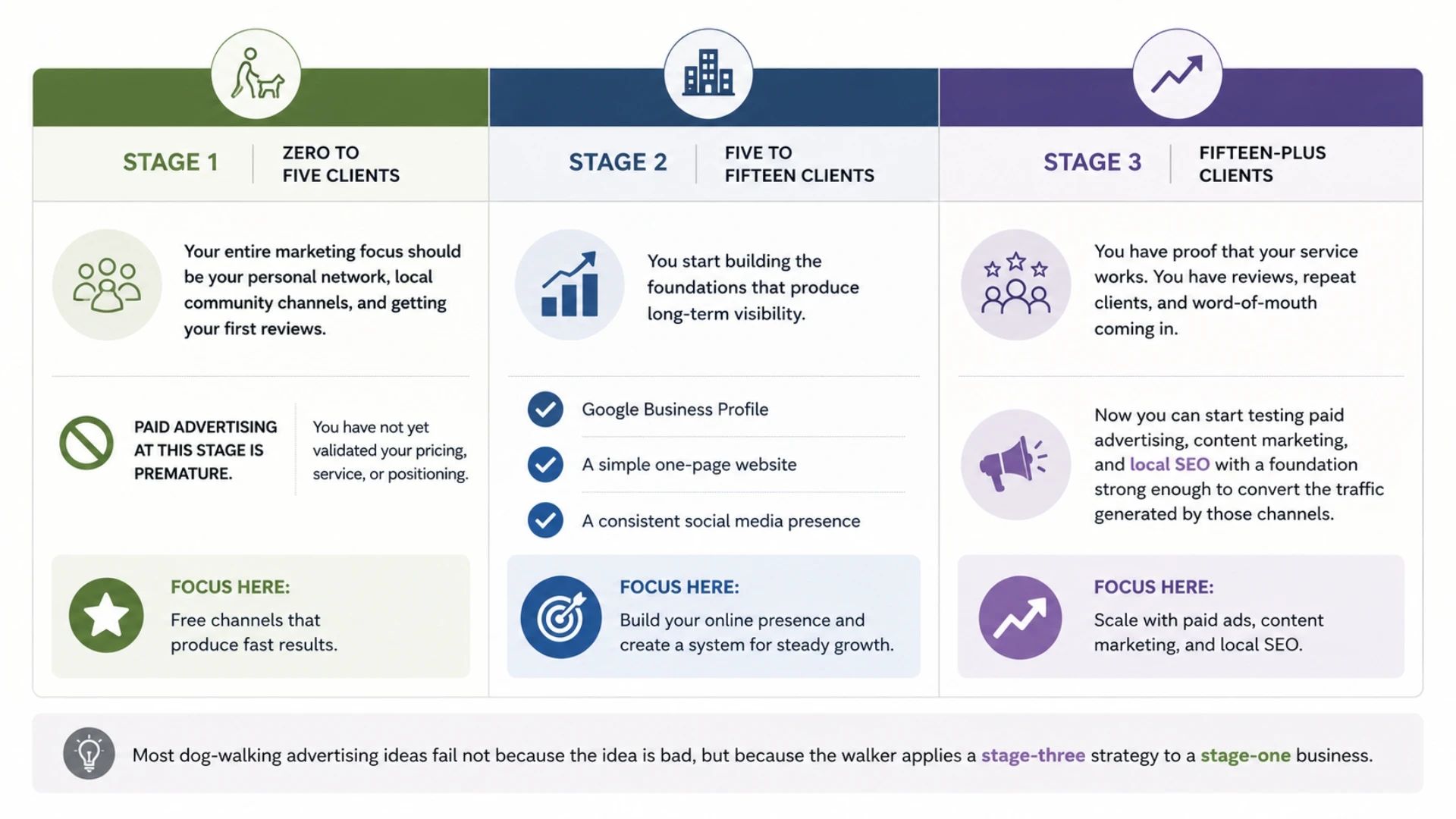
There are three stages of growth in the dog-walking business, and the best way to advertise is to first understand each stage.
Stage 1: Zero to five clients
At this stage, your entire marketing focus should be your personal network, local community channels, and getting your first reviews.
Paid advertising at this stage is premature. You have not yet validated your pricing, service, or positioning. So, you should spend your energy on free channels that produce fast results.
Stage 2: Five to fifteen clients
At this stage, you start building the foundations that produce long-term visibility.
For instance, focus on Google Business Profile, a simple one-page website, and a consistent social media presence.
Stage 3: Fifteen-plus clients
At this stage, you have proof that your service works. You have reviews, repeat clients, and word-of-mouth coming in. Now you can start testing paid advertising, content marketing, and local SEO with a foundation strong enough to convert the traffic generated by those channels.
Most dog-walking advertising ideas fail not because the idea is bad, but because the walker applies a stage-three strategy to a stage-one business.
The Best Dog Walking Marketing Ideas for 2026
1. Start With the People You Already Know
This is the most effective dog walking advertising idea available to a new business, and most walkers underestimate how far it can take them.
Tell everyone in your personal network that you are starting a dog walking business. Create a direct, specific message saying:
"I just started a dog walking business in the Rosedale area. I am taking on new clients now. Do you know anyone with a dog who could use a reliable walker?"
Send that message to every person in your contacts who lives in or near your service area.
The dog walking industry thrives on referrals. Word of mouth is the highest-converting channel in this business, and it costs nothing. Your first five clients will likely come from your personal network or within one degree of separation of it. People hire walkers they trust, and trust starts with someone they already know vouching for you.
Do not be embarrassed to ask. Dog owners are not waiting to be sold to. They are already looking for someone reliable, and if you are the person their friend recommended, you have already cleared the biggest hurdle.
2. Set Up Your Google Business Profile
This is the most important thing you can do for your long-term dog walking advertising strategy, and it is completely free.
When a dog owner types "dog walker near me" into Google, the first results they see are not websites. They are Google Business Profiles displayed in the Map Pack, the three local listings that appear at the top of local search results.
The Map Pack captures approximately 44% of clicks for local searches. If your business is not there, you are invisible to the most motivated buyers in your area.
Setting up a Google Business Profile takes less than 30 minutes. You should optimize your setup by doing the following:
- Choose the right primary category: For dog walking, it should be "Dog Walker"
- Add photos: Google Business Profiles with photos receive more engagement than those without. Dog owners want to see who will be walking their dog. Give them that reassurance before they even click through to your profile
- Fill out every field completely: Include your service area, your hours, a description of your services, and your contact information. Incomplete profiles rank lower and convert worse
- Ask your first clients for reviews: Reviews are the most powerful trust signal on your Google Business Profile. One five-star review with a personal note from a happy client does more for your credibility than a hundred flyers. Make it easy for clients by sending them a direct link to your review page right after their first experience working with you
- Post regularly: Businesses that post two to three times per week on their Google Business Profile see 34% higher engagement than those that post monthly. A short update with a photo from a recent walk takes two minutes and keeps your profile active in Google's local algorithm
3. Join Nextdoor and Local Facebook Groups
These two platforms are where your actual potential clients spend time talking about local services.
They are the digital equivalent of your neighbourhood notice board, and for a hyper-local business like dog walking, they are invaluable.
Nextdoor
This is a neighbourhood-specific social network where people regularly ask for recommendations for local service providers.
Dog walkers who are active on Nextdoor and have clients consistently leaving recommendations there report it as one of their best sources of new clients.
Create a business profile, introduce yourself to your neighbourhood, and engage with conversations about pets and local community topics. When someone posts asking for a dog walker recommendation, you want your name to be familiar already.
Local Facebook groups
Search for groups in your area with names like "Rosedale Pets," "Toronto Dog Owners," or "Midtown Neighbours." Join them, introduce yourself, and be helpful in conversations. Do not just post your services and disappear. Engage. Answer questions. Show that you know and love dogs.
A practical dog walking advertisement example for a Facebook group post usually includes:
- A short introduction
- A photo of you with a dog
- Two or three sentences about your service and service area
- A call to action
4. Put Flyers and Cards in the Right Places
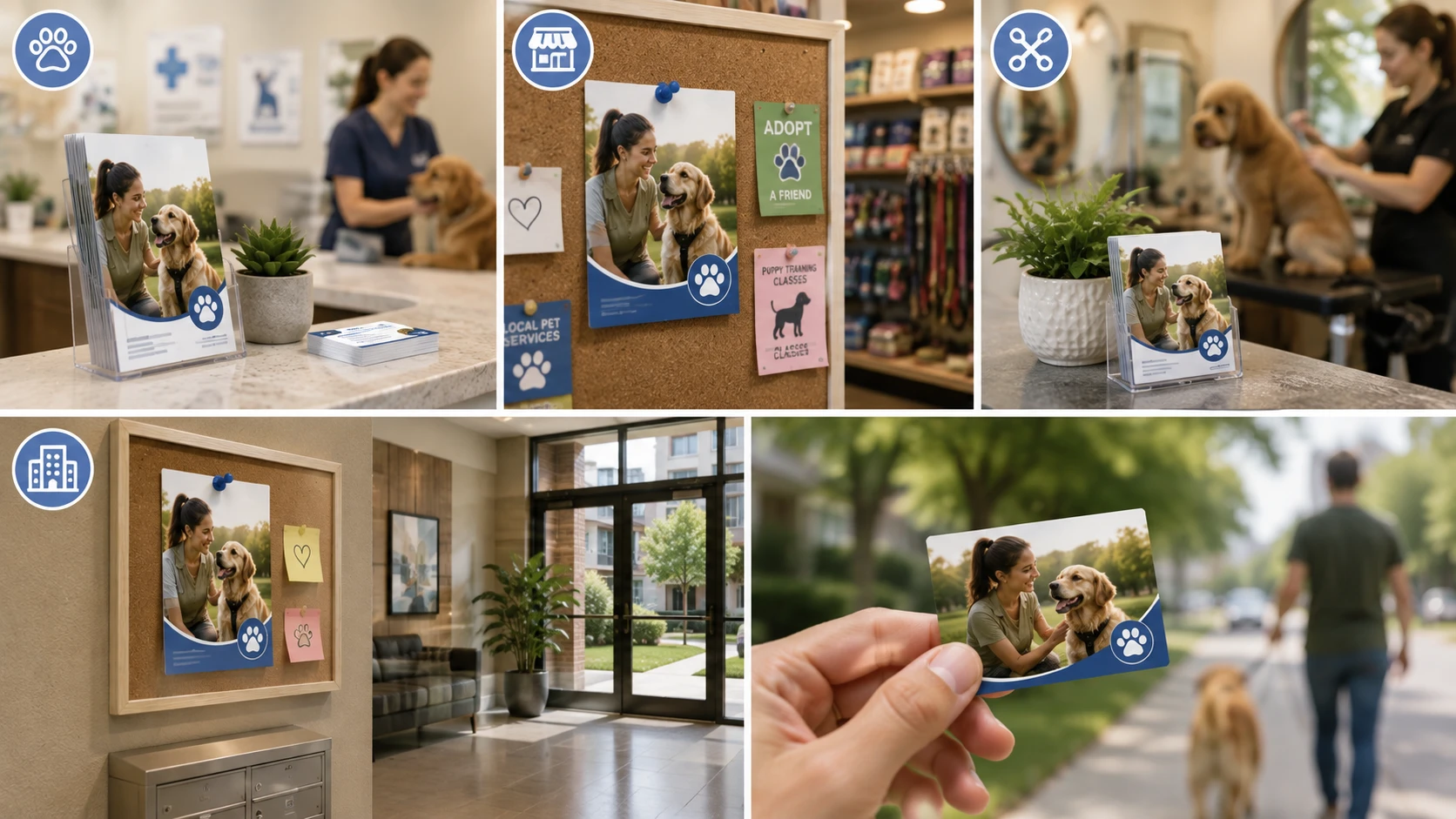
Old-school dog-walking advertising flyers still work when placed correctly. The important thing is to strategically target locations where dog owners already spend time. These places include:
- Vet offices are the highest-value placement. A dog owner sitting in a vet waiting room is already interested in pet care and in spending money on their dog. Drop off business cards and ask if you can leave a small stack at the front desk. Offer to send referrals to the vet in return. Many will reciprocate because the relationship benefits them too
- Independent pet stores usually have community boards where local service providers can leave cards or flyers. Avoid large chains like PetSmart. Independent stores have more community-focused clientele and are more likely to support local businesses
- Dog groomers serve the same clients you want. A simple referral partnership with a local groomer, where you both recommend each other to your clients, costs nothing
- Apartment buildings with pet-friendly policies are really good opportunities. A single building with 200 units could have 30 to 40 dog owners. A well-placed flyer on a community board or a card left with the building manager can reach all of them at once
When designing your dog walking advertising flyer, keep it simple. Include your name or business name, the service you offer, your service area, your phone number, and one clear reason to call you.
A photo of you with a dog also helps to build instant trust. Also, make sure every design element conveys reliability and warmth, because that is exactly what a dog owner is looking for.
5. Build a Referral Program
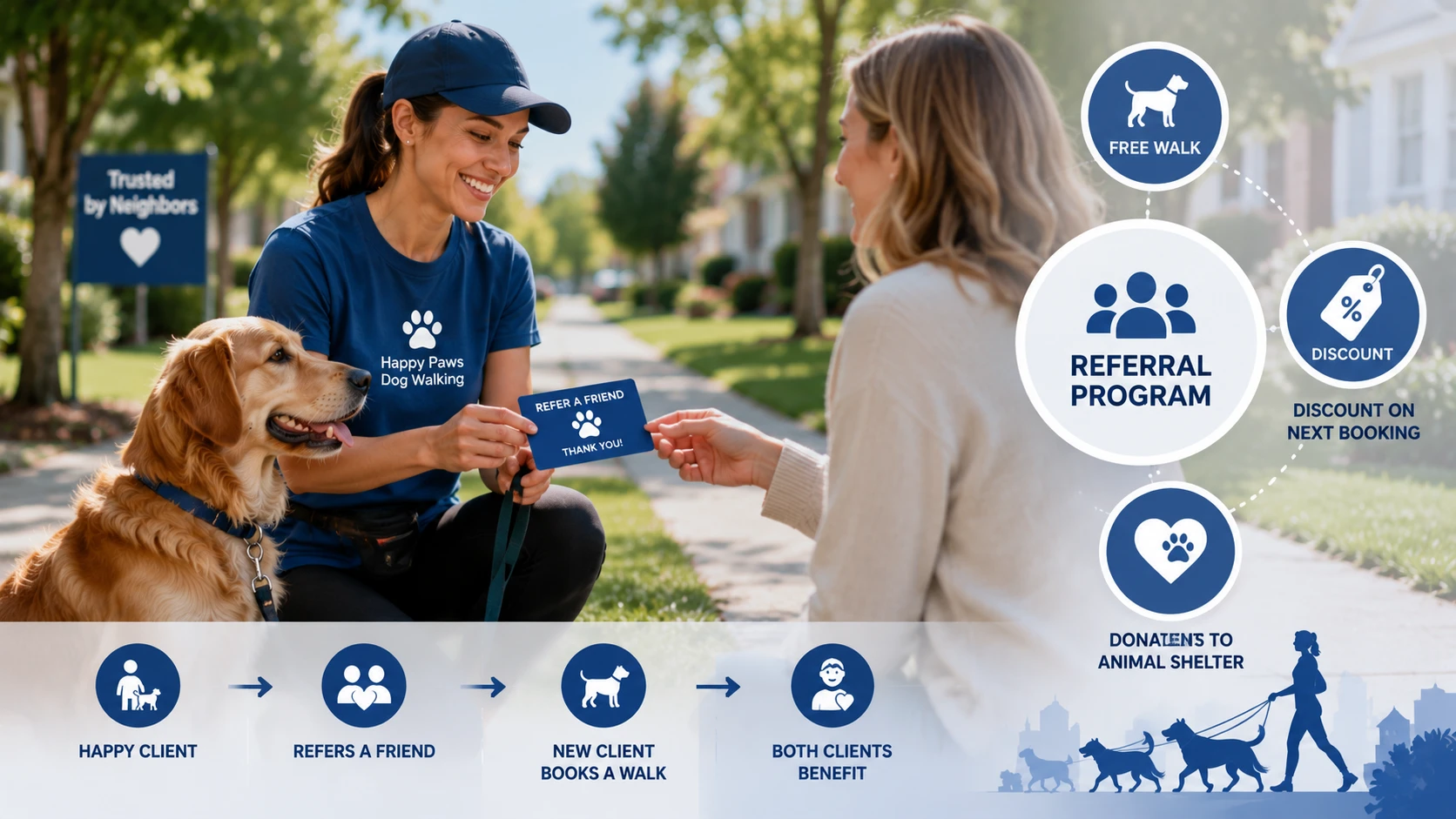
A referral program is one of the most underused marketing tools for dog walkers. It turns your existing happy clients into your most effective sales team.
When a current client refers someone new to your business, they receive something of value in return, such as:
- A free walk
- A discount on their next booking
- A donation made in their name to a local animal shelter
Make the referral process as simple as possible. Give clients a card with the offer written on it. Send a follow-up message after their first few walks reminding them that you are taking on new clients and that you appreciate referrals. Do not assume they know. Tell them directly.
Each referred client eventually becomes a potential referrer themselves. For a dog walking business operating in a residential neighbourhood, this network effect is one of the most sustainable sources of growth available to you.
6. Create a Social Media Presence That Builds Trust
Social media marketing for dog walkers is not about going viral. It is about giving potential clients a window into what it is like to work with you before they ever reach out.
This is one of the best platforms for dog walking businesses because its content is inherently visual. Dogs are photogenic. Walks produce great photos. Happy dogs resonate with everyone who owns one.
Post consistently. Three to four times per week is a realistic target. Each post does not need to be elaborate. You can simply post a photo from a walk with a short caption about the dog, the neighbourhood, or something that happened that day. Tag the location and use local hashtags.
TikTok
Dog walking content performs exceptionally well on TikTok because the format rewards authentic, relatable moments rather than polished production.
A video of a dog excitedly meeting you at the door, a funny moment on a walk, or a day-in-the-life of a dog walker can reach thousands of local viewers without a single dollar of advertising spend.
A business Facebook page gives you a place to post updates, collect reviews, and run local ads when you are ready to invest in paid promotion.
Use the 80/20 rule. Eighty percent of your posts should be educational, entertaining, or engaging content about dogs and pet care. Twenty percent can be direct promotion of your services.
7. How to Advertise Dog Walking on Facebook With Paid Ads
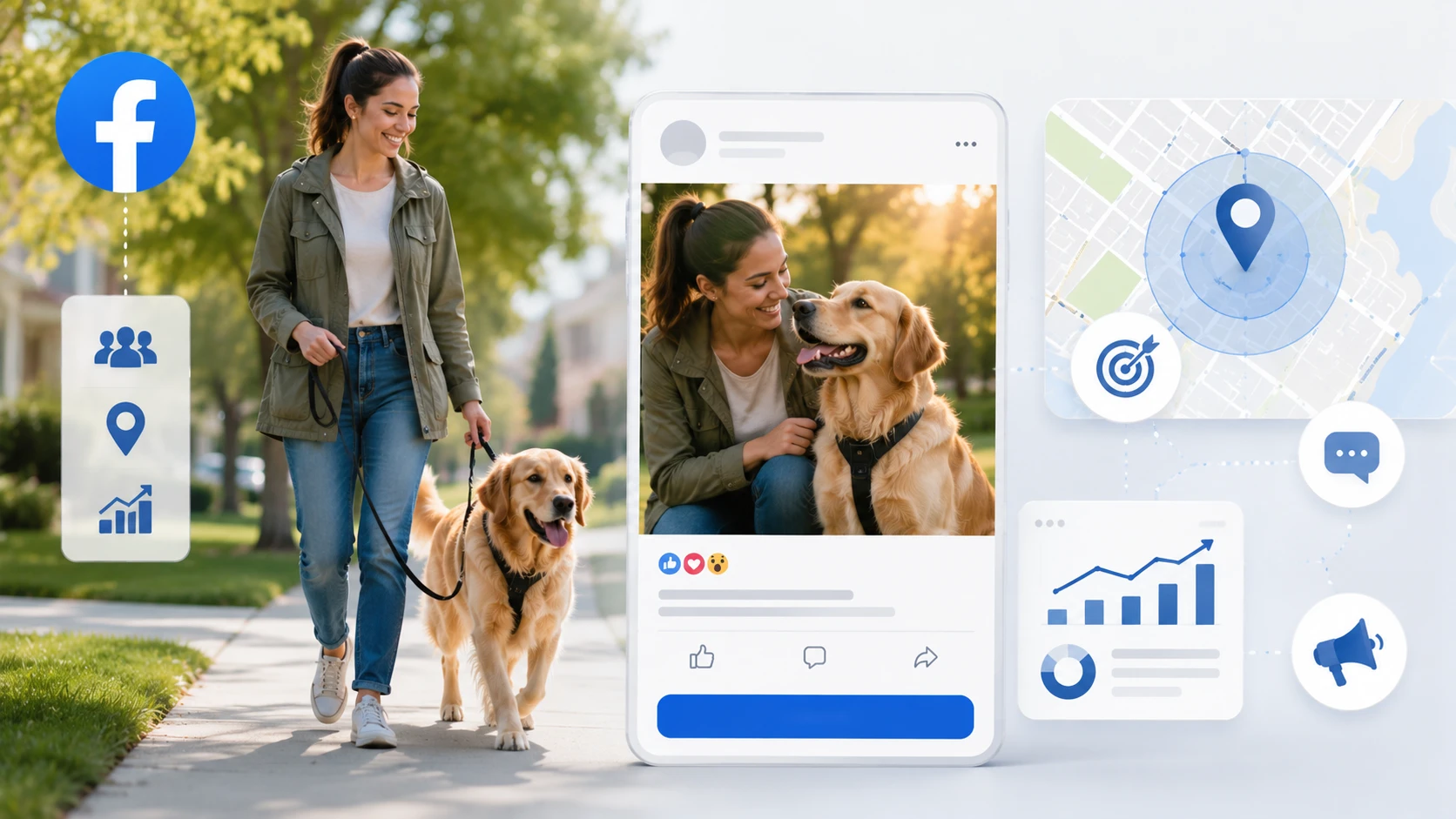
When you have at least 10 regular clients, a Google Business Profile with reviews, and a consistent posting history, you are ready to start Facebook advertising. But prior to that, the organic channels above will produce better results for less money.
Start by creating a Facebook ad with a photo of you with one of your dogs, a short headline that states what you do and where, and a clear call to action. Something like "Looking for a reliable dog walker in Midtown? I have availability this week. Message me to book a free meet and greet." Keep the copy conversational and specific to your area.
Your budget does not need to be large. A daily budget of $5 to $10, tightly targeted to your service area, is enough to generate enough visibility. Run the ad for two weeks, track how many messages or inquiries it produces, and decide from there whether it is worth continuing.
For a dog-walking advertisement on Facebook that converts, focus on the following elements:
- A real photo rather than stock imagery
- A specific service area mentioned in the copy
- A free meet-and-greet, rather than asking for an immediate booking
- A warm, personal tone that communicates trustworthiness before the potential client has ever met you.
8. List on Rover and Wag to Build Early Reviews
Rover and Wag are the two largest dog walking platforms in the US, and both can help new walkers attract clients and earn reviews. Rover takes approximately 20% of each booking. Wag can take up to 40%.
The strategic way to use these platforms is as short-term tools for building credibility rather than as a long-term business model.
Create profiles on both, price competitively to generate your first bookings, deliver exceptional service, and collect reviews. Once you have 10 or more reviews across these platforms, you have the social proof needed to move clients into a direct-booking relationship, where you keep the full fee.
Rover is better for recurring walks and longer-term client relationships. Wag is better for on-demand and last-minute walks. You can use both for the first six months of your business, but neither should be your primary business channel.
9. Build a Simple Website With Local SEO
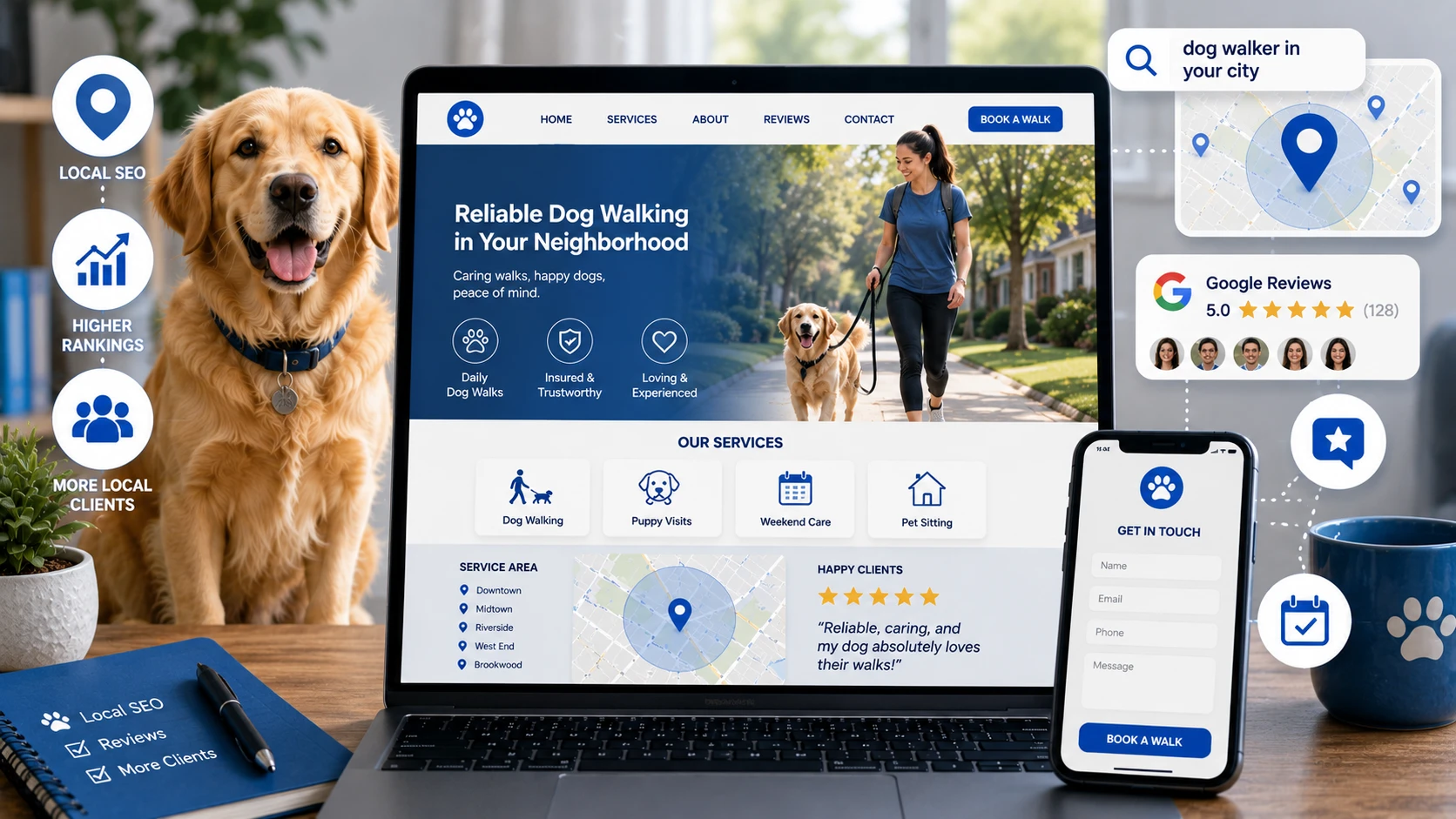
Once you have your first five to ten clients and some positive reviews, a simple one-page website makes a difference in how potential clients find and evaluate you.
Your website does not need to be elaborate. A description of your services, service area, and rates, a few photos, and a contact form or booking button are sufficient.
What matters is that your website uses the language dog owners use when searching. Phrases like "dog walker in [your city]," "dog walking services near [neighbourhood]," and "reliable dog walker [area]" should appear naturally in your page copy.
Include the names of the specific neighbourhoods you serve. Google's local search algorithm displays businesses that clearly serve a specific geographic area. If your website mentions three or four neighbourhood names alongside your service descriptions, you are more likely to appear when someone in those neighbourhoods searches for a dog walker.
Add a page that collects Google reviews by linking directly to your review profile. Consistency between what your website says and what your Google Business Profile says also improves your local search ranking.
How Much Does It Cost to Advertise a Dog Walking Business?
Most of the best dog walking marketing strategies cost nothing. Google Business Profile is free. Nextdoor is free. Local Facebook groups are free. Flyers cost a few dollars to print. A referral program costs whatever discount or reward you choose to offer.
When you are ready to invest in paid advertising, here’s what you should budget:
Facebook ads for a dog walking business can be run effectively for $5 to $10 per day. Google Local Services Ads, which place your business at the very top of search results for service queries, usually cost $15 to $50 per lead depending on your market.
Wrapping Up
The best way to build a dog-walking business is to use channels that cost nothing and produce the fastest results. These channels include word of mouth, Google Business Profile, Nextdoor, local partnerships, reviews, and referral systems.
If you are building a pet brand or a service business and want a marketing system that produces revenue, book a free consultation with Pro Marketer. We work with brands at every stage of growth to build marketing systems that consistently bring clients in.
FAQs
1. What is the best way to advertise a dog walking business?
The best way to advertise a dog walking business is through word of mouth from your personal network, asking directly for referrals, setting up a Google Business Profile, adding a local Facebook and Nextdoor presence, creating a referral program, and building a simple website.
2. How do I advertise my dog walking business on Facebook?
Start with a Facebook business page rather than advertising from your personal profile. Post consistently using the 80/20 rule where 80% of content is engaging and educational and 20% is promotional.
Join local neighbourhood and pet owner groups and introduce yourself. When you are ready to run paid ads, create a simple ad with a real photo of you with a dog, specific copy that mentions your service area by name, and a free meet-and-greet.
3. How do I write a dog walking ad that converts?
Lead with trust rather than credentials. Use a real photo of you with a dog rather than stock imagery. Be specific about the neighbourhoods you serve. Mention something that communicates your care for dogs.
Make the first step as easy as possible by asking potential clients to message you for a free meet-and-greet rather than booking immediately. Keep the copy short, two to four sentences maximum. And use the same warm, personal tone you would use when talking to a neighbour, because that is exactly who you are trying to reach.

.svg)

.avif)

.svg)