What Is a Trusted Peptide Supplier?
A trusted peptide supplier is one you can verify. You can see who makes the product, read lot-specific test results from a named lab, and reach a real company when something goes wrong.
Who Is the Most Reputable Peptide Supplier?
No single supplier is best for every brand. Some “top 7” lists are published by a supplier that ranks itself first. A reputable peptide supplier earns that label by showing you documents you can check, so rank suppliers yourself with the 12 checks below.
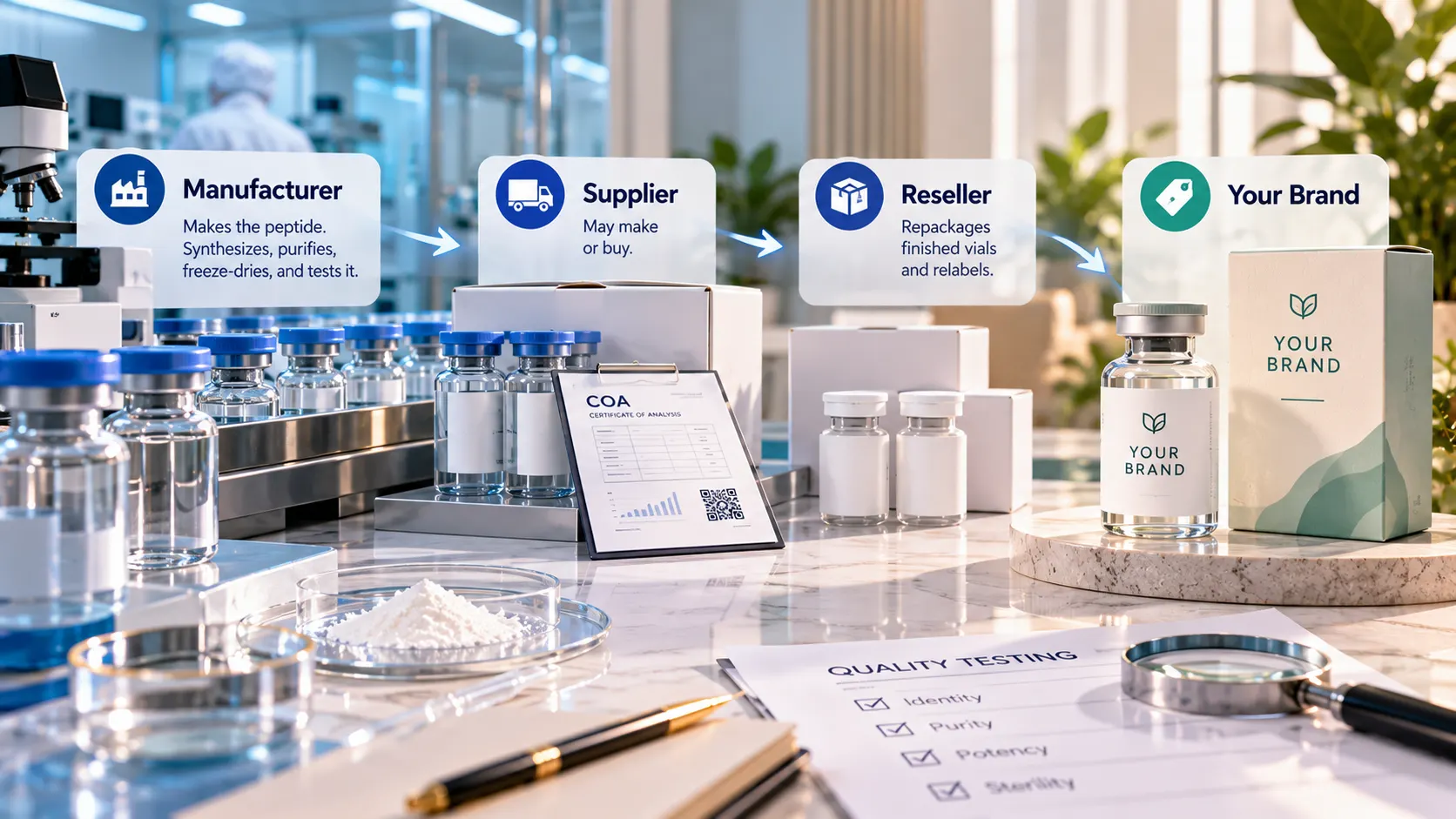
Know the differences between key peptide terminologies
Many companies do a bit of each. That is fine, as long as they tell you which part they do.
1. Find Out Who Actually Makes the Peptide
Start with one question: who makes this? A supplier that can’t answer is probably a middleman, and you can’t judge the quality system of a maker you can’t name.
Country of origin matters less than records. FDA’s import alert for GLP-1 ingredients describes sites that registered as manufacturers, offered product, refused to answer FDA’s requests for records, and then deregistered within a short time. That alert covers GLP-1 ingredients only, but the lesson applies here. Judge a maker by what it will show you.
2. Check the Business Behind the Website
A polished site proves nothing. A few minutes of research proves a lot.
3. Check Their Research Use Only (RUO) Setup
Research use only (RUO) is a legal position, not a label you can buy. FDA judges a product by how it is marketed.
In a March 2026 warning letter, FDA said one seller’s products were intended for human use even though the labels said “Research Use Only,” because of what the seller’s website showed.
Canada works the same way. Health Canada says injectable peptides are prescription drugs that must be authorized before they can be sold, and a Québec court granted it a permanent injunction against Canlab Research in June 2026. Lawyers at Fasken note that peptides can still be supplied for legitimate research to labs, universities, and biotech companies.
If their RUO position is weak, yours is too. For the full legal picture, read our guide on whether it is illegal to sell peptides.
So read the site the way a regulator would. A research peptides supplier should sell in lab quantities, verify who is buying, and publish COAs and safety data sheets. Walk away if you see:
- Dosing or injection guides
- Personal result stories or testimonials
- Consumer checkout with no buyer verification
- Packaging that looks like a supplement
4. Ask for a Lot-Specific COA Before You Pay
A certificate of analysis (COA) is the lab report for one batch. A real one is tied to that batch. A generic PDF that never changes is a brochure.
Ask for the COA for the exact lot allocated to your order before you pay, not after delivery. Once the box arrives, you have already paid.
5. Read the HPLC Purity Number the Right Way
HPLC purity is the share of the main peak compared with all peaks in the chromatogram, usually read at 210 to 220 nm (Bachem). It tells you how much of the peptide-related material is the right peptide. It doesn’t count water or salts.
So a “99% HPLC” claim only means something if you can see the chromatogram. Look for one tall, clean main peak, a peak table, and a percentage that matches the product page. Bachem notes that peptides for research are typically above 95% pure by HPLC, so a claim of 100%, or the same purity on every product, deserves a question.
6. Confirm Identity With Mass Spectrometry
HPLC tells you how pure a sample is. Mass spectrometry (MS) tells you what it is.
The lab measures the mass of the molecule and compares it with the mass calculated from the peptide’s sequence. When the two match, you have the right peptide.
Ask the supplier to show both numbers, expected and observed. Peptides often appear at more than one charge state in MS, so the report may list several peaks, and the lab converts them into one mass. A COA that only says “MS: conforms” gives you nothing to check.
7. Ask About Net Peptide Content and Salt Form
Purity doesn’t tell you how much peptide is in the vial. Synthetic peptides carry salts, such as TFA or acetate, and moisture.
Bachem says the peptide content of the powder can range from 70 to 90%, even when HPLC purity is above 95%. That matters for your label. If a vial says 10 mg and that is the gross weight, it may hold only 7 to 9 mg of actual peptide.
Ask three questions:
- Is the stated quantity gross weight or net peptide content?
- Which salt form is it: TFA, acetate, or something else?
- Do you measure water (Karl Fischer) and peptide content (nitrogen or amino acid analysis)?
If the supplier can’t answer, you can’t know what is in the vial.
GenScript calculates the target peptide amount as gross weight × net peptide content × HPLC purity.
8. Verify Third-Party Testing
Third-party testing means a lab separate from the seller ran the tests. Real independence also means separate from the manufacturer. Check the lab, not only the report.
- Is the lab named? An unnamed lab is a weak claim.
- Is it accredited to ISO/IEC 17025? Labs are accredited to this standard, not “certified,” and accreditation covers a defined scope of tests. Use the accreditation body’s public directory to confirm that HPLC and MS fall inside that scope.
- Who ordered the test? The client on the report may be a purchasing group, not the supplier. That is fine if the supplier tells you.
Accreditation bodies include the Standards Council of Canada and CALA in Canada, and A2LA and ANAB in the US.
9. Ask for Endotoxin Testing Data
Endotoxins are components of bacterial cell walls that can get into a peptide during manufacturing. In sensitive lab tests, they can reduce cell viability and alter immune responses, so they matter if your customers do cell work.
The standard test is the LAL assay, and results are reported in EU/mg. One peptide lab says research materials commonly target 0.5 EU/mg or lower for cell culture and 0.1 EU/mg or lower for animal studies, while injectable products follow USP <85>. Not every research supplier tests for endotoxin, so ask whether yours does, which method it uses, and what limit it sets.
Sterility is a separate test. A supplier that says “sterile” should show data.
10. Verify GMP Claims and Run a Supplier Audit
“GMP” is the most overused word on peptide websites. Good manufacturing practice (GMP, or cGMP for “current”) is a quality system, not a logo. Ask which GMP standard, for which site, certified by whom, and when.
Sources: 21 CFR 207.77 and the GMP guidance FDA uses for active pharmaceutical ingredients (APIs).
If your brand sells collagen supplements or peptide skincare instead, different rules apply. Our guide on how to start a peptide brand covers both.
11. Check Batch Traceability, Labels, and Cold Chain Shipping
Batch traceability means you can follow a vial back to a lot, and a lot back to a COA. Check a sample vial.
The label should show the product name, quantity, lot number, and a research-use designation. The lot on the vial must match the lot on the COA. If a supplier tests a sampled run but vials carry no lot number, you can’t match a vial to a report.
So cold chain shipping isn’t always required for powder. You still need answers:
- What temperature do they ship at, and what is the longest transit time they allow?
- Do they use sealed vials and desiccant?
- What storage do they tell you to use on arrival?
- Lyophilized peptides (freeze-dried powder) are quite stable. Correctly stored, they stay stable at room temperature for several days, if not weeks.
- They are commonly shipped at room temperature.
- For the long term, -20°C or colder is recommended.
Peptide solutions are different. Their shelf life is limited, so a supplier selling pre-mixed liquids needs stricter temperature control.
12. Compare MOQ, Pricing, and Terms, Then Order a Sample
A minimum order quantity (MOQ) tells you what kind of supplier you are dealing with. Treat these figures as starting points. Each supplier sets its own.
Peptide wholesale should also mean something specific. It is a verified business account with its own price list, not a discount code anyone can use. A peptide bulk supplier that sells 200 vials to anyone, with no checks, hasn’t thought about who it sells to.
Your supplier’s paperwork also matters beyond quality. Payment processors ask for a product catalogue with research-use framing and documentation, as our guide to payment processors for peptide merchants explains.
Wrapping Up
You don’t need a lab of your own to vet a peptide supplier. You need to ask for documents and check them: who makes the product, what is in the lot, who tested it, and how it ships. Run the 12 checks, order a sample, and test it before you scale.
A good supplier is one part of a compliant peptide brand. Pro Marketer’s peptide marketing team builds compliant ads, SEO, email, and conversion systems for research peptide brands.
You may also want our guides on LegitScript certification for peptide brands and Google Ads for peptides.
When you’re ready to grow, book a free consultation →This guide is not legal advice. Run your plans past a regulatory lawyer before you buy or sell.
FAQs


Ami Okorie
Content Writer
Ami Okorie
Content Writer
Ami Okorie is a content writer at Pro Marketer. She helps e-commerce and DTC brands blend strategic copywriting with storytelling. With an eye for strategy and storytelling, she builds content engines that boost visibility, engagement, and sales.