

TABLE OF CONTENTS
Weight Loss Clinic Requirements: Who Can Open One?
Can a Nurse Practitioner Open a Weight Loss Clinic?
Can You Start a Weight Loss Clinic Without a Medical Licence?
What If You’re Opening in Canada?
How to Start a Weight Loss Clinic: Step by Step
- Choose Your Clinic Model
- Check Your State’s Rules and Set Up Your Legal Structure
- Line Up Your Medical Director or Collaborating Physician
- Get Your Licences, Registrations, and Insurance
- Decide What You’ll Prescribe
- Build Your Business Plan, Budget Your Costs, and Plan Your Team
- Set Up Your Systems and Get Your First Patients
- How much does it cost to start a weight loss clinic?
- Can a nurse practitioner open a weight loss clinic?
- Do you need a doctor to start a weight loss clinic?
- Can you start a weight loss clinic without a medical license?
- Is a weight loss clinic profitable?
- How long does it take to open a weight loss clinic?
- Should you start a virtual or in-person weight loss clinic?


Share via:
To start a weight loss clinic, you need to choose your clinic model, set up a legal structure that follows your state’s rules, work with a licensed medical director or collaborating physician, get your licenses and insurance, and decide what you will prescribe. In many states, a physician must own or oversee the medical practice. GLP-1 medications are not controlled substances and can be prescribed through telehealth by licensed prescribers. Controlled drugs like phentermine fall under DEA telehealth rules that are set to expire on December 31, 2026, unless they are extended or replaced.
If you want to start a weight loss clinic, you’ve probably noticed how many people are asking about GLP-1 medications. That tells you that the demand is there. What’s not very clear is the legal angle, because the rules about who can own a clinic, who can prescribe, and what you’re allowed to say in your ads change from state to state, and they keep changing. That’s where many new owners get stuck, and it’s also where costly mistakes happen.
This guide tells you how to start a weight loss clinic step by step, in the order you’ll do things. You’ll see what a medical director does, when you need a collaborating physician, how scope of practice affects what you can offer, what to know about GLP-1 prescribing and telehealth, and what startup costs to plan for. A few rules are also changing going into 2027, so we’ll point those out as we go.
NOTE: This guide provides general information, not legal advice. Because the rules differ by state, talk to a healthcare attorney before you sign anything.
Weight Loss Clinic Requirements: Who Can Open One?

Before you spend money on a space or a website, find out whether you’re allowed to run a clinic the way you want to. When you’re starting a medical weight loss clinic, the weight loss clinic requirements come down to three questions. Who holds the medical licence? Who owns the business? Who is allowed to prescribe?
Weight loss care counts as medical care once a clinic diagnoses a condition, orders lab work, or prescribes medication. That means medical rules apply, and they change from one state or province to the next. Your regulator has the final say, so check with them.
Here are the terms you’ll run into most:
- Medical director: A licensed physician who oversees patient care at the clinic. They help set treatment protocols, review how patients are doing, and carry responsibility for the medical side
- Collaborating physician: A physician who works with a nurse practitioner or physician assistant in places that require it. This can mean a written agreement and chart reviews
- Scope of practice: What each license lets a person do under the law. Nurse practitioners, physician assistants, and dietitians all have different limits.
Can a Nurse Practitioner Open a Weight Loss Clinic?
In many US states, yes. A little more than half of the states let nurse practitioners run their own practice and prescribe without a physician’s agreement, which is called full practice authority.
The list keeps changing as new laws pass, so check the American Association of Nurse Practitioners state map for your state. In the other states, an NP needs a collaborating or supervising physician.
Physician assistants usually work under a physician’s supervision. Registered dietitians can provide nutrition care, but a licensed clinician must provide any medical treatment.
Can You Start a Weight Loss Clinic Without a Medical Licence?
Yes, as the business owner, but not as the person giving medical care. Many US states have a rule called the corporate practice of medicine, which says a physician must own the medical practice. Texas is one example.
Where that rule applies, a non-physician can usually still take part by setting up a separate management company. That company handles things like marketing, scheduling, and billing support under a written agreement with the physician-owned practice.
Payments between the two must follow state and federal law, including the US Anti-Kickback Statute.
The US Anti-Kickback Statute is a federal law that makes it a crime to pay or receive anything of value in exchange for patient referrals, where the care is paid for by a federal healthcare program like Medicare or Medicaid. The payment doesn’t have to be cash; it can be free rent, gifts, discounts, or inflated fees, and any of these can count. Penalties include criminal charges, fines, and exclusion from federal healthcare programs.
This means that if a physician-owned practice pays a management company, the payments should be a fair price for the services the company provides, such as marketing, billing support, and scheduling. It becomes a problem when payments become a reward for sending patients to the practice, such as a fee that increases with every new patient the marketing brings in. Regulators scrutinize percentage-based fees for this reason.
Have a healthcare attorney review the agreement before you sign.
What If You’re Opening in Canada?
In Canada, medicine is regulated province by province, not by one national body. So, the rules come from your province’s or territory’s medical regulator (usually a college of physicians and surgeons) and its nursing regulator, and they set who can prescribe, who can supervise, and how a clinic must be run.
Drugs are overseen by Health Canada, so the US agencies named in this guide, like the Drug Enforcement Administration (DEA) and the Food and Drug Administration (FDA), don’t apply to you. Check with your provincial regulator before you plan your clinic, and talk to a healthcare lawyer in your province.
Once you know which of these paths fits you, you can start on the steps below.
How to Start a Weight Loss Clinic: Step by Step
Starting a weight loss clinic is easier when you follow the right order. Some steps can’t happen until you complete another. For instance, you can’t sign a lease or buy insurance until you know who your medical director is.
Here is the order we recommend taking when starting your clinic:
1. Choose Your Clinic Model
First, decide where your patients will see you. There are three popular clinic models, and they include:
- In-person clinic: Here, patients visit you at a physical location. You can do exams, weigh-ins, and lab work on site, and being local helps you build trust in your community. You’ll pay for rent, equipment, and build-out, and you can only serve people who live near you
- Virtual clinic: A virtual weight loss clinic lets patients meet you by video or messaging, and it runs on telehealth weight loss visits. You skip rent and most equipment; you can open faster and reach more people. However, some patients still want to see someone in person, and you’ll need a plan for blood draws and other tests
- Hybrid clinic: In this model, you offer both in-person and virtual visits. Patients can come in for the first visit and do follow-ups online, or choose one or the other. It gives people more choice, but you’ll be managing two ways of working
Here are a few things to check before you choose:
- Where your patients live: For a virtual clinic, your prescribers usually need to be licensed in the state or province where the patient is during the visit. If you plan to serve several states or provinces, you’ll need a licence for each one
- How you’ll get labs done: Virtual clinics often send patients to a nearby partner lab
- How prescriptions get filled: Prescriptions usually go to a pharmacy. Some places limit whether a clinic can hand out medication itself, so check the rules where you plan to operate
- How much you can spend at the start: A virtual clinic usually costs less to open, but you’ll still pay for software, licences, insurance, and marketing.
Some companies sell “white-label” services, where they supply the prescribers, pharmacy, and technology, and you provide the brand. This can speed things up for you, but you’re still responsible for following the rules, so read any contract carefully.
If you’re starting out and want to test demand, a virtual clinic is often the easiest option. However, if your plan depends on local trust, like a clinic connected to a gym or a doctor’s office, then the in-person model may be a better fit. Either way, the legal steps are the same, and we’ll cover them next.
2. Check Your State’s Rules and Set Up Your Legal Structure

Start by finding out what your state or province requires. Look up three things:
- Who is allowed to own a medical practice: In some places, only a licensed physician can own one, which is the corporate practice of medicine rule from earlier
- What your prescribers are allowed to do: This comes from the medical board and the board of nursing, and it affects whether you need a collaborating physician
- What the rules say about running the clinic itself: Some states have extra rules for weight loss clinics or for how drugs can be handed out
Next, choose the business structure. In the US, a physician-owned clinic is usually set up as a professional entity. In Texas, for example, that’s usually a professional limited liability company (PLLC).
If you’re not a physician, you’ll usually end up with two separate businesses. The first is the medical practice, which a physician owns and which provides the medical care. The second is a management company that you own. It handles the business side, like marketing, scheduling, and billing support, and it works with the practice under a written agreement. The management company is often set up as an LLC. Your attorney will tell you which business types your state allows.
In Canada, the rules on who can own a medical practice differ by province. Ask your provincial regulator and a health lawyer before you set up anything.
Then you also have to do the following:
- Register the business and get a tax number. In the US, that’s an Employer Identification Number (EIN). In Canada, it’s a business number from the Canada Revenue Agency
- Get any local business licence your city requires
- Put your agreements in writing. That usually means a management services agreement, a medical director agreement, and employment or contractor agreements for your staff
- Plan for patient privacy. In the US, that means the Health Insurance Portability and Accountability Act of 1996 (HIPAA). In Canada, privacy laws vary by province, so check yours
Hire a healthcare attorney for this step, not a general business lawyer. A lawyer who works with medical practices knows which setups regulators accept and can spot problems in your agreements before you sign.
3. Line Up Your Medical Director or Collaborating Physician

If you’re a physician, you can be your own medical director. If you’re a nurse practitioner in a state that gives you full practice authority, you may not need one at all. But, in most other cases, you’ll need a physician before you can see a single patient, so this step is really important.
You must note that a medical director and a collaborating physician are two separate roles:
- Medical director: Oversees the medical side of the whole clinic. They help set treatment protocols, review how patients are doing, and are responsible for the care your clinic provides
- Collaborating physician: Works with a specific nurse practitioner or physician assistant where required. This usually involves a written agreement and regular chart reviews
Sometimes one physician does both jobs. Your state or province decides what is required, so ask your attorney which role you need.
When you’re looking for the right physician, check for these things:
- A licence where your patients are: For a virtual clinic, the physician usually needs to be licensed in each state or province you serve
- Experience with weight management: Some physicians hold a board certification in obesity medicine, which is a good sign, though it isn’t always required
- Time for the job: A medical director who is too busy to review charts or answer questions can put your patients and your clinic at risk
- A clean record: Ask your attorney how to check the physician’s licence history with the medical board
Put everything in a written agreement. It should spell out what the physician will do, how often they’ll review charts, how you’ll handle questions about a patient, and what happens if either of you wants to end the arrangement.
You also need to consider pay. It should be a fair rate for the physician's work, and it shouldn’t depend on how many patients the clinic brings in. Your attorney should look over the agreement before anyone signs it.
4. Get Your Licences, Registrations, and Insurance

Once your legal setup and your physician are in place, you can start collecting the paperwork. Some of it takes weeks to come back, so try to apply early.
Don’t book patients until everything below is approved:
- Professional licences: Every prescriber, nurse, and dietitian needs a current licence in the state or province where the patient is. For a virtual clinic, that can mean several licences
- Business registration and tax number: As stated earlier, in the US, this is an EIN. In Canada, it’s a business number from the Canada Revenue Agency. You may also need a local business licence from your city
- DEA registration, only if you prescribe controlled drugs: GLP-1 medications like Ozempic and Wegovy are not controlled substances, so you don’t need a DEA registration just to prescribe them. You do need one for controlled drugs like phentermine. Some states also ask for their own controlled substance registration, so check with your board. In Canada, there’s no DEA, and prescribers follow their provincial college’s rules and Health Canada’s rules for controlled drugs
- A lab certificate, if you test on site: In the US, a clinic that runs simple tests like blood sugar or A1C in the office usually needs a CLIA waiver certificate. If you send all tests to an outside lab, you can skip this. Each province has its own lab rules in Canada
- Insurance: Get malpractice (professional liability) coverage for the practice and for each provider. Add general business insurance, and workers’ compensation if you have employees. Since you’ll store patient health records, ask your broker about cyber coverage too
Some providers also earn extra credentials in weight care. A physician in the US can become board certified in obesity medicine through the American Board of Obesity Medicine. It isn’t required to open a clinic, but it gives patients a reason to trust you.
Keep a simple checklist with each item, the date you applied, the expiration date, and who is responsible for renewing it. Missing a renewal can stop you from seeing patients, so someone on your team should own this.
5. Decide What You’ll Prescribe

This choice affects your costs, your risk, and what you can say in your marketing, so choose it with your medical director.
Here are the main options.
FDA-approved GLP-1 medications.
Wegovy (semaglutide) and Zepbound (tirzepatide) are approved for weight management. Ozempic and Mounjaro are approved for type 2 diabetes, so using them for weight loss is off-label.
GLP-1 prescribing needs a licensed prescriber, but these drugs are not controlled substances, so they can be prescribed through telehealth. Patients will need follow-up to check for side effects.
Compounded GLP-1 medications
The FDA ended the semaglutide and tirzepatide shortages, so the rules that allowed large-scale compounding no longer apply.
In April 2026, the FDA proposed removing both drugs from the list that large compounding facilities use, and it sent about 30 warning letters to telehealth companies in February 2026 over misleading ads. Compounding for an individual patient through a licensed pharmacy can still be allowed in limited cases. Check the FDA’s website to see whether the proposal has been finalized, and ask your attorney before you build a clinic that’ll prescribe these medications.
If you offer a compounded drug, don’t call it generic, FDA-approved, or the same as a brand-name drug, and don’t put your clinic’s name on a label if a pharmacy made it.
Controlled medications like phentermine
Phentermine is a controlled drug, so you need a DEA registration to prescribe it. The current DEA rules that let providers prescribe controlled drugs by video without an in-person visit are set to expire on December 31, 2026.
The DEA has proposed a new “special registration” to replace them; check the DEA’s site before you plan on prescribing these through telehealth in 2027.
Services that don’t involve drugs
Nutrition counselling, coaching, lab testing, and ongoing check-ins are core parts of weight loss care, and they help patients keep results after medication changes.
Two more things to check before you decide:
- Who hands out the medication: In some states, like Texas, a physician usually can’t dispense prescription drugs from the clinic. Prescriptions go to a licensed pharmacy instead. Your state may differ
- Who is eligible: Your medical director should set clear rules for who gets which treatment, based on things like BMI and health conditions
In Canada, Health Canada approves drugs and your provincial college sets the prescribing rules, so the FDA and DEA points above don’t apply.
6. Build Your Business Plan, Budget Your Costs, and Plan Your Team

A weight loss clinic business plan doesn’t need to be long, but it does need to answer a few questions clearly. Writing it down helps you spot problems before you spend money, and you’ll need it if you ever ask a bank or investor for funding.
Who will you serve? Trying to help everyone makes it hard to stand out. Picking a group is easier to market to and easier to serve well. Some clinics focus on women with PCOS, women going through perimenopause or postpartum, people with type 2 diabetes, or busy professionals. Look at the clinics near you, or the virtual ones in your market, and see who they’re missing.
What will you offer, and how will you charge? You can take insurance, charge patients directly, or do both. Insurance brings more patients but adds billing work and lower pay per visit. Direct pay or a monthly membership gives you steadier income and more freedom in how you design your programs. Many clinics use both, taking insurance for medical visits and direct pay for coaching and extras. Add-ons like dietitian visits, health coaching, and follow-up programs can also help patients keep their results.
How will you get patients? Name your main channels, like local search, ads, referrals from doctors, and email. We’ll cover this in step 7.
What does it cost, and when do you break even? Work out your monthly costs, then divide by what you earn from each patient per month. That tells you how many patients you need to cover your costs. This number matters more than any industry average.
Weight Loss Clinic Startup Costs
Costs vary a lot, depending on your model, your state or province, and what you offer. A virtual clinic usually costs less to open than an in-person one because there’s no rent or build-out. These are the main things to budget for:
- Legal fees for your attorney, entity setup, and agreements
- Licences, registrations, and insurance
- Your medical director or collaborating physician
- Software, including your health records system and telehealth platform
- Space, equipment, and build-out, if you’re opening in person
- Your website and branding
- Marketing before and after launch
- Staff pay for the first few months
- Lab and pharmacy setup
Get real quotes for each item instead of relying on a number you found online. Then add a cushion for the months before patient income covers your costs. That gap is where many new clinics run into trouble.
Plan Your Team
Start small. A new clinic often needs just two or three people to begin, and you can add specialists as you grow. A good starting team could be:
- Medical director or prescriber: Handles assessments, prescriptions, and medical oversight
- Registered dietitian: Builds nutrition plans and checks in with patients. They’re often the person patients talk to most
- Medical assistant or nurse: Takes vitals, handles intake, and keeps visits running smoothly
You can add these roles over time, or hire them part-time:
- Behavioural health coach or counsellor: Helps with the habits and emotions behind weight
- Front desk or patient coordinator: Greets patients and sets the tone, which matters in a field where people can feel judged
- Billing specialist: Needed once you accept insurance
Write down what each person is allowed to do under their licence, and make sure no one steps outside it. Most clinics start with contractors for specialist roles before hiring full-time.
7. Set Up Your Systems and Get Your First Patients
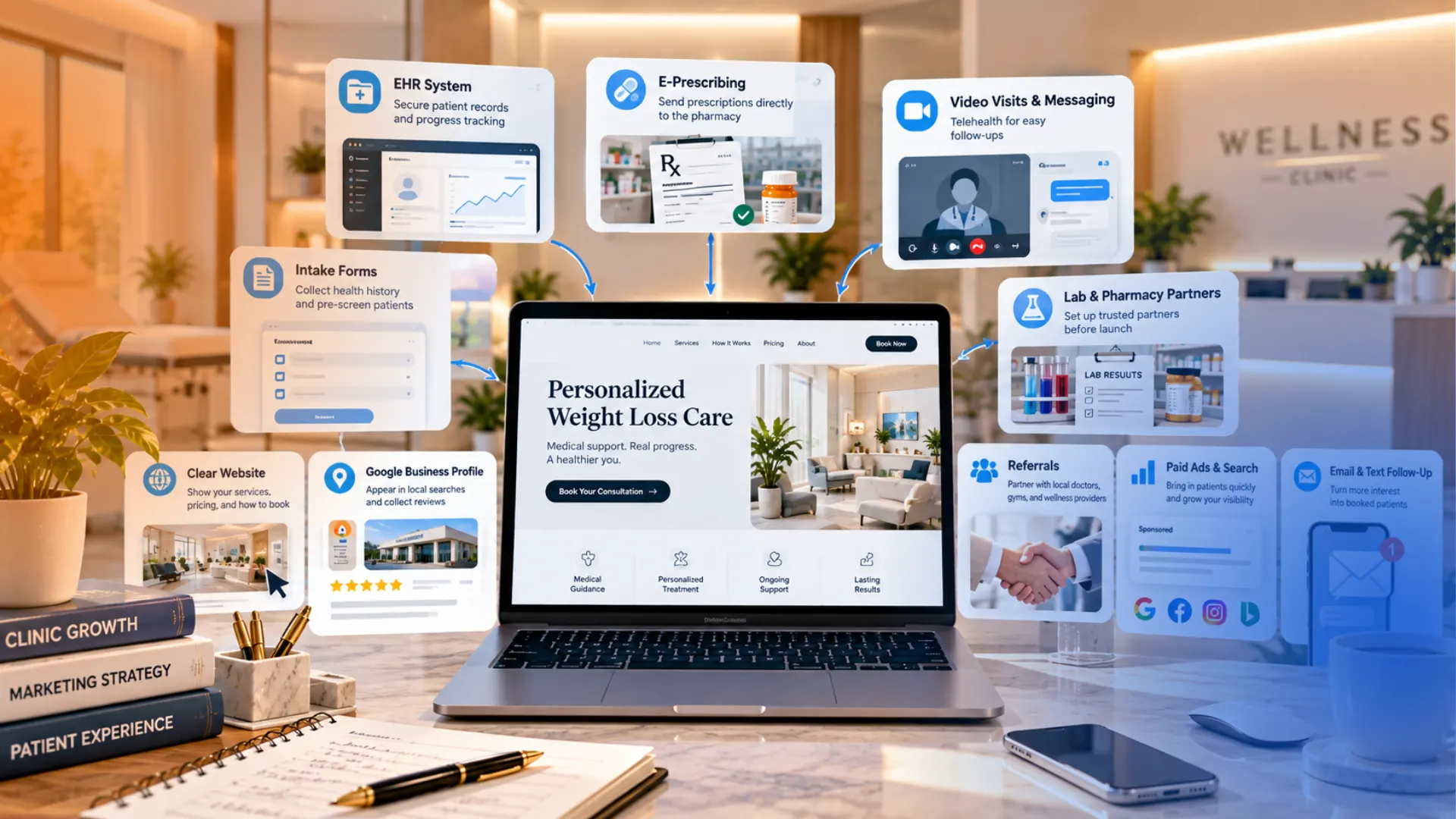
You need the tools to treat patients and a way for patients to find you. It’s best to set up both at the same time, because your marketing should start working weeks before you launch
Your systems
Here’s what most clinics need:
- A health records system (EHR): It should be secure and built for privacy rules, which means HIPAA in the US. In Canada, privacy law differs by province, so confirm your requirements. Look for one that tracks weight and lab results over time, not just single visits
- E-prescribing: This sends prescriptions straight to the patient’s pharmacy
- Video visits and secure messaging: Telehealth weight loss care depends on frequent check-ins, and many follow-ups don’t need an in-person visit
- An intake form: It should collect health history and screen out patients you can’t treat safely before they book
- Lab and pharmacy partners: Set these up before your first patient so you’re not figuring out where to send blood work too on launch day
- A way to take payments: Some payment processors handle prescription weight loss and peptide-related businesses as high risk, so ask about this before you sign up. We cover your options in our guide to the best payment processor for peptide merchants
Getting your first patients
Patients tend to compare clinics before they book. They search, read reviews, and check prices, often at several clinics in one evening. So your online presence has to answer their questions before they call.
Start with these:
- A clear website: Explain who you treat, what a visit looks like, what it costs, and how to book. Hiding prices makes people leave
- A Google Business Profile: This helps you appear in local searches, and it’s where you will collect reviews
- Referrals: Introduce yourself to local doctors, gyms, and wellness providers who see people looking for help
- Paid ads and search: Both of these strategies can bring in patients quickly, but you need time to test them
- Email and text follow-up. Many people won’t book on the first visit, so a reminder often brings them back
Your marketing has to follow the same rules as your medicine. Don’t promise results, and don’t compare a compounded drug to a brand-name one. Ad platforms also have their own rules for weight loss and prescription drug ads, so read them before you spend a dollar. For a closer look at turning clicks into booked patients, read our guide to weight loss clinic lead generation.
Wrapping Up
Starting a weight loss clinic takes more planning than most people expect, but the order is simple. Learn what you can do in your state or province, set up the right legal structure, bring in a physician if you need one, and be careful about what you prescribe and how you advertise it. Then put your systems in place and start finding patients.
Once you’re ready to open, patients still have to find you. Pro Marketer’s weight loss clinic marketing agency team helps new clinics appear in search, run compliant ads, and turn inquiries into booked visits. Book a consultation, and we’ll go through your launch plan with you.
FAQs
1. How much does it cost to start a weight loss clinic?
It depends on your model, your location, and what you offer. A virtual clinic usually costs less than an in-person one because you don’t need rent or a build-out. The main costs are legal fees, licences, insurance, your physician, software, marketing, and staff pay for the first few months.
2. Can a nurse practitioner open a weight loss clinic?
In many US states, yes. A little more than half of the states give nurse practitioners full practice authority, which means they can run their own practice and prescribe without a physician’s agreement. In the other states, an NP needs a collaborating or supervising physician. The list changes as new laws pass, so check the American Association of Nurse Practitioners state map and your state board of nursing.
3. Do you need a doctor to start a weight loss clinic?
You need a licensed prescriber to provide medical care, but not always as the owner. If you’re a physician, you can be your own medical director. In a full practice authority state, a nurse practitioner may not need one. In many other places, a physician has to own or oversee the medical practice, so you’d work with a medical director. Your attorney can tell you which setup your state allows.
4. Can you start a weight loss clinic without a medical license?
Often, yes, as the business owner, but not as the person providing medical care. In states where a physician must own the medical practice, a non-physician can usually run the business side through a separate management company under a written agreement. You can’t diagnose, treat, or prescribe without a licence. You can also offer coaching or nutrition programs that don’t involve medical care. Have a healthcare attorney review your setup.
5. Is a weight loss clinic profitable?
It can be, but there’s no reliable average to promise. Profit depends on how many patients you keep, what you charge, and your costs. Programs that keep patients engaged over time tend to help. The market is also growing. One research firm, Grand View Research, estimates the US medical weight loss clinic market at $1.17 billion in 2024, growing to about $1.5 billion by 2030. Rule changes around compounded GLP-1s could affect clinics that depend on them.
6. How long does it take to open a weight loss clinic?
It depends on your model, your state, and how fast your licences and agreements come through. The legal setup and licensing usually take the longest. A virtual clinic often opens faster than an in-person one because you don’t need to lease or build out space. Start the legal and licensing steps first, since other steps depend on them.
7. Should you start a virtual or in-person weight loss clinic?
A virtual clinic costs less, opens faster, and can reach more people, but you’ll need a plan for labs and for patients who want to see someone in person. An in-person clinic builds local trust and lets you do exams on site, but it costs more and serves only nearby patients. A hybrid clinic offers both. If you want to test demand first, virtual is often the easiest way in.