
TABLE OF CONTENTS
Why Weight Loss Clinic Lead Generation Is Different in 2026
The demand is enormous, but so is the noise
The compliance layer is non-negotiable
The patient decision cycle is long
Patient lifetime value makes the economics work
Retention is part of lead generation
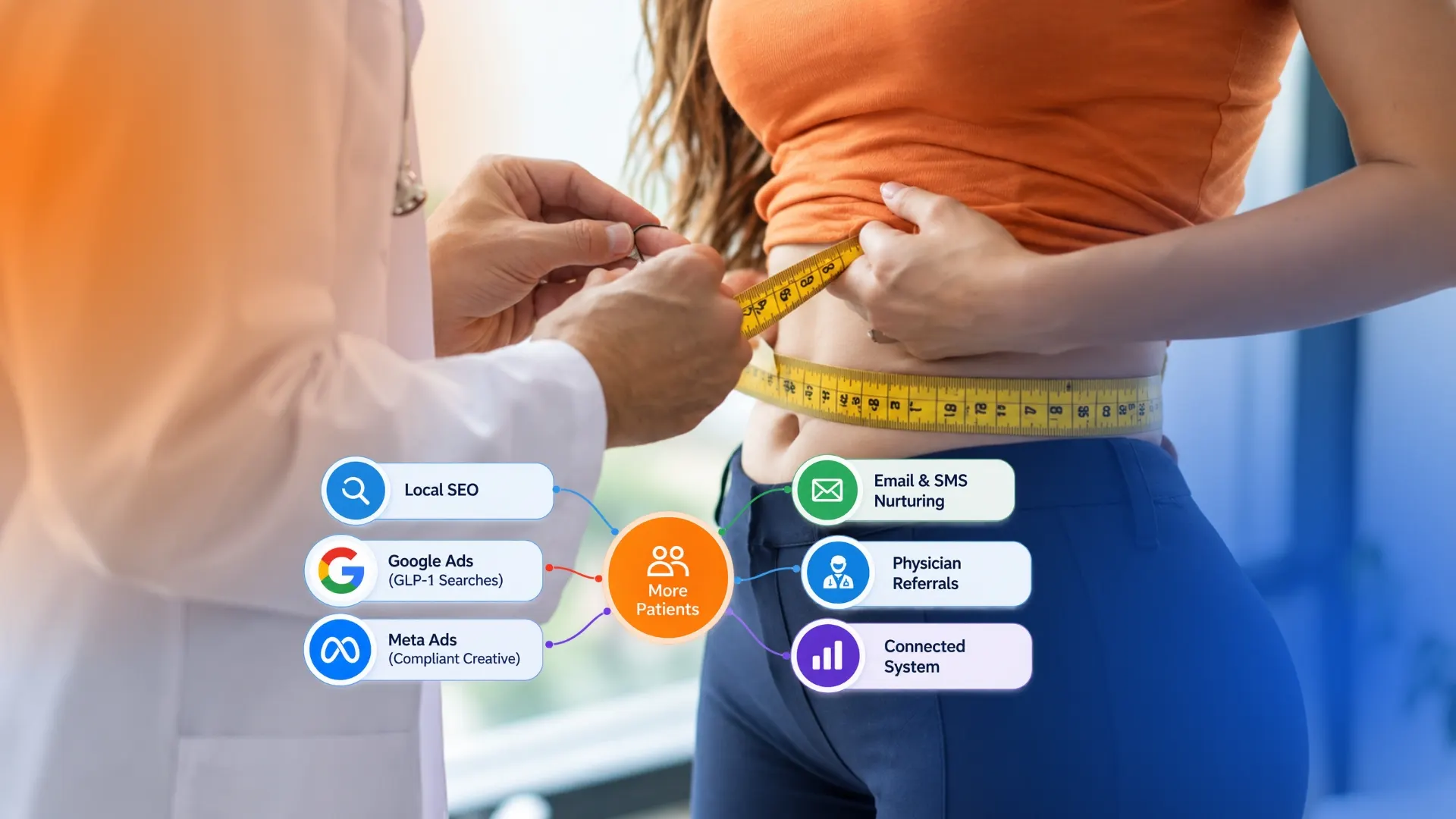
The Weight Loss Clinic Lead Generation System
Strategy 4: Content Marketing and Authority Content
Strategy 5: Email and SMS Nurturing
Strategy 6: Physician Referral Networks
Strategy 7: Patient Referral Programs
- How much does a weight loss clinic lead cost in 2026?
- Can you mention Ozempic, Wegovy, or semaglutide in ads?
- How long does weight loss clinic SEO take to produce leads?
- Should a clinic run Meta ads or Google Ads first?
- Which channel produces the best weight loss clinic leads?
- How fast should a clinic follow up with a new weight loss lead?


Share via:
The most effective weight loss clinic lead generation strategies in 2026 include local SEO, Google Ads targeting GLP-1 searches, Meta ads with compliant creative, email and SMS nurturing, and physician referral networks. Well-optimized clinics are acquiring new patients at a cost per lead of $60 to $180, with patient lifetime values of $3,000 to $8,000 across 12 to 24 months of treatment. The fastest-growing clinics aren't running more ads. They run a connected system where every channel feeds the next.
Medical weight loss has never had more demand than it does right now.
GLP-1 medication searches have increased by 1,200% on Google since 2022. The term "semaglutide near me" alone generates over 100,000 monthly searches.
Nearly 8% of all prescriptions filled in the US in early 2026 were GLP-1 medications. The US medical weight loss market is estimated at over $10 billion annually in 2026, and it is still growing. Over 40% of American adults are classified as obese, and millions of them are actively looking for a medical provider to help them do something about it.
This article covers the strategies that work for medical weight loss clinics in 2026. You’ll learn every channel, every benchmark, and every compliance requirement you need to know before you spend a dollar on patient acquisition.
Why Weight Loss Clinic Lead Generation Is Different in 2026
Before we get into the specific channels, you need to understand what makes medical weight loss patient acquisition different from marketing almost any other healthcare service.
The demand is enormous, but so is the noise
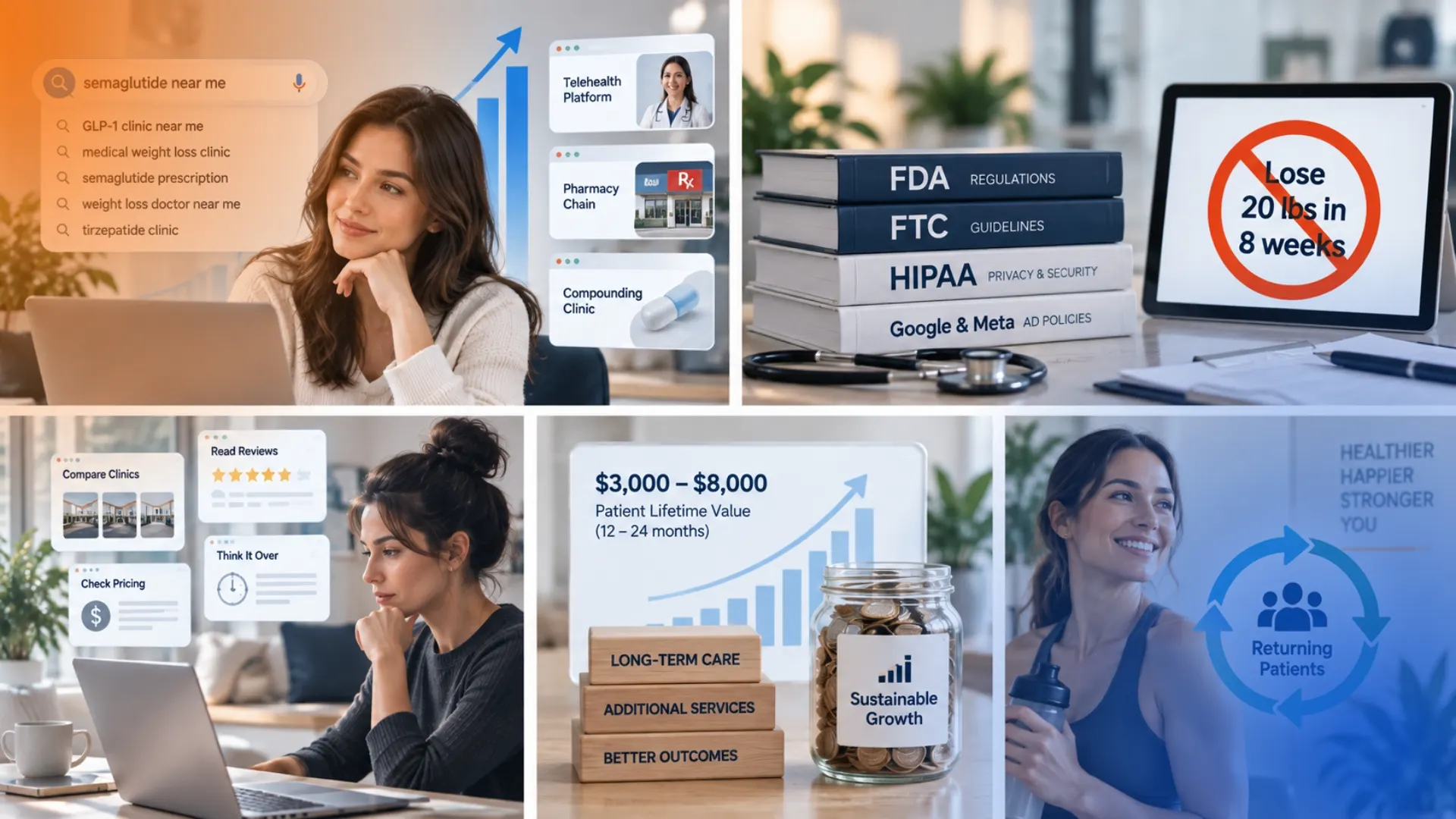
Millions of Americans are actively searching for GLP-1 clinics, semaglutide programs, and medically supervised weight loss. That search volume is real and growing.
But the same demand has attracted national telehealth platforms, retail pharmacy chains, and DTC compounding companies with marketing budgets that most local clinics cannot match.
The compliance layer is non-negotiable
Weight loss clinic advertising operates under four overlapping regulatory frameworks simultaneously.
Food and Drug Administration (FDA) rules govern how you can market compounded semaglutide and tirzepatide following their removal from the FDA shortage list in 2024. Federal Trade Commission (FTC) guidelines require substantiation for any weight loss claim you make.
HIPAA governs how you track, store, and use patient data in your digital marketing infrastructure. And Google and Meta platform policies also have their own compliance rules.
A single non-compliant headline like "lose 20 lbs in 8 weeks" can get your Google Ads account banned. In 2026, 73% of healthcare advertisers get rejected on Meta for noncompliance.
The patient decision cycle is long
Most weight loss leads do not book on the first contact. They research multiple providers, compare pricing, read reviews, and think about it for days or weeks before they call.
That means the nurturing sequence between first inquiry and booked consultation is where most clinics either win or lose the patient. A lead that goes unanswered for 24 hours will move on to a competitor.
Patient lifetime value makes the economics work
A medical weight loss patient on a GLP-1 program requires 12 to 24 months of medically supervised care.
Patient lifetime value ranges from $3,000 to $8,000 depending on program length and add-on services. That means a patient acquisition cost of $150 to $400 is sustainable and profitable when the patient completes their program.
Clinics that understand this invest aggressively in patient acquisition because they know the ROI they’d get back.
Retention is part of lead generation
The national average 6-month retention rate for weight loss programs is only 40 to 55%. That means most clinics lose the majority of their patients within the first year, along with the recurring program revenue those patients represent.
Clinics with good retention programs generate 40 to 60% of revenue from returning clients. So every patient you keep is a patient you do not need to replace with a new one.
The Weight Loss Clinic Lead Generation System
Here is what a weight loss clinic lead generation system looks like:
- Search captures patients who are already looking
- Social media reaches patients who are not looking yet but will be
- Content builds the authority that makes both channels more effective
- Email and SMS nurture the leads both channels produce
- Reviews and reputation feed the visibility that local search depends on
- CRM connects everything so no lead is left unattended to
If you run any one of these channels in isolation, you will get limited results. But if you run them as a connected system, patient acquisition costs drop while your pipeline grows.
With this in mind, here are the channels and strategies to use for each channel.
Strategy 1: Local SEO
For most weight loss clinics, local SEO is the highest-ROI channel in the entire lead generation system. Here is why.
When a patient decides they want medical help losing weight, they do not browse national directories or scroll through telehealth comparison sites. They open Google and type something like "medical weight loss clinic near me," "GLP-1 clinic Toronto," or "semaglutide doctor [their city]."
These are high-intent searches from patients who have already decided to seek medical help and are comparing providers. The clinic that appears at the top of local results at that moment will be the one they book a consultation with.
National telehealth apps and DTC platforms cannot compete in local results the way a well-optimized local clinic can. Once you own the local search results for medical weight loss in your market, every other channel you run becomes more effective because patients can find and verify you easily.
What local SEO for weight loss clinics involves:
1. Your Google Business Profile: It needs to be fully optimized with your correct NAP information, service categories that include medical weight loss and GLP-1 programs, a description that uses the language patients actually search for, and recent patient reviews
2. Your website: It needs to have dedicated service pages for each program you offer. A general "weight loss" page is not enough. You need separate, content-rich pages for your GLP-1 program, your physician-supervised weight loss program, your body composition assessment, and any other specific services you offer. Each page needs to be optimized for the location-specific keywords patients are searching.
3. Citation consistency: Inconsistent name, address, and phone information across the web actively suppresses your local search rankings.
How long does it take?
Organic ranking movement for local terms takes 60 to 90 days. For competitive non-local content, it takes about six to twelve months.
Strategy 2: Google Ads
A well-structured Google Ads campaign can put your weight loss clinic at the top of search results the day it launches, making it the right investment for a new clinic or one entering a new market.
Not every person searching for weight loss information is ready to book a consultation. Some are just curious about whether GLP-1 medications work. Some are comparing providers. Others have already decided and are actively looking for a clinic to call right now. You want to advertise to the last group.
These are the bottom-funnel searches. The ones that produce booked consultations, not just clicks.
Keywords like "medical weight loss clinic near me," "GLP-1 doctor [city]," "semaglutide prescription [city]," "physician supervised weight loss [city]," and "weight loss injection clinic near me" all signal that the patient is ready to act.
Build your Google Ads campaigns around these terms first. Once that's working, you can expand upward into broader awareness keywords. But it's always best to start where the intent is highest.
Google Ads compliance for weight loss clinics is strict
- You cannot promise specific pounds lost or specific timelines
- You cannot imply FDA approval for compounded medications
- You cannot make claims that cannot be substantiated
A single headline like "lose 20 lbs in 8 weeks" can get your entire account flagged. The best compliant approach is to advertise your clinic as a provider of medical weight management with GLP-1 prescription evaluation.
Keep your ad copy clinical, not promotional. Let patients make their own treatment inquiries.
Google Ads for weight loss programs cost about $70 to $150 per lead in most US markets, with average cost per click between $5 and $25 depending on competition.
Landing page conversion rates for consultation requests are usually between 8 and 15% with optimized pages, compared to 1 to 3% for most unoptimized clinic websites.
You should run Local Service Ads (LSA) along with traditional Google Ads campaigns. They appear above regular search ads and carry a Google Guaranteed badge that improves click-through rates for healthcare searches. LSA approval requires verification of professional licensing, insurance, and a background check.
Strategy 3: Meta Ads
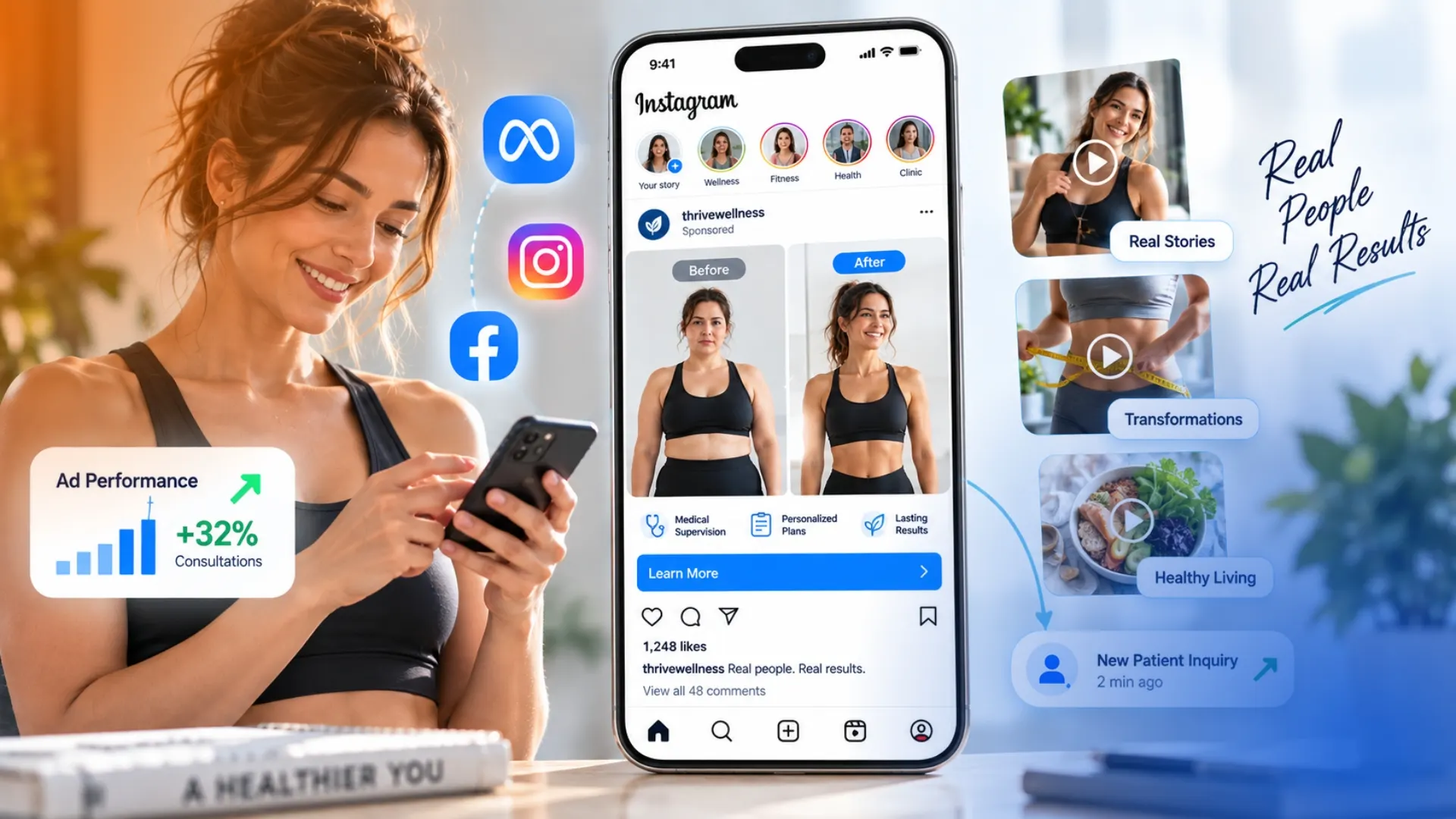
Facebook and Instagram transformation content drives 20 to 40% of new patient consultations for active weight loss clinics.
A patient scrolling Instagram who sees a real person's results from a medical weight loss program was not searching for anything. They were not in buying mode. But that before-and-after stopped them mid-scroll. That "that could be me" moment is the beginning of their patient journey.
Before and after body weight transformation images in a weight loss context were previously automatically rejected by Meta's content moderation system.
As of July 22, 2026, Meta stopped automatically rejecting side-by-side and before-and-after imagery for weight loss ads, moving to a claims-based review instead. This means you can now run real patient transformation photos on Facebook and Instagram, provided your claims are honest, specific, without overpromising, and accompanied by proper patient consent documentation.
What HIPAA requires for patient photos in ads
Patient photos are protected health information. You need the patient's signed written authorization specifically allowing marketing and advertising use before any image appears in an ad.
This is separate from Meta's policy. It is a HIPAA requirement that applies regardless of platform. These patient consent forms for marketing materials are non-negotiable.
What Meta's ad policy still prohibits
Ad copy cannot imply knowledge of an individual's health status. Saying something like "we saw you were researching weight loss" or "struggling with obesity?" is explicitly prohibited.
Health claims that imply guaranteed outcomes are also prohibited. And before-and-after content still needs to be honest.
Saying "lost 47 lbs in 6 months under medical supervision" with appropriate individual results disclosure is compliant. However, saying "lose 50 lbs guaranteed" is not.
On HIPAA and tracking
Have someone who understands HIPAA marketing compliance review your Meta pixel setup before you run your first campaign. Standard pixel configurations that track form submissions and page-specific visits can expose patient health information and create liability.
Meta ad cost per lead for weight loss clinic consultations is lower than Google Ads CPL because the intent at the point of contact is lower. However, Meta leads require more nurturing before they convert to booked appointments.
Strategy 4: Content Marketing and Authority Content

Content marketing drives six times more ROI than traditional advertising while costing 62% less.
A patient researching medical weight loss in 2026 is also reading about how GLP-1 medications work, whether semaglutide or tirzepatide is right for them, the side effects, how long treatment takes, and what results are realistic.
They are doing this research across multiple sessions over days or weeks before they ever contact a clinic. The clinic whose content answers these questions clearly, honestly, and with medical credibility wins the patient's trust before the first consultation is ever booked.
Educational blogs on topics like "The Science of Semaglutide," "How to Maintain Muscle Mass During Weight Loss," and "What to Expect in Your First 90 Days on a GLP-1 Program" create long-term assets.
Unlike a paid ad that stops working the second you stop paying, a well-optimized blog post keeps attracting traffic and generating medical weight loss leads for years.
Right now, Google's Search Generative Experience, Perplexity, and similar platforms are increasingly serving patients direct answers instead of a list of blue links.
AI systems cite clinics whose content is structured as clear, expert-level answers to specific patient questions. Clinics that don't produce authority content are becoming invisible to many patients who never click through to a traditional search result.
Strategy 5: Email and SMS Nurturing
Most weight loss leads do not convert on the first contact; that is why a consistent nurture sequence between first inquiry and booked consultation is one of the highest-leverage investments in medical weight loss marketing.
Email works best for education and trust-building. Start with a simple sequence: a welcome email on day one, followed by educational content about your program and GLP-1 medications in the first two weeks, then a consultation reminder and a patient story.
SMS outperforms email for weight loss patient retention by large margins. A patient who receives an SMS on the morning of their appointment is far less likely to miss it than one who receives only an email reminder.
Also, subject line best practices for weight loss clinic email marketing involve:
- Keeping subject lines under 45 characters for mobile display
- Avoiding spam trigger words like "FREE," "Act Now," and "Guaranteed"
- Using natural conversational language that mirrors how patients speak
For instance, saying "Your questions about GLP-1 programs, answered" will consistently outperform "HUGE weight loss results waiting for YOU."
Strategy 6: Physician Referral Networks

One active primary care physician referral generates three to eight new patients every month, at zero cost per lead. You might be tempted to ignore this channel completely, but that would be a mistake.
Primary Care Providers (PCPs) see patients with Type 2 diabetes, hypertension, sleep apnea, and elevated cardiovascular risk every single day. These are exactly the patients who need medical weight loss.
A PCP who knows your clinic and trusts your outcomes is not just sending you referrals. They are sending you pre-qualified patients who already have a doctor telling them to lose weight. That is the warmest lead you can get.
Building these relationships takes time, but you can do it by:
- Inviting PCP offices to an educational lunch where you walk them through your program protocols and patient outcomes
- Creating a simple co-management protocol for shared patients
- Giving them a one-page referral form
Endocrinologists and cardiologists managing obesity-related conditions are equally good referral partners and are even more motivated to find a trusted clinic they can send patients to.
If a single PCP sends you five referrals per month at a patient lifetime value of $5,000, that is $25,000 in monthly revenue. This comes from one relationship that costs nothing to maintain once established.
Strategy 7: Patient Referral Programs
Patients who achieve weight loss results are among the most motivated referrers in any healthcare category. They want to share what worked for them. The problem is that most weight loss clinics never systematically ask.
Referral programs generate 20 to 30% of new patient acquisition at zero cost per lead for the clinics that run them properly.
A structured referral program does not need to be complicated. Here’s what you can do:
- Reach out automatically when a patient hits a meaningful milestone
- Make the referral process simple
- Offer something worthwhile for both the patient referring and the new patient they bring in
- Do those three things consistently, and referrals can become a source of new consultations within 60 to 90 days
The timing of the ask is also important: A patient at week six who just hit their first real milestone is in a completely different headspace from a patient in week one who is still adjusting to the medication. Ask too early, and you get nothing. Ask at the right moment, and you get a patient who genuinely wants to tell people about what is working for them.
Final Thoughts
Medical weight loss has never had more patient demand. GLP-1 medications have brought millions of people into this category. Search volume and patient intent are high, and patient lifetime value makes aggressive medical weight loss marketing more compelling.
If you want help building a connected weight loss clinic marketing system that generates consistent, qualified medical weight loss leads without the compliance risk, book a free consultation with Pro Marketer. We work with weight loss clinics and medical practices to build the patient acquisition systems that fill consultation schedules and grow revenue month over month.
FAQs
1. How much does a weight loss clinic lead cost in 2026?
Well-optimized clinics are acquiring new patients at a cost per lead of $60 to $180. Google Search ads cost $70 to $150 CPL. Meta ads cost less but require more nurturing before converting. Patient acquisition costs of $150 to $400 are sustainable when patient lifetime value ranges from $3,000 to $8,000 across 12 to 24 months of treatment.
2. Can you mention Ozempic, Wegovy, or semaglutide in ads?
Yes, but carefully. You cannot imply FDA approval for compounded semaglutide or tirzepatide following their removal from the FDA shortage list in 2024. The safest approach is to describe your clinic as a provider of medically supervised weight management with GLP-1 prescription evaluation rather than naming specific branded medications in ad copy.
3. How long does weight loss clinic SEO take to produce leads?
Local terms show meaningful ranking within 60 to 90 days. Competitive non-local content takes six to twelve months. Clinics that invest consistently in SEO end up with patient acquisition costs that drop year over year, while competitors paying only for ads watch their cost per lead.
4. Should a clinic run Meta ads or Google Ads first?
Google Ads first. It captures patients already searching and ready to book. Meta reaches patients who aren't searching yet but will be. Get consistent patient flow from Google first, then add Meta to build the awareness pipeline that feeds search demand.
5. Which channel produces the best weight loss clinic leads?
Local SEO produces the best quality leads over time. Google Ads produces the best immediate leads. Physician referral networks produce the highest-converting leads because referred patients arrive with clinical validation already in place. The highest-performing clinics use all three channels.
6. How fast should a clinic follow up with a new weight loss lead?
Within five minutes. A lead that goes unanswered for 24 hours converts at a lower rate than one contacted immediately. Patients are highly motivated when they submit an inquiry. Automate your initial response so no lead waits more than a few minutes, no matter when they come in.

.svg)
.avif)

.svg)