

TABLE OF CONTENTS
Why SEO Is Important for Peptide Brands That Can't Run Paid Ads
How Google Judges Peptide Websites: YMYL, E-E-A-T, and Topical Authority
E-E-A-T signals peptide sites need
Compliance First: What Peptide Brands Can and Can't Publish
Why research use only (RUO) claims don't protect you
Peptide Keyword Research for 2026
Product Pages, COA Pages, and Content That Rank
Certificate of Analysis (COA) pages
Educational content that builds topical authority
Technical SEO for Shopify and WooCommerce Peptide Stores
AI Search and AEO for Peptide Websites


Share via:
Peptide SEO involves earning visibility for a peptide brand on Google and in AI answers without relying on paid ads. It combines compliant content, strong E-E-A-T signals, clean technical SEO, and accurate product schema markup.
In August 2026, five online peptide sellers got FDA warning letters. Although their products were labelled "research use only," that didn't help. The FDA read their websites and judged what the products were for.
That is the risk behind peptide SEO. Your pages aren’t just for ranking. They show Google, AI tools, and regulators what you sell and why.
This guide explains how peptide brands can rank on Google and in AI search without getting flagged. You will learn how Google judges and ranks peptide sites, what you can and cannot publish, and how to build product pages, COA pages, and content. You will also learn how to fix technical SEO issues, appear in AI answers, and budget for it.
What Is Peptide SEO?
Peptide SEO is the practice of improving how a peptide website ranks on Google and appears in AI answers. Instead of paid ads, it relies on compliant content, technical fixes, and trust signals.
It's different from regular ecommerce SEO in three ways:
- First, compliance limits what you can say, because the FDA and FTC look at what your pages claim. A page that ranks but makes a drug claim is a legal risk
- Second, Google holds health pages to a higher standard of accuracy and trust
- Third, many peptide searches ask about dosing or results, which your site may not be able to honestly answer
Who needs SEO for peptides?
- Skincare and collagen brands that follow standard cosmetic and supplement claim rules
- Research peptide suppliers that sell to qualified labs
- Peptide clinics and telehealth providers that offer peptide therapy and are in need of peptide therapy SEO and peptide clinic SEO
- Wellness or DTC brands that sell peptide-related products directly to consumers
If you want one team to handle SEO, ads, email, and CRO for any of these, check out our peptide marketing services.
Why SEO Is Important for Peptide Brands That Can't Run Paid Ads
Paid ads are the fastest channel for most ecommerce brands. But for peptides, they're the hardest marketing channel to use.
Google places peptides under its Healthcare and Medicines policy, and its unapproved pharmaceuticals and supplements policy prevents promoting unapproved products as safe or effective for treating disease. Telehealth clinics also need LegitScript certification plus a separate Google certification.
Meta also limits certain health claims and product categories, so peptide ads usually get rejected. Then there's the payment issue. Many peptide merchants are treated as high risk, so read our guide to the best payment processor for peptide merchants before proceeding.
Organic search has different rules. Google's spam policies and ranking systems govern it, so an indexable, original, honest, and useful page can be eligible to rank. But eligible doesn't mean lawful. Selling an unapproved drug is a legal problem wherever you rank.
How Google Judges Peptide Websites: YMYL, E-E-A-T, and Topical Authority

YMYL content
Google uses the term Your Money or Your Life (YMYL) for topics that can affect health, safety, or finances, and peptide content falls in that category. Google expects accurate pages that match expert consensus.
E-E-A-T signals peptide sites need
E-E-A-T stands for experience, expertise, authoritativeness, and trust. It isn't a single ranking factor. It's how Google describes what good pages look like, and trust is the most important.
You build trust with real authors who show their credentials, plus a scientific or medical reviewer when the topic needs one.
You also link to FDA pages and peer-reviewed studies right next to the claims they support, and you show clear business details like your address, contact info, and policies.
Keep those details identical across your site. Batch-level COAs and clear specifications help too, because they show your quality instead of just claiming it. And never invent experts. It's deceptive, and it destroys trust fast.
Topical authority
Topical authority means Google sees your site as a deep, reliable source on one subject. You don't get it from random posts. You get it from connected content.
Pick a core topic, like peptide quality and testing, then publish a hub page and supporting articles that link to each other.
Compliance First: What Peptide Brands Can and Can't Publish
The FDA classifies a product by its intended use, and it reads your whole website to decide what that is.
So your content isn't just a ranking asset. It's evidence of what you say your product is for.
Why research use only (RUO) claims don't protect you
Lots of sellers add a research use only (RUO) label and assume they're covered. The FDA disagrees with this approach.
In a March 31, 2026 warning letter to Gram Peptides, the agency pointed to website claims about weight management and appetite despite the RUO labels.
On August 24, 2026, it sent more letters to five online sellers, including TXP Innovations, doing business as Tex Peptides. Law firm summaries of those letters say dosing information, injection instructions, and dose calculators showed intended human use.
For SEO, that means titles, meta descriptions, image alt text, schema, calculators, and blog posts can all become part of a claim.

In Canada, injectable peptides are regulated as prescription drugs and need Health Canada authorization. Our overview of whether it's illegal to sell peptides explains the details.
NOTE: This section is general marketing guidance, not legal advice. Ask a qualified regulatory adviser to review any page about a product whose status is unclear.
Peptide Keyword Research for 2026
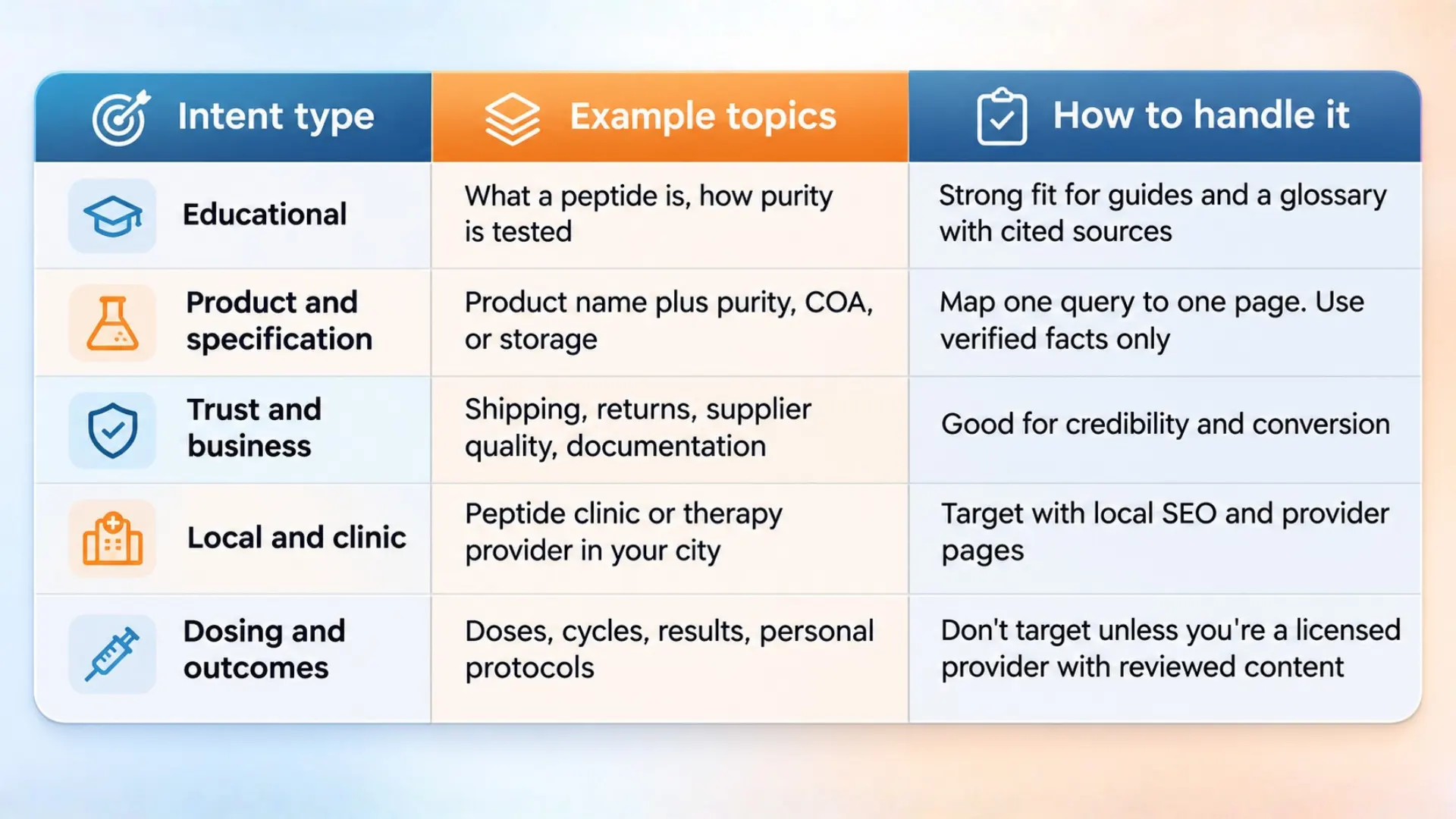
When you build a list of research peptide SEO keywords for 2026, always check difficulty and volume.
Use numbers like these to judge competition. Many high-volume compound searches come from people looking for human-use advice, so choose terms your site can answer within the rules above.
Search Console, your site search, and customer emails will show you what potential buyers want to know.
Product Pages, COA Pages, and Content That Rank
Product pages
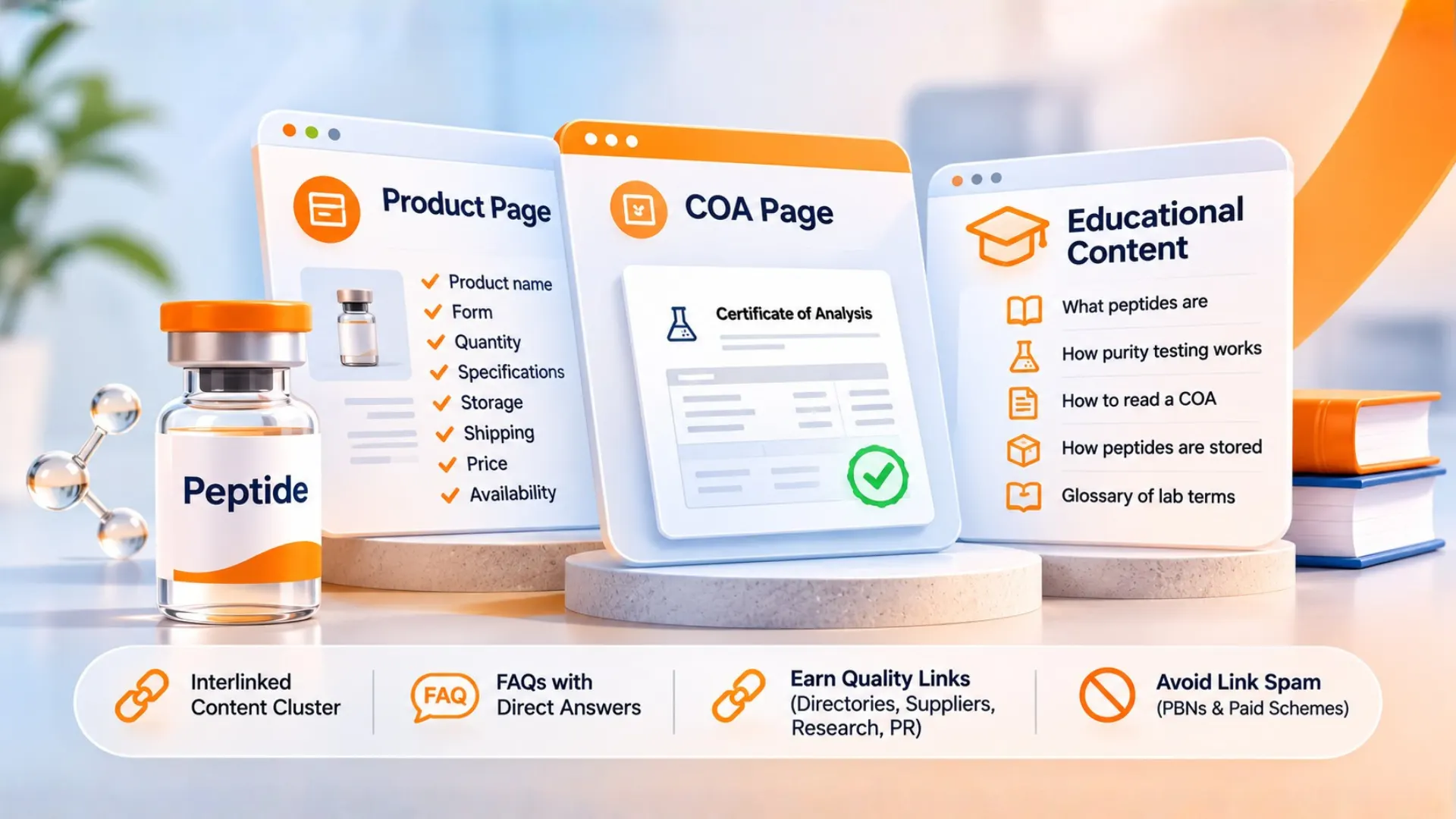
Write every product page yourself. Pasting the same supplier text across hundreds of listings is thin content, and it won't rank. Each page should have the:
- Product name
- Form
- Quantity
- Verified specifications
- Storage
- Shipping
- Price
- Availability
Link to the batch COA, and keep titles, headings, and meta descriptions free of claims.
Certificate of Analysis (COA) pages
A Certificate of Analysis (COA) is a lab report for a specific batch that shows identity and purity test results.
COA pages build trust with buyers, and they give Google a clear quality signal:
- Make them easy to find and link to
- Show the COA for the batch that's in stock
- Compress the images so they don't slow your pages down
Educational content that builds topical authority
Build a small cluster around one topic. A hub page on what peptides are and how quality is tested works well. Then add supporting pages on how purity testing works, how to read a COA, how peptides are stored, and a glossary of lab terms:
- Every supporting page should link back to the hub and to related pages
- Add a short FAQ to each one
- Put the direct answer in the first sentence under each question
Focus on earning links from industry directories, supplier lists, research citations, and digital PR. Skip private blog networks and paid link schemes, since Google's link spam policies cover them.
Technical SEO for Shopify and WooCommerce Peptide Stores

Here's the technical SEO checklist we use most for Shopify and WooCommerce.
- Start with indexing: Check robots.txt, noindex tags, and the Crawled, currently not indexed report in Search Console, because a staging setting left on after launch can block a whole store
- Next, look for duplicate URLs: Filters, sorting, and tags can create thousands of crawlable duplicates, so use canonical tags and clear crawl rules
On Shopify, confirm that product URLs under collections point to the main product URL. On WooCommerce, check filter plugins and tag pages. Then check your site structure, speed, and security.
Keep the path from the homepage to a category to a product short, with descriptive internal links.
Heavy themes, large images, and extra scripts negatively affect Core Web Vitals, so use modern image formats and lazy-load COA images.
Keep your sitemap to live, indexable, canonical URLs. And watch for hacked content, because health stores attract spam redirects.
Product schema markup
Product schema markup helps search engines read your price, availability, and specifications.
Include the name, SKU, brand, price, currency, availability, and verified specifications. Make sure every value matches the visible page text, and leave out any property that states a health benefit. Then validate it with Google's Rich Results Test.
FAQ markup rarely produces quality results for most sites now. But the questions and answers still help readers, and AI tools understand the page.
AI Search and AEO for Peptide Websites
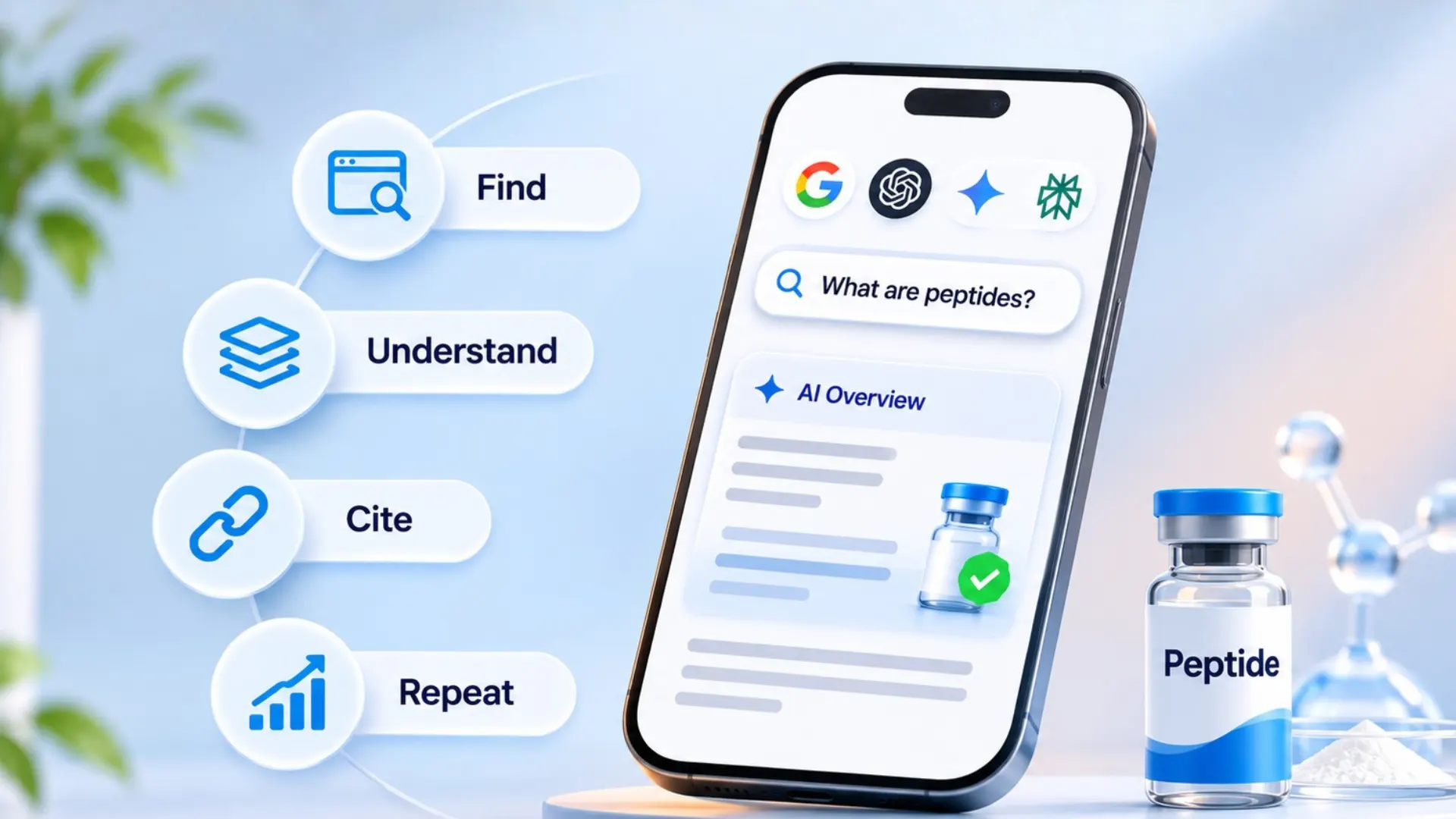
Answer engine optimization (AEO) is the process of making your pages easy for AI tools to find, understand, and cite.
Google says that there are no additional requirements to appear in AI Overviews or AI Mode, and no special optimizations are needed. Your page just has to be indexed and eligible to appear with a snippet. And nobody can guarantee a citation in Google or in tools like ChatGPT.
You can achieve AI citations using traditional SEO:
- Let crawlers in through robots.txt and your CDN
- Put a direct answer at the top of each section, define your terms, and cite your sources
- Name your authors with their credentials
- Keep company details consistent across your site and profiles
- Link your pages together.
Google counts traffic from AI features in the overall search traffic in Search Console. For ChatGPT, Gemini, and Perplexity, we recommend testing real customer questions each month and logging which sources get cited.
If you want a specialist, our AI SEO team runs AI visibility audits, tracks citations. and helps you get cited on AI search engines.
How Long Does Peptide SEO Take, and What Does It Cost?
Peptide SEO usually takes three to six months before you see clear ranking and traffic gains. Better results usually take six to twelve months, but it depends on site age, competition, and page quality.
Ahrefs' 2026 survey of 439 providers discovered that the average agency retainer is about $3,209 a month, and most businesses spend between $1,500 and $5,000 a month, based on agency pricing guides.
Peptide SEO can cost more than basic ecommerce SEO because every page needs a claim review.
Wrapping Up
Those five sellers didn’t get FDA letters because their SEO was bad. They got them because their pages showed what the products were really for. In peptide marketing, your website is your evidence.
Make sure you audit your pages for risky claims. Then fix your indexing and publish COAs in batches.
Want help? Pro Marketer starts every peptide SEO project with a compliance audit. Book a free consultation with Pro Marketer, and we’ll review your site together.
FAQs
1. What is peptide SEO?
Peptide SEO is the practice of improving how a peptide website ranks on Google and appears in AI answers. It uses compliant content, technical SEO, and trust signals instead of paid ads. Because health content is YMYL, it also needs careful review of claims.
2. Why is SEO so important for peptide brands that can't run paid ads?
Google, Meta, and many payment processors restrict peptide brands, so paid channels are unreliable. Organic search follows different rules and keeps working without a cost per click. That makes SEO a more reliable way to reach potential buyers.
3. What content can peptide brands publish without breaking FDA or FTC rules?
The FDA judges intended use based on your entire website, and an RUO label doesn't protect you. Lower-risk content includes specifications, batch COAs, company policies, and neutral science explainers with cited sources. Avoid disease claims, dosing, injection instructions, calculators, and personal result testimonials. The FTC also expects strong scientific evidence for health claims.
4. How much does peptide SEO cost?
General SEO retainers cost about $3,209 a month, and many businesses spend $1,500 to $5,000. However, peptide SEO may cost more because pages need claim review.