

TABLE OF CONTENTS
What Is Skincare Product Development?
The Skincare Product Development Process: Step by Step
Step 1: Market Research and Product Concept
Step 2: Ingredient Sourcing and Selection
Step 3: Skincare Formulation Development
Step 5: Skincare Product Testing
Step 8: Skincare Product Manufacturing
Step 9: Launch and Post-Launch Optimization


Share via:
Quick Answer: Skincare product development is the process of taking a skincare idea from concept through formulation, testing, regulatory compliance, packaging, and manufacturing into a finished product ready for sale. The full process typically takes 6 to 24 months, depending on your product complexity and the route you choose. Costs range from $8,000 for a simple private-label product to $50,000 or more for a fully custom-formulated skincare line.
So, you finally have an idea for a skincare product, and you have spotted a gap in the market that bigger brands are not filling. Well congratulations! The idea is the easy part, and you’ve successfully scaled that; now comes the hard part.
You need to think of formulation, testing, suppliers, packaging, regulations, and manufacturing. Most first-time founders underestimate how many steps are involved in skincare product development and how long each one takes.
To launch successfully, you need to understand the process, plan for the real costs and timelines, and make smart decisions at each development stage before committing to the next.
This guide contains the complete skincare product development process in 2026.
You will discover how formulations work, how to develop a skincare product, what testing is required, which regulations apply to skincare products in Canada and the US, how to choose a manufacturer, what packaging development involves, and the realistic budget and timeline you should prepare for.
What Is Skincare Product Development?

Skincare product development is the end-to-end process of creating a skincare product from an initial concept to a finished, compliant, market-ready product.
It involves every decision and action between your idea and the moment a customer opens your product for the first time.
Most people think of skincare product development as just the formulation. But the actual process is much broader than that. It includes:
- Defining your product concept and target customer
- Choosing your development route
- Working with a chemist or manufacturer to develop or select a formula
- Sourcing ingredients
- Conducting stability and safety testing
- Navigating regulatory compliance
- Designing your packaging
- Manufacturing your first production run
- Launching to market
There are two main routes for how to develop a skincare product:
1. The first is private label skincare development: Here, you select an existing formula from a manufacturer's catalogue, brand it as your own, and go to market. This is the fastest and most affordable route. It is how most new skincare brands launch their first products. The formula is not exclusive to you, but the brand, packaging, and positioning are entirely yours.
2. The second route is custom formulation: You work with a cosmetic chemist or a manufacturer's in-house R&D (Research and Development) team to create a proprietary formula built specifically for your brand. You own the formula. Nobody else can make the same product. This route takes longer, costs more, and requires more technical input from you, but it gives you a differentiated product that competitors cannot replicate by placing the same order with the same supplier.
Understanding which route is right for your brand at this stage of your business is one of the most important decisions in the skincare product development process, as it shapes your timeline, budget, manufacturer options, and how quickly you can get your product to the market.
The Skincare Product Development Process: Step by Step
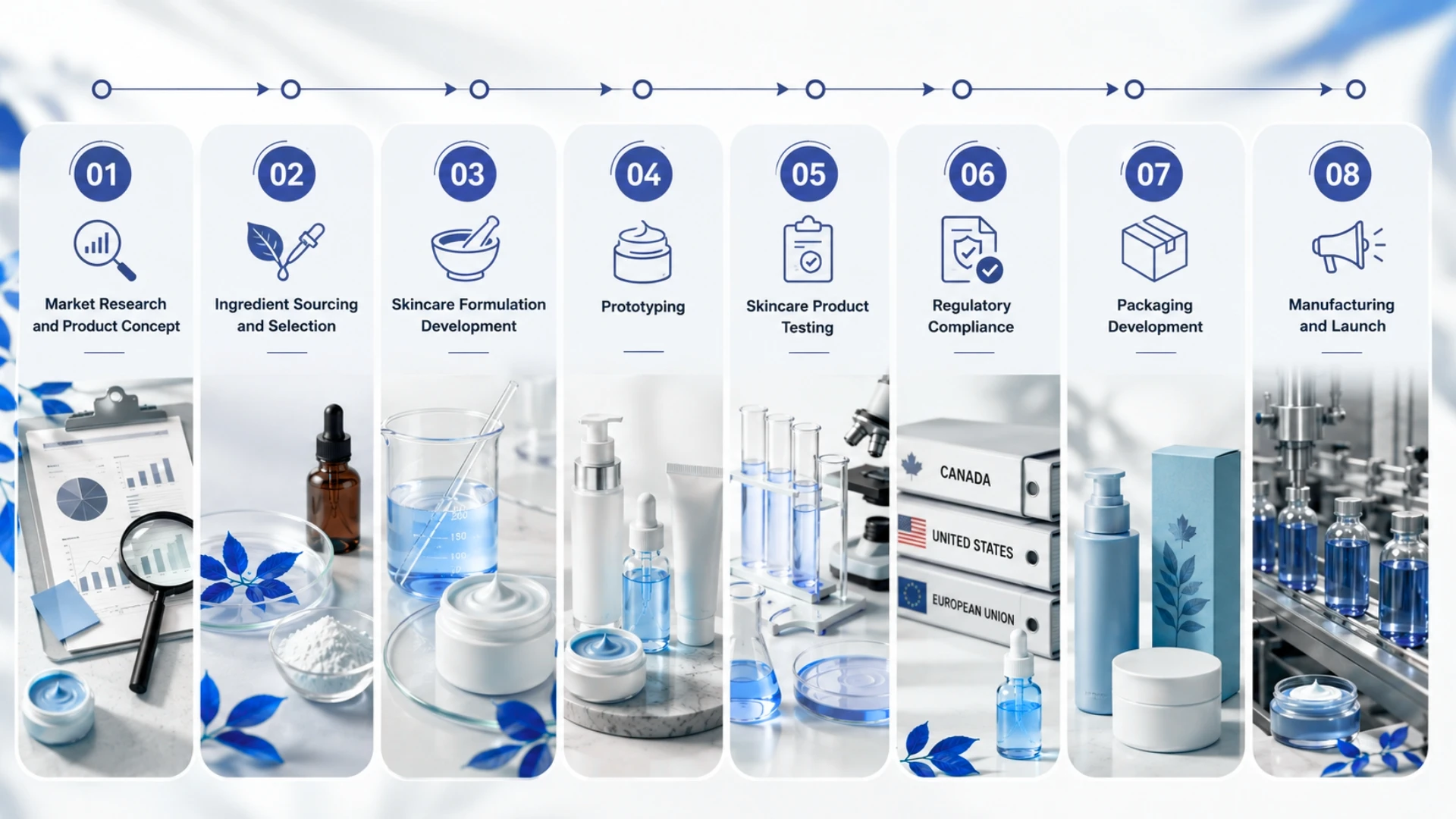
Skincare product development is a sequence of connected stages that ultimately leads to the launch of your skincare brand. Skipping or rushing any stage will create problems for you later, usually expensive ones.
Step 1: Market Research and Product Concept
Before you touch a formula, you need to understand the market you are entering. This means:
- Studying your competitors
- Identifying gaps they are not filling
- Understanding exactly who your customer is and what problem they have that your product will solve
A lot of founders skip this step and jump straight to formulation. This causes you to create a good product that nobody actually wants to buy.
Good market research tells you what your product needs to do, what claims are realistic, what price point the market will support, and how your brand needs to position itself to stand out.
It also forces you to define your unique selling proposition so you don’t spend money on formulation, testing, or packaging.
Your concept should be documented in a product brief before any formulation work begins. The brief should include your:
- Target audience
- Intended skin type
- Key benefits
- Desired texture and format
- Packaging preferences
- Claims you want to make
The document will become the reference point for every decision that you make.
Step 2: Ingredient Sourcing and Selection
Once your product concept is clear, the next stage is to select the ingredients you will use to formulate the product.
Every ingredient in your formula needs to be chosen based on three things:
- Proven efficacy for your intended claims
- Safety for your target skin type
- Regulatory compliance in every market where you plan to sell.
To achieve this, you need to work with suppliers who can provide full documentation for every ingredient, including Certificates of Analysis, Safety Data Sheets, and sourcing information.
If your brand positioning includes clean, organic, or sustainably sourced claims, your ingredient sourcing needs to be supported by documentation, not just marketing language.
It’s also important that you test your ingredient compatibility early. Some active ingredients lose potency or become unstable when combined with certain bases or other actives. A cosmetic chemist can run feasibility checks to flag potential problems before they become expensive ones.
Step 3: Skincare Formulation Development
This is the stage most people think of when they hear skincare product development. It is called the formulation stage.
A cosmetic chemist or your manufacturer's in-house R&D (Research and Development) team takes your product brief and ingredient selections and develops a formula for you. To do this, you’d have to:
- Choose a base
- Integrate your active ingredients at the right concentrations
- Balance the formula for stability, texture, pH, and performance.
The first formulation is rarely the final one. You should expect multiple rounds of iteration where the chemist adjusts ingredient ratios, modifies the base, or swaps out components that are not performing as expected.
In this stage, you will evaluate each iteration for texture, absorption, scent, colour, and its alignment with the sensory profile you defined in your product brief.
NOTE: Custom formulation gives you a proprietary formula that belongs to your brand. Private label development means selecting from a manufacturer's existing catalogue of proven formulas and branding it as your own.
The right choice depends on your budget, timeline, and the level of product differentiation you need to compete in your chosen category.
Step 4: Prototyping
Once the formulation reaches a stable state, a physical prototype is developed. This is as close to the final product as possible.
It is produced in a small batch using the intended ingredients, packaging, and manufacturing process.
The prototype is what you evaluate before committing to full-scale testing and production.
Before committing, we recommend you do the following:
- Check the texture, spreadability, and absorption against what you described in your product brief
- Confirm the formula dispenses correctly from the intended packaging
- Assess the colour and scent under different lighting and temperatures
Prototyping is also where you see early red flags, such as separation, pH drift, or changes in consistency, that indicate the formula is not as stable as it needs to be.
Step 5: Skincare Product Testing
There are three categories of testing every serious skincare product needs to pass before it can go to market.
Stability testing
This assesses how your product works under different temperature, light, and humidity conditions over time. This tells you your product's expected shelf life and whether the formula will remain safe and effective throughout that period.
Accelerated stability testing compresses months of real-time aging into weeks by exposing the product to elevated temperatures and humidity.
Real-time stability testing runs concurrently and confirms what accelerated testing predicts. A product with a claimed 24-month shelf life requires at least 6 months of accelerated-testing data before launch.
Safety and irritation testing
This confirms your formula is safe for use on human skin. This includes:
- Patch testing for irritation
- Microbial challenge testing to verify that the preservative system is effective
- Sensitization testing to confirm the formula does not trigger allergic reactions
Without passing safety testing, your product cannot legally make safety-related claims, and it presents a liability risk if it causes consumer harm.
Efficacy testing
This test validates that your product provides the benefits you claim.
If your product claims to reduce the appearance of fine lines, improve hydration, or brighten skin tone, those claims need to be supported by testing data, such as in vitro and in vivo testing.
In-vitro testing uses cell-based methods in a laboratory. In vivo testing involves real human subjects.
Also, keep in mind that clinical testing under dermatologist oversight is required to support stronger claims such as dermatologist-tested or clinically proven.
Step 6: Regulatory Compliance
Before your product can legally be sold, it needs to meet the regulatory requirements of every market you are selling in.
In Canada
Cosmetics in Canada are regulated under the Food and Drugs Act and the Cosmetic Regulations.
Any cosmetic sold in Canada must be notified to Health Canada through a Cosmetic Notification Form (CNF) within 10 days of first sale.
The CNF includes the:
- Product name
- Manufacturer details
- A full ingredient list using INCI names
There is no pre-market approval for cosmetics, but Health Canada can order a product off the market if it is found to be unsafe or non-compliant.
If any of your skincare products make therapeutic claims or contain ingredients that fall under the natural health product category, they may require a Natural Product Number from Health Canada, which is subject to a more rigorous approval process.
In the United States
Cosmetics are regulated by the FDA under the Federal Food, Drug, and Cosmetic Act.
Under the Modernization of Cosmetics Regulation Act of 2022 (MoCRA), which came into full effect in 2024, cosmetic facility registration and product listing with the FDA are now mandatory for most brands.
Your labelling must also comply with FDA requirements, including the INCI ingredient list, net weight, manufacturer contact information, and any required warning statements.
In the EU
Cosmetics in the EU are regulated under the EU Cosmetics Regulation.
A Cosmetic Product Safety Report, prepared by a qualified safety assessor, is required before products can be sold, along with notification via the EU Cosmetic Products Notification Portal.
Your labelling must comply with the requirements of every market you sell in. That means INCI ingredient names, bilingual labelling in Canada, net content declarations, and manufacturer contact details.
Any claim you make on the label or in your marketing must be substantiated by your testing data.
Step 7: Packaging Design
Packaging does two jobs: it protects your formula and communicates your brand.
The material you choose for your packaging needs to be compatible with your formula. Some ingredients react with certain plastics. For instance:
- Oxidation-sensitive formulas need airtight or airless packaging
- Formulas with high water content need packaging with better preservative systems and minimal air exposure
From a designer's perspective, your packaging needs to communicate your brand positioning clearly and immediately. The colour palette, typography, finish, and format must all indicate something to the consumer before they read a single word of copy.
Premium brands use materials and finishes that are expensive. Beauty brands use minimalist design and sustainable materials. Clinical brands use simple, functional packaging that signals efficacy over aesthetics.
Every element on your label must comply with the regulatory requirements of your target market. That means your INCI ingredient list must be in:
- Descending order of concentration
- Net weight or volume
- Manufacturer name and address
- Country of origin
- Required warning statements
- Bilingual content for the Canadian market
As you plan your design, you should know that there is an increasing consumer demand for recyclable, refillable, and minimally packaged skincare products.
Step 8: Skincare Product Manufacturing
Choosing the right manufacturer is one of the most important decisions in the entire skincare product development process.
The wrong manufacturer can produce inconsistent batches, miss timelines, use substandard ingredients, or create regulatory problems that take months to resolve.
Here is what to verify before you commit to any manufacturer:
- GMP certification: Good Manufacturing Practices are the baseline quality standard for cosmetic manufacturing. ISO 22716 is the international standard specifically written for cosmetic GMP. Any manufacturer you work with should hold one or both
- Regulatory compliance: In Canada, your manufacturer must comply with Health Canada's Cosmetic Regulations. In the US, MoCRA now requires facilities to register with the FDA. Ask specifically about their compliance documentation
- Minimum order quantities (MOQs): Large-scale facilities may require 5,000 to 10,000 units. Smaller contract manufacturers produce/sell as low as 500 units. Know your realistic sales forecast before negotiating MOQs. Ordering more than you can sell creates waste and unnecessary expenditure
- Formulation ownership: Confirm in writing that you own your formula if you are doing custom formulation development. Some manufacturers retain partial rights to formulas developed in their facility unless this is explicitly addressed in your agreement
- Scale-up capability: Your manufacturer needs to replicate your lab formula accurately at scale. Scale-up involves adjusting mixing times, temperatures, and filling systems to maintain the same texture, stability, and performance across larger batches. Ask specifically how they manage large-scale production and what their batch consistency standards are
- Transparency and documentation: Every batch should be fully documented, including ingredient sources, batch records, in-process testing results, and finished-product testing results. This documentation is necessary for regulatory compliance and protects you in the event of a product recall or customer complaint
Step 9: Launch and Post-Launch Optimization
Before you launch, align your production schedule, inventory levels, and logistics to avoid stockouts or shipping delays in your first weeks of selling.
A soft launch to a smaller audience before a full rollout gives you feedback before you increase your marketing budget.
After launch, track your performance indicators closely. These include:
- Return rates
- Customer reviews
- Repeat purchase data
These numbers tell you exactly how your product is performing in the market. A high return rate indicates a gap between what your marketing promises and what the product delivers.
Don’t consider negative reviews about texture, scent, or performance as just bad feedback. Consider them as instructions. Take them back to your formulation team.
Keeping track of regulatory changes such as ingredient bans, new labelling requirements, and updated safety standards can require reformulation or relabelling with very little notice.
We also advise you to always use your launch data when planning your next product. Your first product tells you more about your customer, your positioning, and where the demand in your niche is than any amount of pre-launch research ever could.
How Much Does Skincare Product Development Cost?
The cost depends on your development route, your product complexity, and the markets you plan to sell in.
Here is a cost breakdown for the main expense categories:

A few things that would affect these ranges include:
- Number of SKUs: Every additional product you launch multiplies your formulation, testing, packaging, and production costs
- Target markets: Selling in Canada, the US, and the EU simultaneously requires navigating three regulatory systems. Each one adds additional compliance costs
- Certifications: Organic, cruelty-free, and vegan certifications all add cost to your product development process. Each certification body has its own application fees, audit requirements, and ingredient standards. Only pursue the certifications that align with your brand positioning
- Packaging complexity: A simple tube or bottle with a printed label costs less than custom-moulded packaging with multiple components, specialty finishes, or sustainable materials that require custom sourcing
Final Thoughts
Skincare product development is a process that rewards preparation. So, you need to invest in proper research, formulation, testing, and regulatory compliance before you start spending on marketing and inventory.
It’s true that the process is not simple. But it is manageable when you understand every stage, plan realistic timelines, budget accurately, and make smart decisions at each stage before committing to the next.
If you are building a skincare brand and want to make sure your marketing and ecommerce strategy is set up to support your launch, book a free consultation with Pro Marketer. We work with skincare brands at every stage of growth and will show you exactly what it takes to turn your product into a profitable, scalable online business.
FAQs
1. What is skincare product development?
Skincare product development is the end-to-end process of creating a skincare product from concept to finished market-ready product.
It involves market research, product concept definition, ingredient sourcing, formulation development, prototyping, stability testing, safety and efficacy testing, regulatory compliance, product packaging design, manufacturing, and launch.
2. How long does skincare product development take?
A private label skincare product takes 6 to 12 months from concept to market launch. A fully custom-formulated product takes 12 to 18 months.
Stability testing is the primary driver of the timeline and cannot be compressed. A product claiming a 24-month shelf life requires at least 6 months of accelerated stability test data prior to launch.
Custom formulation development, regulatory compliance, and packaging production are the other major timeline variables. How quickly you provide feedback and approvals at each stage also affects your total timeline.
3. How much does it cost to develop a skincare product?
A private-label skincare product typically costs $8,500 to $42,000, from formulation through your first production run. A custom formulated product costs $23,500 to $98,000.
The main cost variables are your development route, number of SKUs, target markets, certifications, packaging complexity, and minimum order quantities.
Stability testing, safety testing, and regulatory compliance are costs that apply regardless of route and cannot be skipped without creating legal and product-quality risks.

.svg)

.avif)

.svg)