

TABLE OF CONTENTS
Global Outdoor Apparel Market Size in 2026
Outdoor Apparel Market Share by Region
Latin America and Middle East and Africa
Outdoor Apparel Market Trends in 2026
- Lifestyle Trends
- Sustainability Trends
- Fabric and Technological Trends
- E-Commerce and Direct-to-Consumer Trends
- Women's Outdoor Apparel Trends
Outdoor Apparel Market Segmentation
Outdoor Apparel Market Growth Drivers
- How big is the global outdoor apparel market in 2026?
- What is the projected growth rate of the outdoor apparel market?
- What are the major trends driving the outdoor apparel market?
- How is the women's outdoor apparel segment performing compared to men's?
- How has the premium outdoor apparel segment evolved in recent years?


Share via:
Not too long ago, outdoor apparel was a niche category. It was specialized gear for hikers, climbers, and skiers who needed technical clothing for demanding conditions. But that's not really the case anymore.
Today, consumers who have never set foot on a trail are buying waterproof jackets because they look good, feel comfortable, and align with the active, wellness-focused lifestyle they want to live.
So, where does the global outdoor apparel market stand in 2026? How big is it, which segments are growing fastest, and what trends will create demand over the next decade?
In this article, you'll find the latest data on the outdoor apparel market size, share, growth projections, and top trends.
Global Outdoor Apparel Market Size in 2026

The global outdoor apparel market was valued at approximately USD 17.47 billion in 2024 and is projected to reach USD 18.44 billion in 2025. By 2034, the market is expected to hit USD 29.85 billion, growing at a CAGR (Compound Annual Growth Rate) of 5.5%.
The US outdoor apparel market alone generated around USD 5.41 billion in 2024, accounting for roughly 88.7% of North America's share. North America is not just the largest market for outdoor apparel in the world right now. It's also the fastest-growing region.
Outdoor Apparel Market Share by Region

North America
North America leads the global outdoor apparel market. In 2025, 57.3% of North Americans participated in outdoor activities, and the outdoor recreation economy contributed around USD 639.5 billion to the United States GDP.
The United States is the largest market-share contributor, with brands like The North Face, Patagonia, Columbia Sportswear, and Arc'teryx leading the industry. A strong retail network, a digitally engaged consumer base, and a culture that increasingly values outdoor experiences at all fitness levels keep demand consistent year-round.
Europe
Europe accounts for around 30% of the global outdoor apparel market and is expected to grow at a 5.6% CAGR. Adult physical activity rates are high across major markets:
- Germany at 79%
- France at 76%
- Finland at 77%
These are consumers who have grown up valuing functional, durable outdoor clothing.
Sustainability is a very important factor in Europe. Regulatory frameworks like the EU's Extended Producer Responsibility policies are pushing brands toward circular design, traceable supply chains, and eco-friendly materials.
Asia Pacific
The Asia Pacific outdoor apparel market is growing at a CAGR of 5.3% and holds around 20% of the global market share. Rising incomes, rapid urbanization, and a growing middle class with an interest in outdoor recreation are the major contributors. The primary markets are:
- China
- Japan
- Australia
The region is also becoming a center for fabric innovation, with manufacturers investing in breathability, moisture control, and UV protection technologies that are making their way into global outdoor collections.
Latin America and Middle East and Africa
Latin America is growing at a CAGR of 3.9%, and the leading countries holding demand are:
- Brazil
- Mexico
- Argentina
The Middle East and Africa account for around 5% of the global market share, but long-term opportunities exist in these regions as interest in outdoor tourism and adventure sports grows, particularly in South Africa and the UAE.
Outdoor Apparel Market Trends in 2026
Here are the top apparel market trends according to research:
1. Lifestyle Trends
The biggest trend in outdoor apparel right now isn't a fabric or a technology. It's a mindset change. Consumers no longer see outdoor clothing as gear you only wear when doing outdoor activities like sports.
They want apparel that performs on the trail and still looks good in the city. This combination of performance and everyday wear is pushing brands to develop hybrid product lines that serve both functions.
Urban dwellers are one of the fastest-growing customer segments in the outdoor apparel market. They want waterproof jackets, breathable layers, and durable pants, not because they are planning a camping trip, but because those products fit the active, wellness-oriented lifestyle they aspire to have. which is also why so many new founders are launching their own fitness clothing brands to serve this exact consumer.
2. Sustainability Trends
Consumers are making purchase decisions based on environmental values, and brands that can't demonstrate ethical sourcing, recycled materials, and low-impact production are losing customers.
Brands are now using recycled polyester made from plastic bottles and fishing nets, organic cotton, biodegradable insulation, and PFAS-free finishes. Certifications like Bluesign, Fair Trade, OEKO-TEX, and the Global Recycled Standard are becoming common identifiers of responsible and sustainable production.
More importantly, circular design, where garments are built to be repaired, recycled, or returned after use, is also gaining popularity, particularly in Europe.
3. Fabric and Technological Trends
Technical fabric innovations are one of the fastest-growing areas in the outdoor apparel industry. Right now, moisture-wicking textiles, thermoregulation systems, and UV protection fabrics have become standard features in outdoor apparel.
Wearable technology is now entering the market as premium features. Clothing that monitors body temperature, tracks hydration levels, or adjusts insulation in real time is being produced.
Arc'teryx partnered with Gore-Tex in 2024 to co-develop next-generation waterproof and breathable fabrics. Black Diamond Equipment partnered with Polartec in 2025 to launch technical climbing apparel featuring advanced moisture-wicking and insulation.
These productions reflect a broader industry push toward performance-driven product development.
4. E-Commerce and Direct-to-Consumer Trends
The growth of e-commerce has fundamentally changed how outdoor apparel is sold and marketed.
Online sales in the outdoor apparel sector grew by 25% in the past year alone. Brands are using data analytics to offer personalized product recommendations, virtual try-ons, and influencer-driven campaigns, reducing reliance on traditional retail.
The DTC (Direct-to-Consumer) model is important for the outdoor sports apparel market because it gives brands direct access to consumer data, control over brand storytelling, and better margins.
That said, offline retail still accounts for the majority of outdoor apparel revenue. The offline distribution channel generated USD 11.98 billion in 2024.
5. Women's Outdoor Apparel Trends
The women's outdoor apparel market is one of the biggest growth opportunities in the entire category.
Women are participating in outdoor activities at increasing rates, and demand for apparel designed specifically for the female physique, not just scaled-down versions of men's products, is growing with it.
Brands are responding with purpose-built women's lines that prioritize fit, functionality, and style. For instance, Outdoor Research launched an extended size range for women in 2022, and the move was widely noted across the industry.
As more brands follow this trend, the women's segment is expected to outpace men's growth through the forecast period.
Outdoor Apparel Market Segmentation
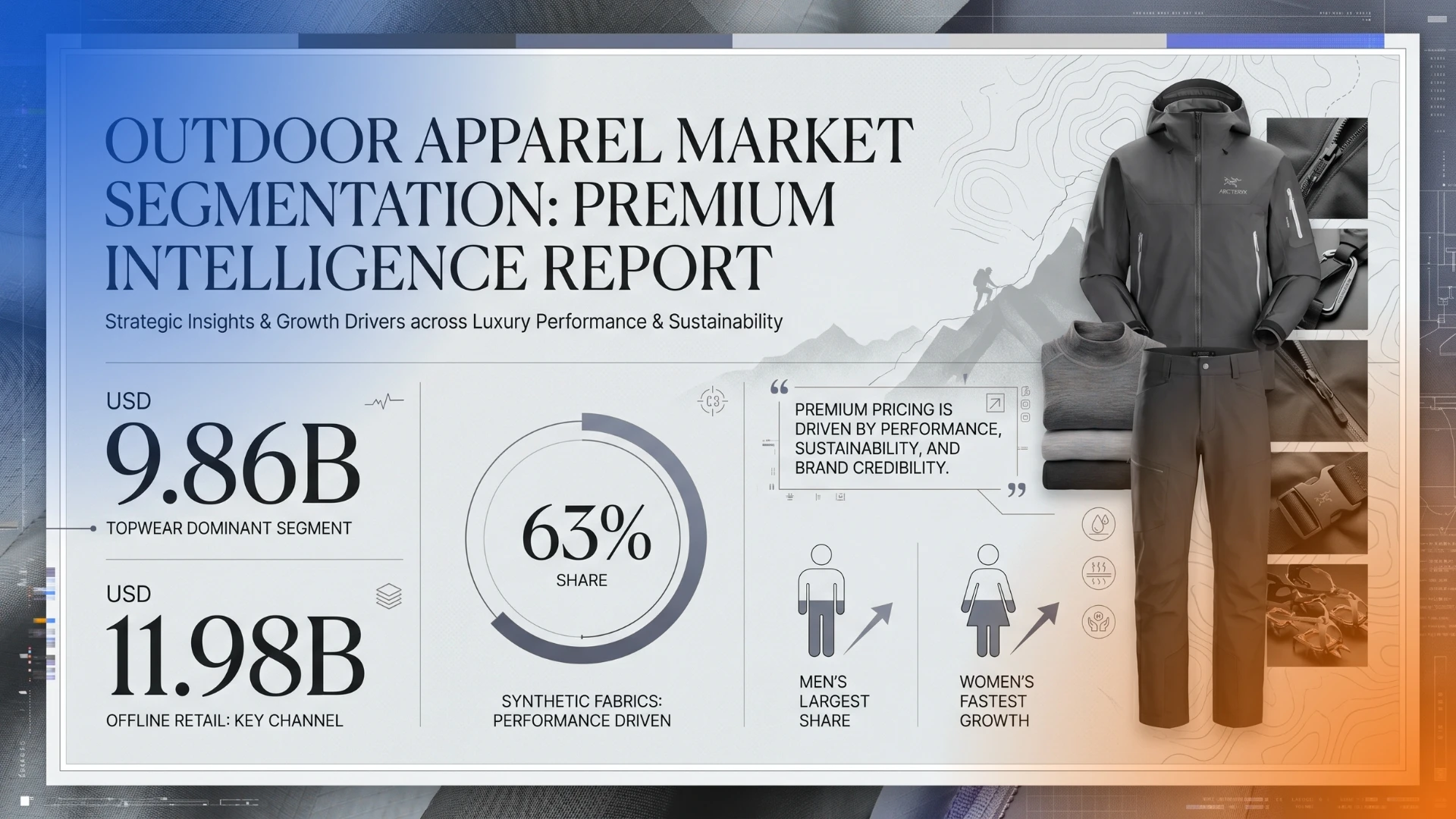
Topwear is the dominant product segment, generating USD 9.86 billion in 2024. The products sold included jackets, base layers, fleece, hoodies, and performance shirts.
Topwear is the leading product because it has the highest technical differentiation (Gore-Tex shells, Polartec insulation, merino wool base layers) and the highest price points. It's also the most visible piece of an outdoor outfit.
Bottomwear, such as pants, shorts, leggings, and ski pants, has the second-largest share and is growing at a steady pace.
Other segmentations include:
By Material
Synthetic fabrics account for 63% of the outdoor apparel market. Fabrics like polyester, nylon, and spandex dominate the market because of their moisture-wicking properties, durability, quick-drying capability, and resistance to abrasion.
Most outerwear products use DWR coatings or Gore-Tex membranes to add waterproofing and breathability on top of a synthetic base.
Natural fabrics are the fastest-growing material segment. Organic cotton, merino wool, hemp, and bamboo are becoming increasingly popular as consumers opt for more sustainable outdoor clothing.
By Gender
Men's outdoor apparel has the largest market share. But the women's segment is growing faster.
This is because women are increasingly participating in hiking, trail running, camping, and climbing, and brands that have invested in women's apparel are seeing better results.
The kids' segment is also growing, driven by parents who are introducing children to outdoor activities earlier and investing in quality gear to support it.
By Price Range
Consumers are increasingly willing to pay more for technical performance, sustainable materials, and brand credibility.
Brands like Arc'teryx, Patagonia, and The North Face have built dominant positions in the premium space by consistently delivering on all three.
By Distribution Channel
Offline retail generated USD 11.98 billion in 2024 and remains the dominant channel. Specialty outdoor stores, department stores, and brand-owned retail give consumers the ability to assess fit, feel, and functionality before buying.
Outdoor Apparel Market Growth Drivers
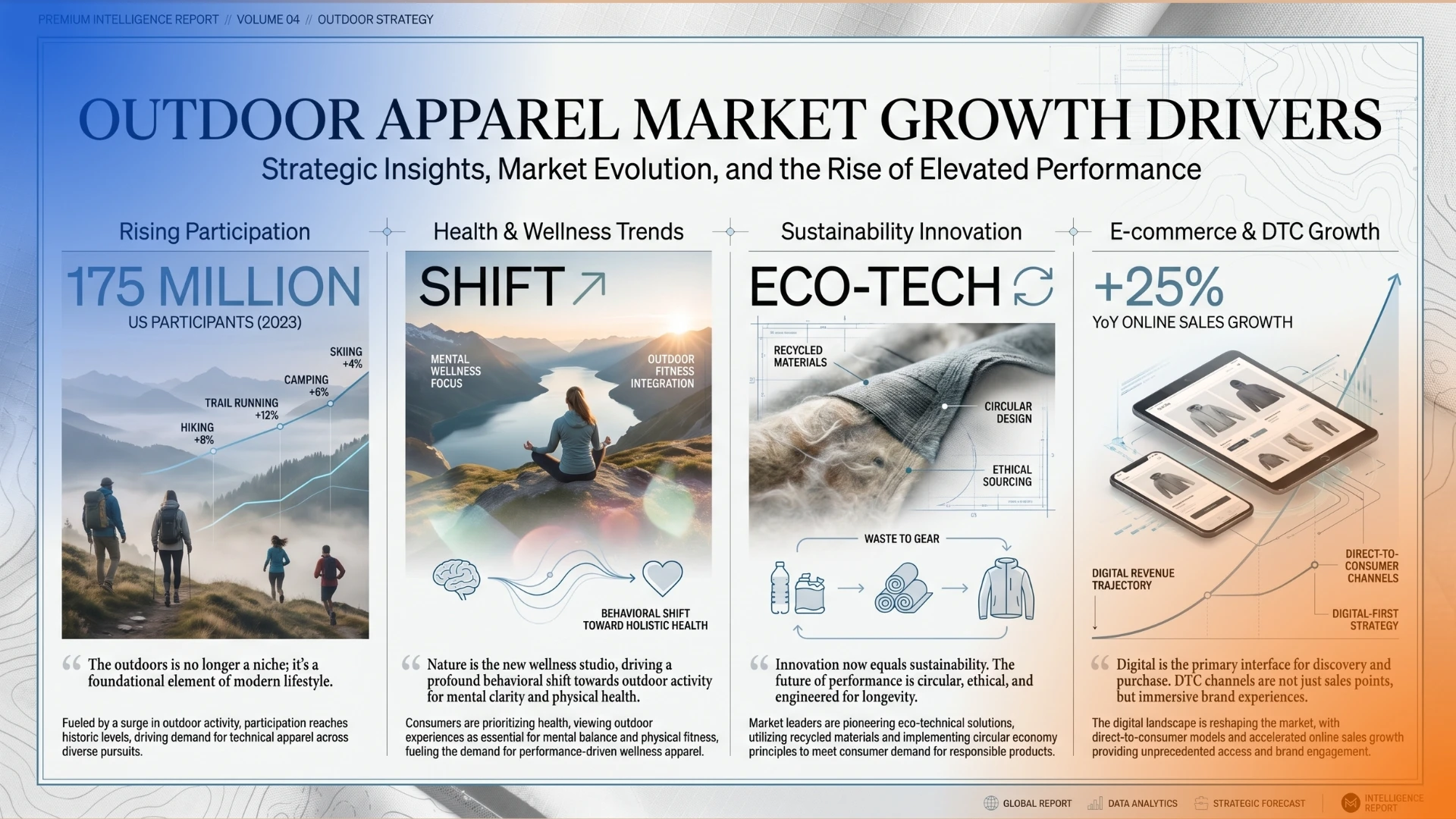
The outdoor apparel market growth is being driven by the following:
- Rising participation in outdoor activities: Hiking, trail running, camping, cycling, and skiing are growing in popularity across age groups, income levels, and geographies. In the US alone, outdoor participation reached nearly 175 million people in 2023. More people outdoors means more demand for outdoor performance apparel
- Health and wellness trends: People are turning to outdoor activities to manage physical fitness, mental well-being, and quality of life. That behavioral change creates sustained, recurring demand rather than one-off purchases
- Sustainability innovation: The demand for sustainable outdoor clothing is creating new product categories and attracting a previously underserved consumer segment. Brands that invest in recycled materials, ethical sourcing, and circular design are gaining popularity
- E-commerce and DTC growth: Online sales in the outdoor sports apparel market grew by 25% year-on-year, opening up new acquisition channels and giving brands direct access to consumer data and better margins.
Wrapping Up
The outdoor apparel market is growing steadily, expanding into new consumer segments, and being reshaped by changes in how people think about health, sustainability, and everyday wear.
For brands in this space, the opportunity exists, but so does the competition. The brands that will profit from this industry over the next decade are the ones that understand their consumers deeply, invest in product and material innovation, and build marketing strategies that connect performance credentials with the lifestyles their customers live.
If you're an outdoor apparel brand looking to grow your ecommerce revenue, improve your digital presence, or scale your DTC channels, that's exactly what we do at Pro Marketer. Get in touch and let's talk about how to grow your business.
FAQs
1. How big is the global outdoor apparel market in 2026?
The global outdoor apparel market is estimated at approximately USD 18.44 billion in 2025 and is projected to grow to between USD 26.6 billion and USD 29.85 billion by the mid-2030s. The market is growing at a consistent CAGR of 5.4%-5.5%.
2. What is the projected growth rate of the outdoor apparel market?
The outdoor apparel market is projected to grow at a CAGR of approximately 5.4% to 5.5% through to 2034 or 2035. Some estimates put the CAGR slightly higher at 6.4% through 2029, particularly for segments driven by product premiumization and portfolio extension. North America and Europe are the largest markets, while the Asia Pacific is the fastest-growing region.
3. What are the major trends driving the outdoor apparel market?
The key outdoor apparel market trends in 2026 include the shift from niche to lifestyle apparel, growing demand for sustainable outdoor clothing, rapid advances in technical fabrics, the expansion of e-commerce and DTC channels, and the rapid growth of the women's outdoor apparel segment. The blending of outdoor performance with everyday urban wear is arguably the most significant structural trend reshaping the category.
4. How is the women's outdoor apparel segment performing compared to men's?
The men's segment still holds the largest share of the outdoor apparel market, but the women's segment is the fastest-growing.
Rising female participation in outdoor sports, combined with brands investing in purpose-built women's product lines, is driving this growth.
5. How has the premium outdoor apparel segment evolved in recent years?
The premium outdoor apparel market has grown significantly in recent years, driven by consumer willingness to pay more for technical performance, sustainable materials, and credible brand stories. Brands like Arc'teryx, Patagonia, and The North Face have led this evolution, collectively accounting for 15 to 20% of the global premium segment.
The premiumization trend is expected to continue as outdoor participation grows among higher-income demographics.

.svg)

.avif)

.svg)