

TABLE OF CONTENTS
What Does an Amazon Agency Do?
What Does an In-House Amazon Team Do?
COST COMPARISON: AGENCY vs IN-HOUSE
When to Build an In-House Amazon Team
The Hybrid Model: The Option Most Brands Do Not Consider
Amazon Agency Pricing: What to Expect in 2026


Share via:
Quick Answer: Hiring an Amazon agency costs $2,000–$8,000/month, depending on your revenue and service scope. Building an in-house team runs $12,000–$20,000/month once you factor in salaries, tools, and benefits. For most ecommerce brands that do under $2M/year on Amazon, an agency saves you time and money. For organizations with complex operations and revenue exceeding $5M/year, a hybrid model is more effective. The right answer depends on your revenue, catalogue size, and the level of control you want over day-to-day decisions.
Running a profitable Amazon store in 2026 is not a side project. It is a full-time operation.
Between Amazon PPC management, listing optimization, FBA inventory management, A+ content, account health monitoring, and keeping up with every algorithm change Seller Central throws at you, there is a team working hard to maintain a high-performing Amazon storefront.
So when your Amazon channel starts generating revenue, the question is "who should run this?"
Do you hire an Amazon agency and hand it off to specialists? Do you build an in-house team and keep full control? Or is there a better middle ground?
This is the decision framework we use at Pro Marketer when ecommerce brands come to us asking exactly that question. We are going to walk you through the costs, trade-offs, and thresholds that help you choose which option.
What Does an Amazon Agency Do?

Before you can decide between an Amazon agency vs in-house team, you need to understand what you are getting when you hire an agency.
A good Amazon agency is not just running your ads. They are managing your entire Amazon operation as a system. Here is what that means:
- Amazon PPC management: This goes deeper than setting bids. A proper Amazon PPC agency builds campaign architecture from the ground up, segmenting by match type, identifying search-term opportunities, and optimizing ACoS and ROAS weekly. On a growing account, this is a full-time job
- Amazon listing optimization: Your listings are your storefront. A good agency writes keyword-rich titles, bullet points, and descriptions that rank in search and convert browsers into buyers. They also build A+ content that tells your brand story and increases conversion rate
- FBA inventory management: Stockouts kill your ranking. Overstock eats your cash flow. An experienced agency tracks inventory velocity, plans replenishment, and flags problems before they become expensive. A one-to two-week hiring gap can cause rank losses that take months to recover
- Amazon account health monitoring: One policy violation or a spike in negative reviews can get your account suspended. Agencies monitor your account health dashboard daily and handle issues before they escalate
- Amazon storefront management: Your branded storefront drives real revenue, especially when you are pushing external traffic. Agencies build and update storefronts to support launches, promotions, and seasonal campaigns
With all these, you’ll have a cross-functional team of specialists working on your account every week. That is what a good agency delivers. That is also what you have to replicate if you choose to go in-house.
What Does an In-House Amazon Team Do?
When brands think about managing Amazon in-house, they usually picture one smart person handling everything. That is not how it actually works.
The mistake most brands make is comparing an agency retainer to a single salary. That math is almost always wrong.
To replicate what a good agency provides, you need at a minimum three people: an Amazon PPC specialist, a content and listing manager, and an operations manager handling FBA and account health. That is $200,000 to $350,000 in salaries before you add benefits, tools, recruiting costs, and management overhead.
And there is a risk most brands underestimate: single point of failure. When your one Amazon person leaves, and in this job market, they eventually will, you lose months of learned strategy, advertising history, keyword data, and platform knowledge.
You are back to zero. Agencies spread that risk across a team.
There is also the knowledge isolation problem. An in-house hire sees one account.
An agency managing 50 to 100 brands across categories has pattern recognition that no single-brand team can replicate.
COST COMPARISON: AGENCY vs IN-HOUSE
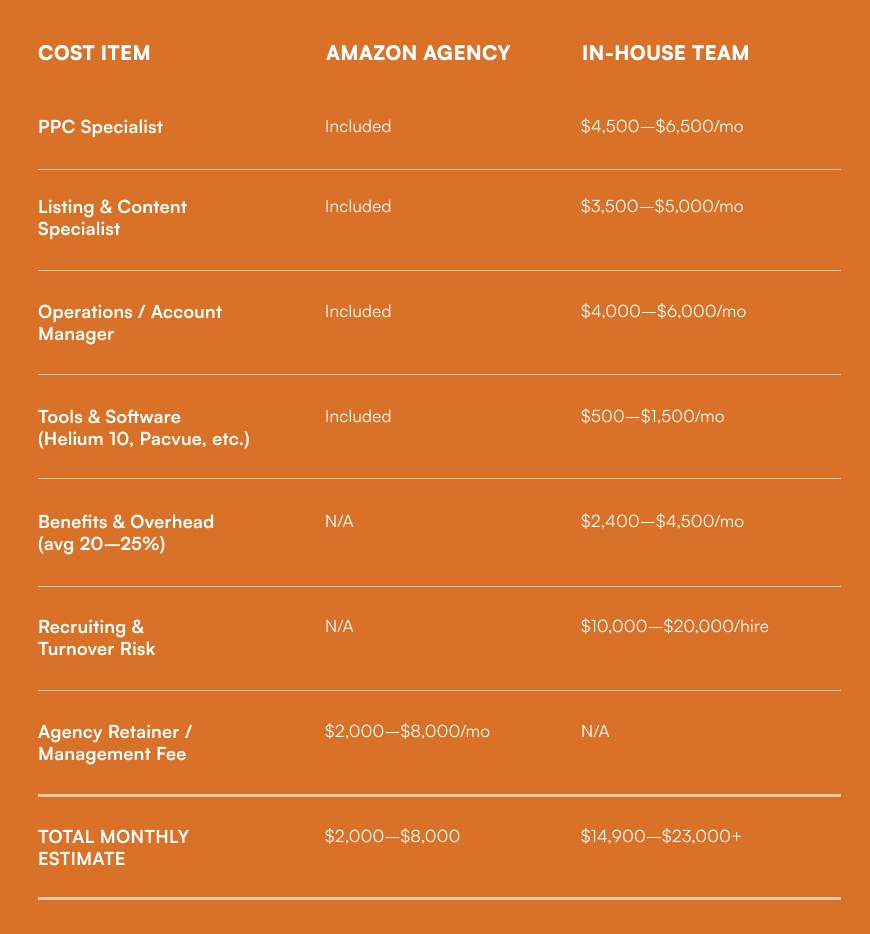
For most brands, an agency is cheaper than a fully resourced in-house team. The gap closes as your revenue grows and your operation gets more complex.
When to Hire an Amazon Agency

Knowing the cost difference is only one of the criteria for choosing between in-house and agency options. Here are the signals that tell you it is time to outsource Amazon management to a specialist.
- You are launching on Amazon for the first time: The learning curve is steep, and you’ll make mistakes in your first 90 days (poor listing structure, wrong campaign architecture, inventory miscalculations) that can set your account back by months. An agency compresses that curve because it has already made those mistakes in the past
- Your revenue is growing, but your margins are not: If your top line is up but ACoS is higher, and profitability is going sideways, that is a campaign management problem. It is exactly what an Amazon ppc agency is built to solve
- You do not have internal bandwidth: Your team is already managing your Shopify store, email, customer service, and inventory. Adding Amazon on top without dedicated resources means mediocre results across everything
- You are stretched thin: One person doing five jobs on Amazon is not a strategy. It is a liability
- You are entering new Amazon marketplaces: Expanding from Amazon Canada to Amazon US, or into Amazon UK or EU, introduces new compliance requirements, different consumer behaviour, and separate PPC dynamics. An agency that has done this before saves you from making certain mistakes
- Your listings have not been professionally optimized in the past 12 months: Stale listings with outdated keywords and no A+ content are losing money every single day.
When to Build an In-House Amazon Team
An agency is not always the right answer. Here is when building internally works:
- You are doing $10M or more annually on Amazon: At this revenue level, the economics change. You can afford specialized talent, and the complexity of your operation, large catalogue, multiple SKUs, multiple marketplaces, may justify a team that is 100% focused on your brand
- You have hundreds of SKUs requiring deep proprietary knowledge: If your catalogue involves regulatory complexity, technical specifications, or brand nuance that takes months to absorb, an in-house team that lives your products every day can outperform an agency managing multiple clients
- Speed and direct control are priorities: In-house teams move faster on brand-specific decisions. If your category demands daily pricing changes, promotions, and listing updates, removing the communication layer of an agency relationship is important
In-house only works when it is a real team. One generalist expected to be an expert in PPC, copywriting, FBA logistics, and account health simultaneously is not a team. That is five jobs with one salary.
The Hybrid Model: The Option Most Brands Do Not Consider
The hybrid model means keeping one strong in-house operator for brand operations, strategy, and internal coordination, while partnering with a specialist agency for PPC management, listing optimization, and account health.
The in-house person owns the brand relationship, inventory planning, and day-to-day Seller Central operations. The agency owns:
- Campaign strategy
- Keyword research
- Bid management
- Performance optimization
This works particularly well for brands doing $1M to $5M on Amazon. You get the control and brand depth of an internal hire without the cost of building a full team from scratch. You get the PPC expertise of a specialist agency without paying for services you do not need yet.
The important thing is to get a clear division of responsibilities. When both sides know exactly what they own, the model runs cleanly. When the lines blur, gaps form.
The hybrid model is also a smart transition path. If your goal is to eventually take everything in-house, the internal operator learns from the agency over time and can absorb more responsibility as your team and revenue grow.
Amazon Agency Pricing: What to Expect in 2026
One of the most common questions we get is about Amazon agency cost. Here is an honest breakdown of what the market looks like.
- Flat monthly retainer: Most agencies charge a fixed monthly fee regardless of ad spend. This ranges from $2,000 to $5,000 per month for small to mid-sized accounts. Predictable costs, clear scope of work
- Percentage of ad spend: Some agencies charge 10–20% of the monthly Amazon ad spend. This aligns incentives on paper, but it can get expensive fast as you scale spend
- Percentage of revenue: Less common, but some full-service agencies charge 3–8% of total Amazon revenue. This is fair when the agency is managing your complete Amazon operation, not just PPC
- Hybrid fee structure: A base retainer plus a performance component above a spend threshold. Increasingly common for established accounts
When evaluating Amazon agency pricing, do not just compare the monthly number. Compare what is included.
An agency charging $4,000 per month that covers PPC management, listing optimization, A+ content, and account health monitoring is very different from one charging $2,000 per month for PPC alone. The cheaper option is not always the better value.
How to Evaluate an Amazon Agency Before You Hire

The market is full of generalist digital marketing agencies that have added Amazon as a service line.
Here is what to look for before you sign anything.
- Amazon-specific experience, not general digital marketing experience: Managing Meta ads and managing Amazon PPC management are completely different disciplines. Ask specifically about their experience with Seller Central, how they structure campaigns, and how they handle account health issues when they arise. A vague answer here is a red flag
- Case studies from brands in your category: An agency that has scaled supplement brands on Amazon understands the compliance requirements, review dynamics, and competitive pressures specific to that space. An agency that has scaled apparel brands understands sizing variation management, seasonal inventory cycles, and the listing structure that works for that category
- A clear process for Amazon listing optimization: Ask them to walk you through their approach to a new listing from scratch. They should be able to speak confidently about keyword research, title structure, bullet-point hierarchy, backend search terms, and how they use A+ content to improve conversion rates. If they are vague, they are not the team you want optimizing your storefront
- How they handle FBA inventory management: Agencies that only care about ads ignore the operational side of your account. But a stockout tanks your ranking just as fast as a bad campaign. Ask how they monitor inventory velocity, how they flag restock alerts, and what their process is when an FBA shipment gets lost or delayed. The best agencies treat your Amazon storefront as a full business, not just an ad account
- Their reporting cadence and what they report on: You should be getting weekly or bi-weekly performance updates with clear metrics: ACoS, ROAS, total ad spend, revenue, sessions, conversion rate, and Amazon account health status. If an agency's reporting starts and ends with ROAS, that is a problem. ROAS can look healthy while your organic rank decays, your TACoS climbs, and your margins erode
- How many accounts each manager handles: An account manager overseeing 30 or more accounts cannot give your account the meaningful attention it deserves. The best agencies keep their account-to-manager ratios low. Ask directly. A confident agency will answer without hesitation
- Their communication style before you hire them: Slow response times, vague answers, or an unwillingness to explain their decisions clearly during the sales process are a preview of what working with them will feel like
Final Thoughts
There is no universal right answer in the Amazon agency vs in-house debate. The right decision depends on where your brand is today, where you are trying to go, and what resources you have.
If you are ready to build a scalable Amazon strategy, book a free consultation with Pro Marketer.
We will audit your current standing and show you exactly what needs to happen next.
FAQs
1. What is the difference between Amazon PPC, DSP, and AMC?
Amazon PPC refers to self-service ads run inside Seller Central (Sponsored Products, Sponsored Brands, and Sponsored Display).
DSP (Demand-Side Platform) is Amazon's programmatic advertising tool that lets you reach audiences both on and off Amazon, including past visitors, competitor audiences, and category browsers.
It requires a minimum spend commitment and is managed through a certified agency partner. AMC (Amazon Marketing Cloud) is a data clean room that lets you analyze the overlap between your PPC and DSP campaigns, understand full customer journeys, and build custom audience segments based on behaviour across your entire Amazon storefront.
Most ecommerce brands start with PPC. DSP and AMC become relevant as your Amazon revenue scales, and you need more sophisticated targeting and measurement tools.
2. What is the hybrid Amazon management model?
The hybrid model splits Amazon management between an in-house operator and an external agency. The in-house person handles brand operations, FBA inventory management, Seller Central day-to-day tasks, and internal coordination.
The agency handles amazon ppc management, listing optimization, A+ content, and account health monitoring. It is the most practical model for brands doing $1M to $5M annually on Amazon, as it gives you internal control without the cost of building a fully specialized team.
It also works as a transition strategy for brands that plan to bring everything in-house over time.
3. What does a good Amazon agency do?
A good agency manages your Amazon operations as a single, cohesive system. That means Amazon ppc management, Amazon listing optimization, A+ content creation, FBA inventory management, Amazon account health monitoring, and storefront management, all connected and working together.
Beyond the tactical work, a good agency thinks strategically: identifying growth opportunities, planning for seasonal peaks, responding to competitive shifts in your category, and connecting your Amazon performance to your broader ecommerce goals.
The difference between a good agency and an average one is whether they are reactive or proactive. Good agencies catch problems before they hit your revenue.
4. What red flags should I watch for in an Amazon agency?
Watch out for agencies that guarantee specific rankings or revenue numbers; no one can promise that. Be cautious of agencies that cannot clearly explain their Seller Central campaign structure or optimization process.
If their reporting only covers ROAS without any discussion of TACoS, Amazon account health, or contribution margin, they are measuring the wrong things.
Agencies that are vague about who specifically manages your account, how many accounts that person handles, or that avoid talking about Amazon listing optimization and FBA inventory management as part of their scope are showing you their limits before you have even started.

.svg)

.avif)

.svg)