
.webp)
TABLE OF CONTENTS
What Is a Supplement Facts Label?
How to Read a Supplement Facts Label
- Serving Size
- Servings Per Container
- Nutrient Amounts
- % Daily Value
- Other Ingredients
- Supplement Label Allergen Information
Supplement Facts Label vs. Nutrition Facts Label: What's the Difference?
Common Mistakes People Make When Reading a Supplement Facts Label
Confusing servings per container with total pills
Overlooking the "Other Ingredients" section
Assuming a high % DV is always better
FAQs About Supplement Facts Labels
- What is a supplement facts label and why is it important?
- How is a supplement facts label different from a nutrition facts label?
- What does each row on a supplement facts panel mean?
- What is the "% Daily Value" on a supplement facts label?
- Do all vitamins and minerals need to be listed on a supplement facts label?
- How do I know if the amounts on a supplement facts label are accurate?


Share via:
So picture this: You're standing in a health store, holding a bottle of vitamins. You flip it over and see a dense block of text filled with percentages, milligrams, and ingredient names you can barely pronounce. What do you do?
That block of text is called a supplement facts label, and it holds information about what you're putting into your body. It doesn’t matter if you're shopping for protein powder, fish oil, multivitamins, or any other dietary supplement; it’s essential that you know how to read a supplement facts label.
The problem is that most people skip right past it.
In this blog, we're breaking down everything you need to know about the supplement facts panel: what it is, why it’s important, and exactly how to read it line by line. By the time you're done, you'll never look at a supplement bottle the same way again.
What Is a Supplement Facts Label?
A supplement facts label is a standardized panel that appears on the packaging of every dietary supplement sold in the United States. It's regulated by the U.S. Food and Drug Administration (FDA) and is designed to give you clear, accurate information about what's inside the product they're buying.
Think of it as the official "ingredient report" for your supplement. It tells you what nutrients or compounds are in the product, how much of each one you're getting per serving, and how those amounts compare to the recommended daily intake.
You should also note that a supplement facts label is not the same as a nutrition facts label. The nutrition facts label is what you'll find on daily food and beverage products.
The supplement facts label, on the other hand, is specific to dietary supplements, which include things like vitamins, minerals, herbs, amino acids, and enzymes.
The FDA made the supplement facts panel mandatory in 1997, under the Dietary Supplement Health and Education Act (DSHEA) of 1994. This means that any product sold as a dietary supplement in the U.S. must carry this label.
So, the next time you pick up a bottle of supplements, that panel isn't just there for decoration; it's a legal requirement, and it's there to protect you.
How to Read a Supplement Facts Label
It’s easy to learn how to read a supplement facts panel. All you have to do is know what each section means.
Here's a breakdown of every section you'll find on a supplement facts label.
1. Serving Size
This is the first thing you'll see at the top of the panel. The serving size on a supplement label tells you exactly how much of the product counts as one serving. This might be one capsule, two tablets, one scoop, or a certain number of gummies.
Everything else on the label, such as the nutrient amounts and the percentages, is based on this serving size.
So if you're taking more or less than the listed serving, the numbers won't apply to you in the same way. Always check this first before reading anything else.
2. Servings Per Container
Right below the serving size, you'll see the number of servings per container. This tells you how many servings are in the entire bottle or package.
It's important that you know this, especially when you're comparing the value of products or figuring out how long a bottle will last.
3. Nutrient Amounts
This is the main body of the supplement facts panel. It lists every nutrient, ingredient, or compound in the product, along with the amount you're getting per serving, usually measured in milligrams (mg), micrograms (mcg), or grams (g).
Some supplements will have a long list here; others will just have a few. Either way, this section is where you find out exactly what you're taking and how much of it.
4. % Daily Value
Next to most nutrients, you'll see a column labeled "% DV," which stands for percent daily value (DV). The percent daily value on a supplement label tells you how much of the recommended daily intake of that nutrient one serving provides, based on a 2,000-calorie diet.
For example, if a supplement shows 50% DV for Vitamin C, that means one serving gives you half of the amount of Vitamin C the average adult needs in a day.
Some nutrients won't have a % DV listed; this usually means there's no established daily reference value for that ingredient.
5. Other Ingredients
Below the main panel, you'll often find a section labeled "Other Ingredients." This is where manufacturers list everything else that went into making the supplement.
This would include fillers, binders, coatings, and flavoring agents. These aren't the active ingredients, but you should still read them, especially if you have allergies or sensitivities.
6. Supplement Label Allergen Information
Speaking of allergies, many supplement labels will include allergen information either within the "Other Ingredients" section or in a separate allergen statement below it.
This is where you'll find out whether the product contains, or was manufactured in a facility that handles, common allergens such as milk, soy, wheat, eggs, peanuts, or shellfish.
If you have food allergies, then you must not skip this section.
Supplement Facts Label vs. Nutrition Facts Label: What's the Difference?
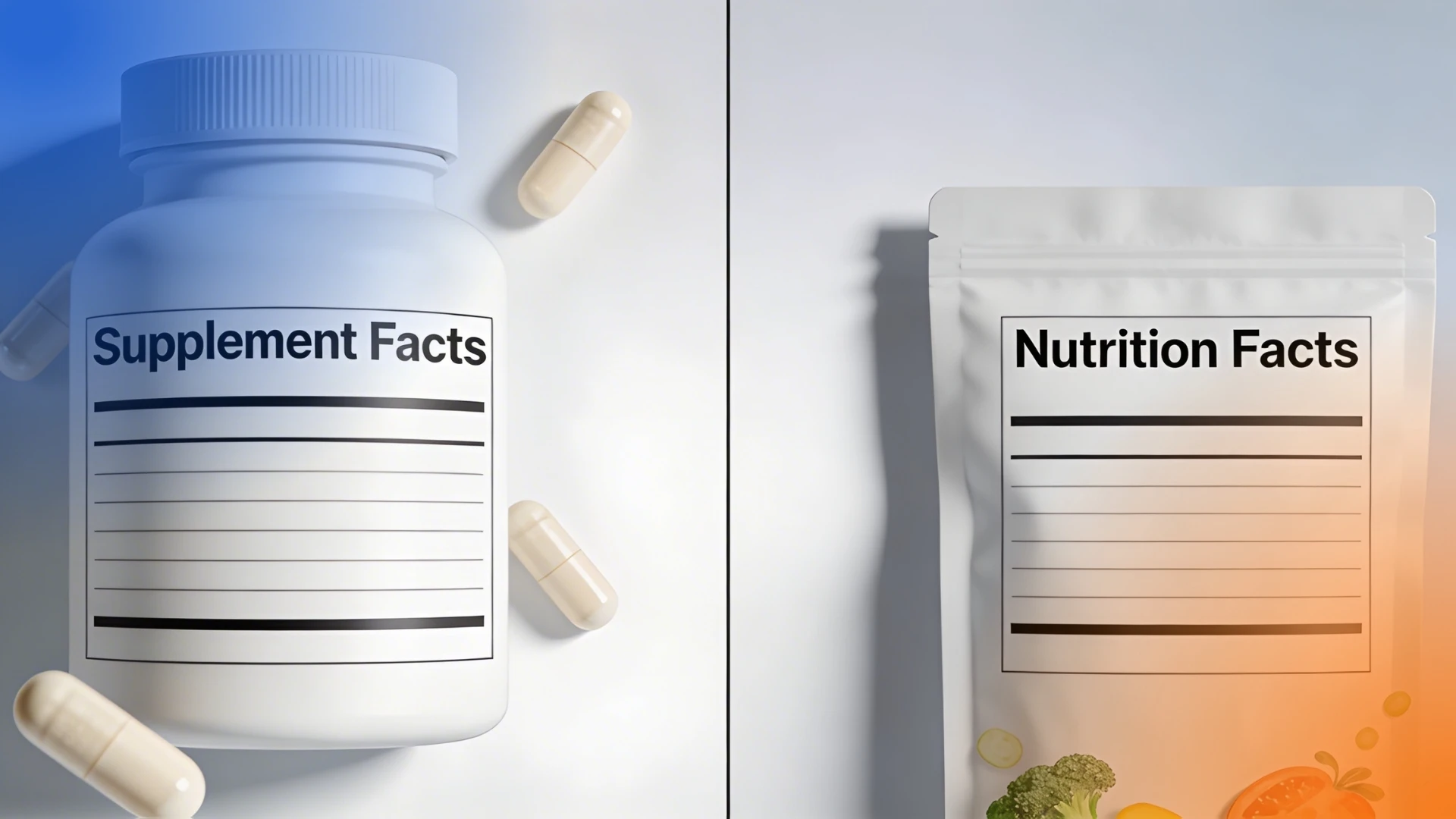
A lot of people assume that a dietary supplement facts label and a nutrition facts label are the same thing. Well, they're not.
Although they share a similar layout, there are some important differences between the two that are worth understanding.
The nutrition facts label appears on conventional food and beverage products. The dietary supplement panel, on the other hand, is exclusive to products classified as dietary supplements.
Here are the differences:
The title
A food product says "Nutrition Facts" at the top. A supplement will say "Supplement Facts." This is the first clue that you're looking at two different types of labels with different rules.
What's listed
A nutrition facts label focuses on macronutrients (calories, total fat, carbohydrates, protein) and so on. A supplement facts label, on the other hand, typically highlights vitamins, minerals, herbs, amino acids, or other dietary ingredients that make up the product.
Calories
Food labels always list calories. On a supplement facts label, calories are only listed if the product contains a meaningful amount; many supplements don't, so you may not see them at all.
% Daily Value
Both labels use percent daily value, but the reference values can differ. Some ingredients commonly found on a supplemental facts label don't have an established daily value, so you'll see a footnote with an asterisk (*) instead of a percentage.
Serving size
The serving size on a supplement label is expressed differently, too. Rather than a standard household measurement like "1 cup," you're more likely to see "2 capsules" or "1 scoop (30g)."
When you understand the difference between a dietary supplement panel vs food label, you’ll be able to approach each one with the right expectations.
Common Mistakes People Make When Reading a Supplement Facts Label
Now that you know how to read a supplement facts label, let's talk about the common mistakes people make when reading a supplement fact label.
Ignoring the serving size
This is probably the most common mistake. People look at the nutrient amounts without first checking the serving size.
If the serving size is two capsules but you're only taking one, you're getting half of what's listed. Always start with the serving size on the supplement label before reading anything else.
Confusing servings per container with total pills
Knowing the meaning of “servings per container” is important for budgeting and planning.
For instance, a bottle with 60 capsules and a serving size of 2 capsules doesn't give you 60 days' worth; it gives you 30 days' worth.
Overlooking the "Other Ingredients" section
People focus so much on the active ingredients that they ignore everything else in the product. This is very risky for people with allergies.
Always check the supplement label allergen information before purchasing, particularly if you're sensitive to common allergens like gluten, dairy, or soy.
Assuming a high % DV is always better
The percent daily value on a supplement is a reference point, not a goal. So you should keep in mind that more isn't always better, and in some cases, consistently exceeding 100% DV of certain nutrients can cause you issues. Use the % DV as a guide, not a target.
Wrapping Up
One thing that confuses people is coming across a blank supplement facts label template online. However, keep in mind that these are just design mockups used by supplement manufacturers to create new products. The actual label on a finished product must be filled out completely and accurately before it can be sold.
The more familiar you get with reading a supplement fact label, the better equipped you'll be to choose the right supplements that support your health goals.
FAQs About Supplement Facts Labels
1. What is a supplement facts label and why is it important?
A supplement facts label is a mandatory panel on all dietary supplement products sold in the U.S. It tells you the serving size, the list of active ingredients and their amounts, the percent daily value, and other important details like allergen information. It's important because it helps you make informed decisions about what you're putting into your body and allows you to compare products before buying.
2. How is a supplement facts label different from a nutrition facts label?
A nutrition facts label appears on food and beverages, while a supplement facts label is specific to dietary supplements. Food labels list macronutrients such as calories and fat, while supplement labels focus on vitamins, minerals, herbs, and other dietary ingredients.
3. What does each row on a supplement facts panel mean?
Each row on a supplement facts panel represents one ingredient or nutrient in the product. The first column shows the ingredient name, the second shows the amount per serving, and the third shows the percent daily value (how much of the recommended daily intake that serving provides).
Some rows may show an asterisk (*) instead of a % DV, which means no daily reference value has been established for that ingredient.
4. What is the "% Daily Value" on a supplement facts label?
The percent daily value on a supplement label tells you how much of a nutrient's recommended daily intake one serving provides, based on a 2,000-calorie diet.
For example, a supplement showing 100% DV for Vitamin D means one serving of the vitamin D supplement meets the full recommended daily amount for an average adult. It's a helpful reference point, but keep in mind that your personal needs depend on your age, health, and diet.
5. Do all vitamins and minerals need to be listed on a supplement facts label?
Not necessarily. Only nutrients that are present in meaningful amounts are required to be listed on a dietary supplement facts label. If a vitamin or mineral is included in the formula but in a negligible amount, it may not appear on the supplemental facts label.
However, any ingredient added intentionally, even in small amounts, should be disclosed on the packaging, often in the "Other Ingredients" section.
6. How do I know if the amounts on a supplement facts label are accurate?
The FDA does not test or approve dietary supplements before they go to market. Manufacturers are responsible for ensuring their products match what's on the label. That said, you can look for third-party certifications from organizations like NSF International, USP, or Informed Sport; these indicate that an independent body has tested the product and verified that what's on the supplements facts label matches what's inside the bottle.

.svg)
.avif)

.svg)