
.webp)
TABLE OF CONTENTS
What Is a Full-Service Advertising Agency?
What Services Does a Full-Service Advertising Agency Provide?
Conversion rate optimization (CRO)
Analytics, attribution, and reporting
Full-Service Advertising Agency vs. Specialized Agency: What Is the Difference?
Benefits of Hiring a Full-Service Advertising Agency
You have one point of contact for everything
Your reporting system improves
You get a better picture of marketing ROI
How Much Does a Full-Service Advertising Agency Cost?
How Full-Service Agencies Measure and Optimize Performance
They connect channel metrics to business outcomes
They report consistently and transparently


Share via:
A full-service advertising agency is a company that manages all aspects of your marketing. That includes paid media, SEO, content, email, social media, web design, branding, and analytics. Instead of hiring and coordinating multiple specialist vendors, you work with one team that connects every channel into a single growth system. Full-service agencies usually cost between $5,000 and $25,000 per month depending on scope and services.
Most ecommerce brands start their marketing the same way. They hire a freelancer for ads, another for email, someone else for SEO, and maybe an agency for social media. Each vendor does their part. But nobody is responsible for how all the parts function together.
That is where the problem starts.
When your paid media team is not talking to your email team, and your SEO strategy has nothing to do with your content calendar, and your website was built by someone who has never seen your ad account, you end up with an unstructured marketing operation.
A full-service advertising agency solves this problem by operating every channel under one strategy. Your ads, your email flows, your SEO, your website, and your creative all work toward the same goal, built by the same team, measured in the same reporting system.
According to The Business Research Company, the advertising agencies industry is forecast to reach USD 444.7 billion in global revenue in 2026. This growth shows how many brands are using full service advertising, rather than multiple disconnected vendors.
This article explains what a full-service advertising agency does, the benefits, what it costs, how it compares to specialist agencies, and how to choose the right one for your brand in 2026.
What Is a Full-Service Advertising Agency?
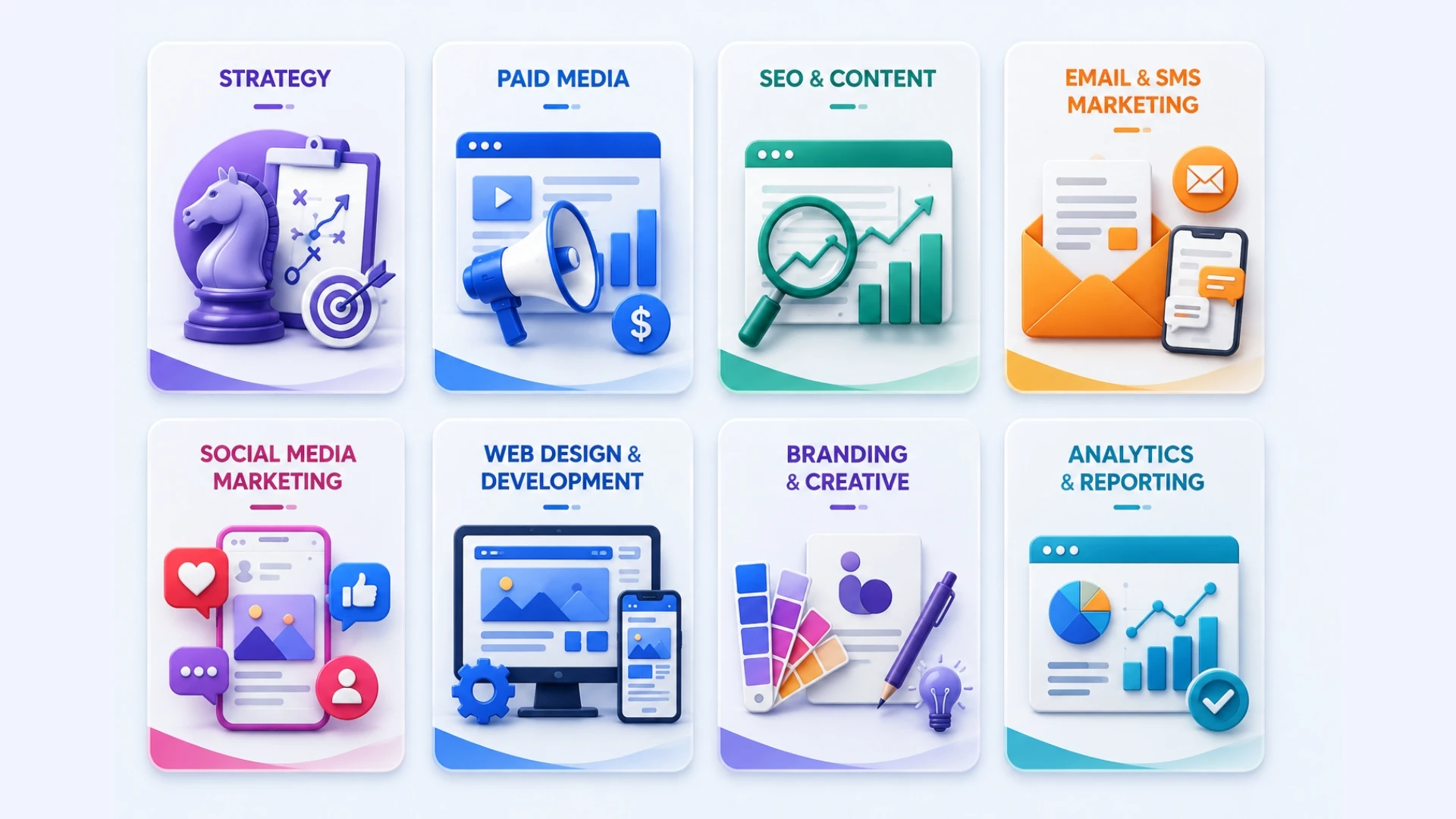
A full-service advertising agency is a company that handles every part of your marketing in one place:
- Strategy
- Creative
- Paid media
- Social media
- Web design
- Analytics
The simplest way to think about it is this. Imagine you are building a house. You could hire a separate architect, contractor, electrician, plumber, and interior designer and coordinate all of them yourself.
Or you could hire one firm that manages the whole process from blueprint to finished product. A full-service advertising agency is the second option for your marketing.
A full-service agency does not just offer many services. It connects them:
- Your paid media strategy influences your email segmentation
- Your SEO research informs your content calendar
- Your website is built to convert the traffic your ads are driving
- Every channel influences the others
A full-service digital marketing agency manages:
Paid media
Managing ad campaigns across Google, Meta, TikTok, Amazon, and other platforms. This includes campaign setup, audience targeting, creative testing, bid optimization, and performance reporting.
For ecommerce brands, this is usually the highest-spend channel and the one with the most immediate revenue impact.
SEO and content
Building your brand's organic visibility on Google through keyword research, on-page optimization, technical SEO, and a content strategy that targets what your customers are searching for.
A good SEO program reduces your dependence on paid ads over time by building traffic that does not disappear the moment you stop spending.
Email and SMS marketing
Setting up automated flows that turn first-time buyers into repeat customers. Welcome sequences, abandoned cart flows, post-purchase sequences, and broadcast campaigns.
For most ecommerce brands, email is the highest-return channel in the entire marketing stack once the flows are built correctly.
Social media management
Creating and publishing content, managing community engagement, and building a brand presence on the platforms where your customers spend time.
Social media works best when it is connected to your paid media strategy rather than running as a separate operation.
Web design and development
A website that does not convert wastes every dollar you spend on advertising.
Full-service agencies build websites as part of a connected system, not as a standalone project handed off to a different team.
Branding and creative
Developing the visual identity, messaging, and creative assets that show up across every channel.
When your ads, your website, your emails, and your social posts all look and sound like the same brand, it builds trust faster and converts better.
Analytics and reporting
Measuring what is working, what is not, and what to do next.
A full-service agency gives you one reporting system that shows how all your channels are performing, rather than separate reports from separate vendors that tell completely different stories about the same customer.
What Services Does a Full-Service Advertising Agency Provide?
Before any campaign launches, a good full-service agency researches your market, your competitors, and your customers.
They map out:
- Who is buying
- Why they are buying
- What the competition is doing
- Where the opportunities are
Here are some of the services a full-service advertising agency offers:
Brand development
Your brand is what people think of when they hear your name.
A full-service agency helps define and develop that identity, covering your visual assets, your brand voice, your positioning, and your messaging.
Paid advertising management
This includes the setup, management, and optimization of campaigns across paid platforms.
For ecommerce brands, that means Meta Ads for discovery and retargeting, Google Ads for search and shopping, TikTok for top-of-funnel reach, and Amazon Ads if you sell on the marketplace.
Each platform has its own algorithm, its own auction dynamics, and its own creative requirements. Running all of them properly requires a specialist.
Search engine optimization
SEO is the process of making your website appear when your customers search for what you sell.
It includes technical site health, on-page content optimization, keyword strategy, link building, and increasingly, generative engine optimization for AI-powered search tools like ChatGPT and Gemini.
SEO compounds over time. You need to invest in it consistently to build organic traffic that’ll become one of your most profitable acquisition channels.
Content marketing
Blog articles, product guides, video scripts, social content, and email copy are all part of content marketing.
They support your SEO by giving search engines more content to index, and they also build trust with potential customers by showing them your brand knows what it is talking about before they ever buy anything.
Email and SMS marketing
Automated sequences and broadcast campaigns that turn your subscriber list into a revenue channel.
For a skincare brand, this might mean a five-part welcome sequence that introduces new subscribers to your brand story, educates them about your ingredients, and converts them with a first-purchase offer.
For a supplement brand, it might mean a post-purchase sequence that explains how to use the product correctly, builds habits around repurchase, and drives subscription upgrades.
Conversion rate optimization (CRO)
Getting traffic to your website is only half the job. CRO is the process of making sure that the people your website attracts actually buys.
It covers your product page design, checkout flow optimization, A/B testing of headlines and images, and site speed improvements.
Even small improvements in conversion rate can impact your revenue because they make every other marketing channel more efficient.
Social media management
Creating and publishing content across platforms, managing comments and DMs, building community, and maintaining a consistent brand presence is all part of social media management.
Social media when done rightly, reinforces your paid media by giving potential customers something to find when they go looking for your brand after seeing an ad.
Analytics, attribution, and reporting
This involves measuring everything and using the data to make better decisions.
A full-service agency should give you clear visibility into which channels are driving revenue, what the customer journey looks like from first click to purchase, and where you need to improve.
Full-Service Advertising Agency vs. Specialized Agency: What Is the Difference?
A specialized agency focuses on one channel. For instance, a paid media specialist knows everything about Meta and Google. An SEO agency knows everything about search. A Klaviyo-certified email agency can build flows that most generalists cannot.
A full-service agency is broad. Instead of expertise in one area, you get coordinated expertise in all areas.
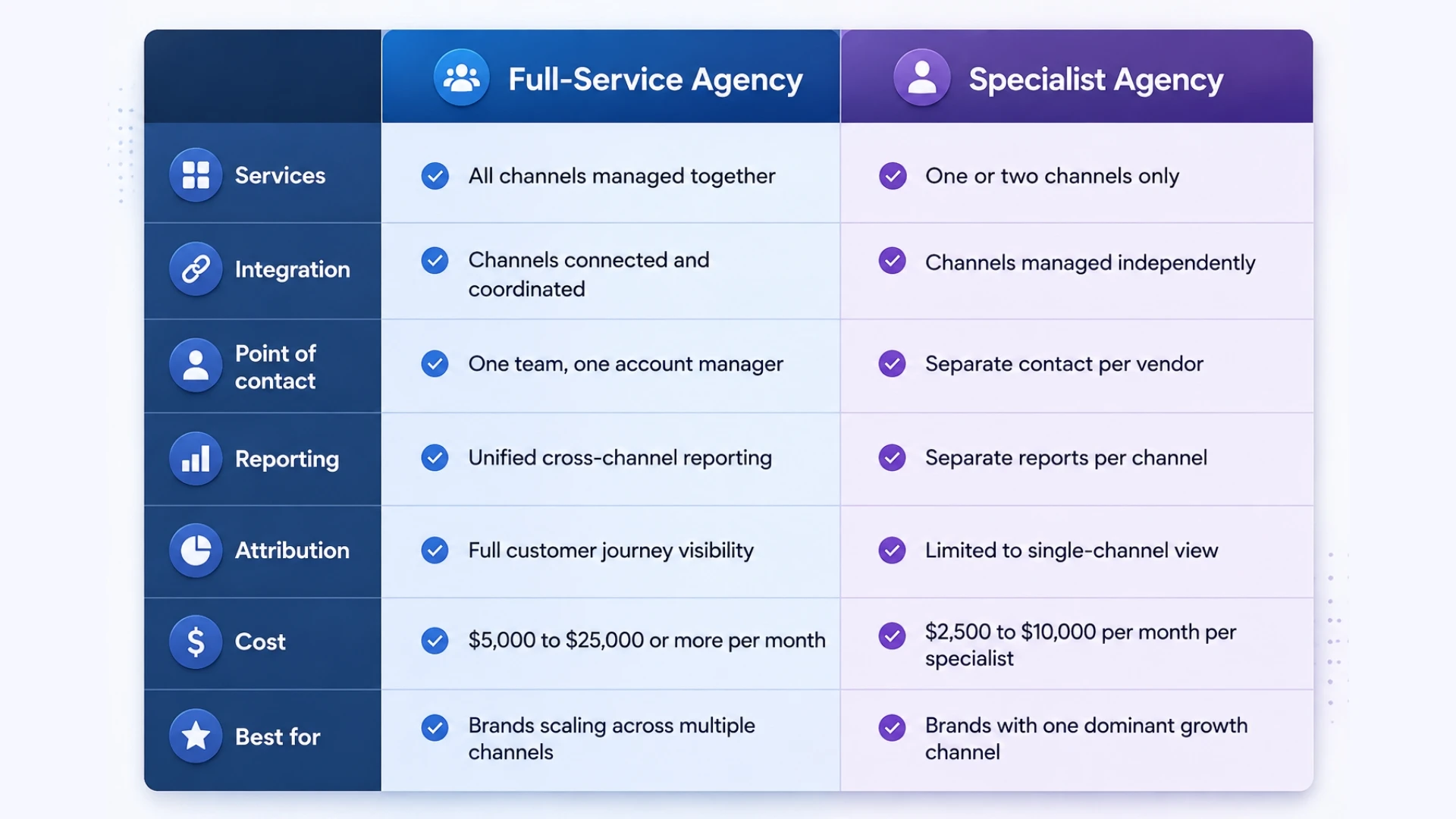
A specialist running your Meta Ads will optimize for the best possible results within Meta. A full-service agency running your Meta Ads will also be thinking about what happens after someone clicks:
- Does the landing page convert?
- Is there an email flow that captures people who do not buy on the first visit?
- Is the SEO content reinforcing the same message the ads are using?
The specialist does not have visibility into those questions, but the full-service agency does.
Benefits of Hiring a Full-Service Advertising Agency
Everything is connected
When one team manages your ads, your email, your SEO, and your website, those channels are designed to work together:
- Your ad creative matches your landing page
- Your email flows ensure interested customers end up buying
- Your SEO content reinforces the messaging your paid campaigns are using
That connection improves performance across every channel because each one is making the others more effective.
You have one point of contact for everything
Instead of emailing five different vendors, attending five different calls, and analysing five different reports, you have one account manager who coordinates everything internally.
For most brand owners, this alone saves five to ten hours per week that were previously spent on agency management.
Your reporting system improves
One of the biggest problems with multiple specialist vendors is that they each report about the status of their own channel.
Your paid media agency says Meta drove 400 conversions. Your email agency says email drove 600. Your total orders were 500. The numbers do not add up because everyone is claiming last-click credit.
A full-service agency builds one attribution model that shows the true customer journey, how channels interact, and where the revenue is coming from.
You get faster execution
When a campaign needs to launch quickly, a full-service agency can ensure every channel is ready to launch without the delays that usually come from multiple vendors needing briefings, approvals, and handoffs.
For time-sensitive launches, promotions, and seasonal campaigns, that advantage is speed.
Your brand is consistent
When different vendors manage different channels, your brand consistency will suffer. The tone in your emails will most likely not match that of your ads, and your social content will look different from your website.
A full-service agency applies your brand guidelines consistently across every channel it manages because the same team produces it all.
You get a better picture of marketing ROI
With a full-service agency, your total marketing investment will be in one place.
You’ll have one retainer, one reporting system, and one view of what your total marketing spend is producing in revenue.
How Much Does a Full-Service Advertising Agency Cost?
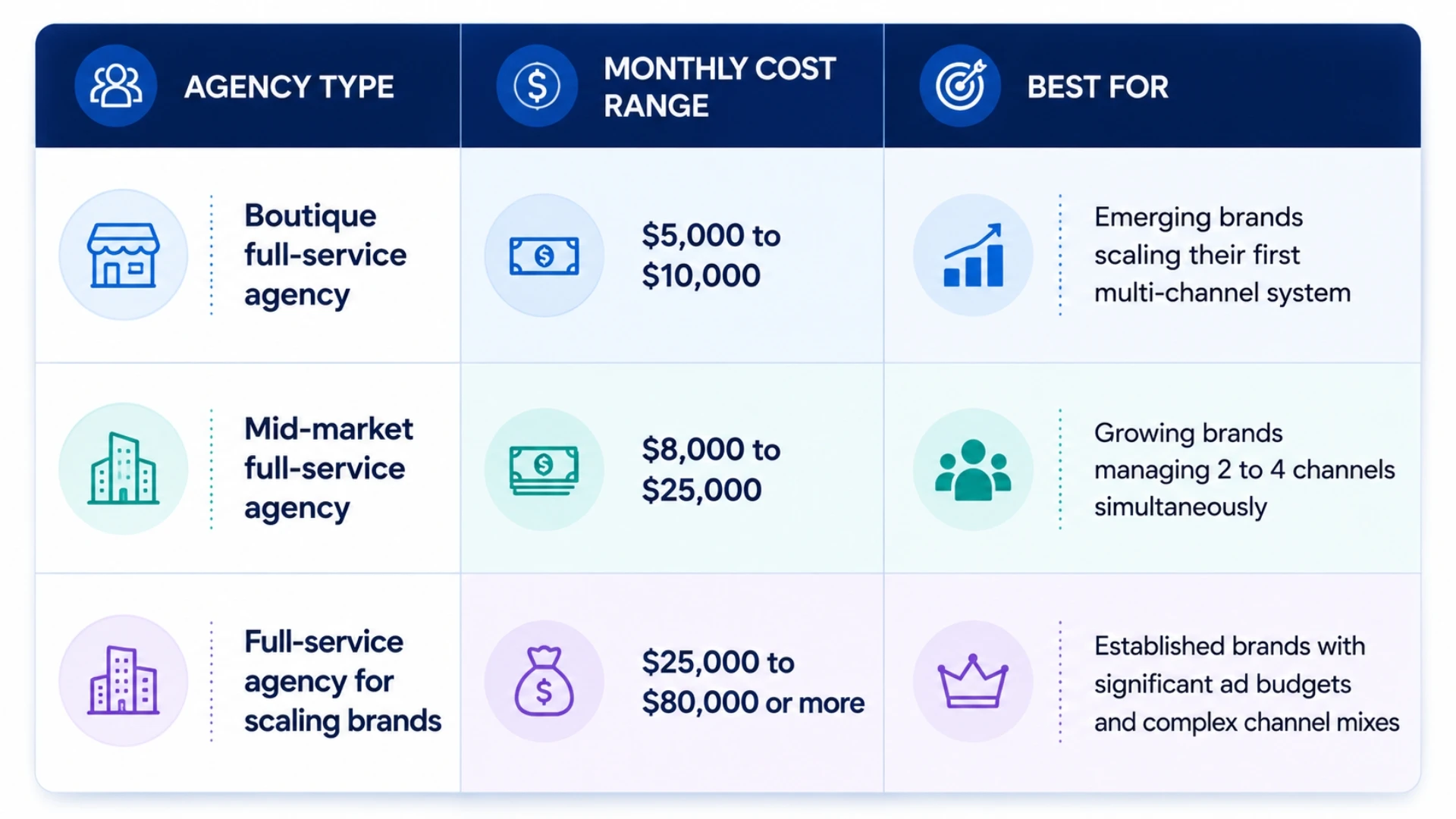
Most full-service agencies use one of three pricing structures:
- A monthly retainer where you pay a fixed fee that covers a scope of services
- A percentage-of-ad-spend model that charges 10% to 20% of your monthly media budget
- A project-based model applies to specific deliverables like building a website or a brand identity project
The most important thing to understand about cost is what it covers. Ask specifically how many hours your retainer covers, who is doing the work, and what deliverables are included each month before you compare prices.
According to Clutch, most advertising projects fall between $10,000 and $49,999, and the average hourly rate for advertising agencies is $100 to $149 per hour.
If you are currently paying $3,000 for an SEO agency, $4,000 for a paid media specialist, $2,000 for an email agency, and spending five hours a week coordinating between them, you are already spending $9,000 per month plus internal time.
A full-service agency at $10,000 per month that replaces all three and saves you time as well.
How Full-Service Agencies Measure and Optimize Performance
A full-service agency's job does not end when a campaign launches. Ongoing measurement and optimization is what determines whether your marketing gets better over time or not.
They connect channel metrics to business outcomes
Impressions, clicks, and engagement are not business outcomes. Revenue, customer acquisition cost, return on ad spend, and customer lifetime value are.
A full-service agency should always be able to connect what is happening at the channel level to what is happening to your business.
If they cannot explain how their work is affecting your revenue, then you shouldn’t be working with them.
They use unified attribution
Multi-touch attribution models show how different channels contribute to a conversion across the full customer journey.
For example, a customer might discover your brand through a TikTok ad, visit your website through a Google search, sign up to your email list, and convert from an email offer a week after that.
A full-service agency tracking the entire journey allocates credit accurately across all four channels rather than giving all the credit to the last click.
They optimize across channels
A full-service agency can optimize your budget and effort between channels based on where the best return is.
During peak season, more budget might go into paid media. During slower periods, more effort might go into content and SEO to build long-term organic traffic.
They report consistently and transparently
A full-service agency should provide monthly comprehensive performance reports, regular check-ins on campaign status, and direct access to your account manager with response times under 24 hours for non-emergency questions.
You should always know what has been done, what is working, what is not, and what is planned next.
They test constantly
The best full-service agencies run structured tests across creative, audience targeting, landing pages, email subject lines, and ad copy on an ongoing basis.
Testing is how performance improves over time.
How to Choose a Full-Service Advertising Agency
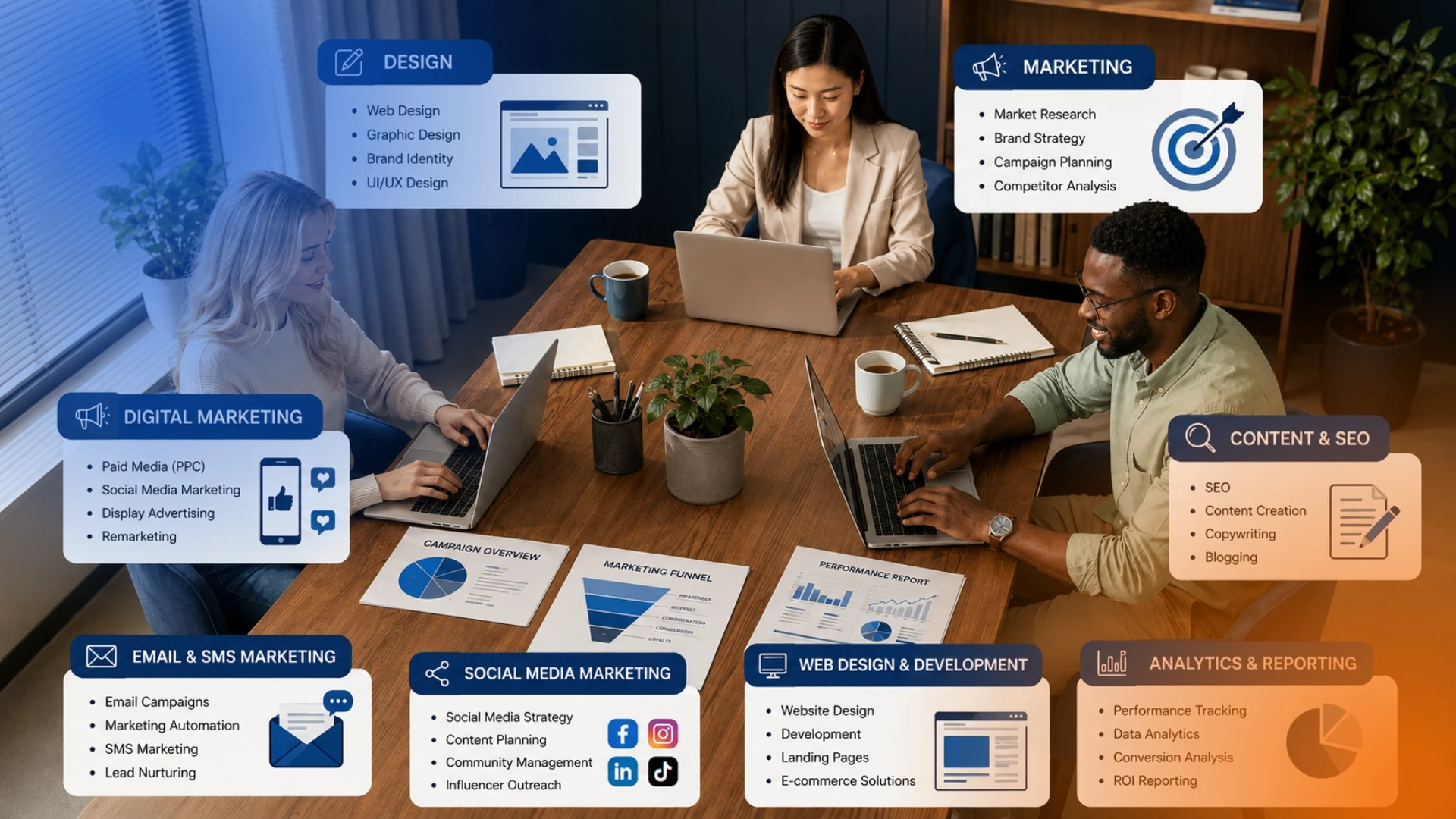
Choosing the right full-service agency is one of the most important decisions you will make for your brand.
Here is how to evaluate your options:
- Define your goals before you start looking: Before you approach any agency, know what you are trying to achieve. Are you trying to acquire new customers at a lower cost? Retain existing customers and grow lifetime value? Launch a new product? Enter a new market? This will give you a way to evaluate proposals and choose an agency
- Look for vertical specialization: An agency that has worked extensively with ecommerce brands in your category understands your customer psychology, seasonal patterns, competitive dynamics, and compliance requirements. They will bring years of experience into your business
- Ask who works on your account: This is the most important question you can ask during any agency evaluation. Who specifically will be managing your paid media? Who writes your email copy? Who does your SEO? What other accounts are those people managing simultaneously? A lot of agencies win clients with senior staff during the sales process and then hand the work to junior team members or white-label it to other agencies entirely. So it’s important that you ask directly
- Verify platform certifications: Google Partner or Premier Partner status, Meta Business Partner certification, and Klaviyo Partner status are platform-issued credentials that confirm an agency meets a recognized standard. They are not guarantees of performance, but they indicate that the agency takes platform expertise seriously enough to maintain certified status
- Review case studies in your specific category: Ask for case studies from clients in your industry or with similar business models. Look for specific numbers: what was the starting revenue, what was it after six months, what channels drove the growth, and what did that growth cost?
- Ask about the first 90 days specifically: A good agency should be able to tell you exactly what happens in the first 90 days. What does onboarding include? What gets built or launched first? What does the reporting process contain? What milestones should you expect? Vague answers to this question usually mean the agency does not have a clear process, which means your onboarding will be disorganized and slow
- Confirm you own your data and accounts: You should own your Google Ads account, your Meta Business Manager, your email platform, your analytics data, and any other assets the agency manages on your behalf. Some agencies set up accounts under their own ownership and withhold your data when the contract ends
- Understand the contract terms before you commit: Most agencies require a minimum commitment of three to six months because meaningful results take time to build. Be realistic about that timeline. But also make sure you understand what happens at the end of that commitment period, what the exit terms are, and what is included versus billed separately
Final Thoughts
A full-service advertising agency is the right choice for ecommerce brands that are scaling across multiple channels. If you fall into this category, book a free consultation with Pro Marketer.
We work with ecommerce brands across beauty, skincare, supplements, apparel, pet, and fashion to build the connected marketing systems that create profitable, scalable growth.
FAQs
1. What is a full-service advertising agency?
A full-service advertising agency is a company that manages all aspects of a brand's marketing. That includes paid media, SEO, email marketing, social media, content, web design, branding, and analytics.
2. Is a full-service agency cheaper than building an in-house marketing team?
In most cases, yes. Hiring a full in-house marketing team means paying salaries, benefits, payroll taxes, recruitment costs, tools, and ongoing training for every role you need.
A mid-level in-house team covering paid media, SEO, email, content, and social media can cost $300,000 to $600,000 or more per year in combined salaries alone, before you factor in software subscriptions, benefits, and the time it takes to hire and manage those people.
A full-service agency covering the same channels usually costs $60,000 to $300,000 per year depending on scope. You also get a broader range of experience from an agency team that has worked across multiple brands and categories, rather than a small internal team that only knows your business.
3. How do I choose the right full-service advertising agency for my business?
Start by defining your goals before you approach any agency. Know what you are trying to achieve, whether that is acquiring new customers at a lower cost, growing repeat purchase revenue, launching a new product, or entering a new market. Then look for an agency with experience in your specific category.
4. Do full-service agencies handle everything in-house, or do they outsource work?
Some full-service agencies employ specialists in every service they offer, with in-house paid media managers, SEO strategists, email marketers, designers, and developers. Others present themselves as full-service but outsource portions of their work to third-party contractors or white-label partners.
Neither model is automatically better, but you should know which one you are buying into.

.svg)

.avif)

.svg)